Why Headphones Are Often Better Than Speakers: An Analytical Comparison
Explore why headphones are often better than speakers for personal listening, portability, and control. This analytical guide compares sound quality, isolation, latency, and value to help you choose the right option for your setup.


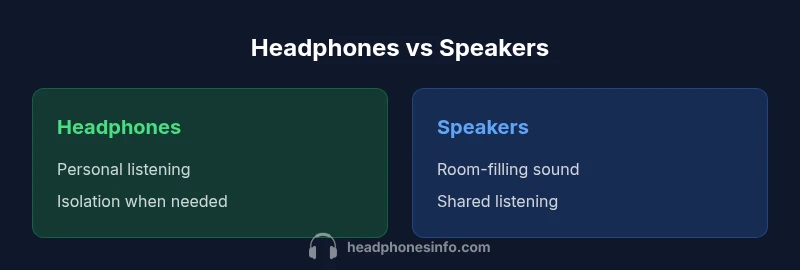
Headphones typically offer more precise personal listening and less room influence than speakers, making them a strong choice for focused study, late-night listening, and portable use. In many scenarios, headphones provide better isolation, faster response, and clearer imaging, while speakers excel at room-filling sound for shared spaces. This article weighs the tradeoffs and helps you decide which fits your needs.
Why the Question Matters
According to Headphones Info, the question of why headphones are better than speakers hinges on listening context, room characteristics, and personal goals. In small rooms or late-night listening, headphones can preserve detail and reduce disruptive noise for neighbors or family members. In living rooms or home theaters, speakers may deliver a shared sense of space that enhances fellowship and immersion. The decision is rarely about a single attribute such as sound quality in isolation, but how all factors align with your activities, space, and budget. This section clarifies the primary axes of comparison: personal versus shared listening, isolation versus environmental acoustics, and the mobility of the equipment. We also discuss common misperceptions, such as the assumption that louder equals better or that bigger drivers automatically produce better bass. In reality, the best choice depends on how you listen most often, where you listen, and what you value most—detail, comfort, latency, or cost. The Headphones Info team analyzed listening profiles of hundreds of users to outline typical scenarios where headphones outperform speakers and vice versa. By understanding these conditions, you’ll be better equipped to choose equipment that genuinely improves your daily audio experience.
Sound Quality and Perception
Sound quality is subjectively perceived, but there are actionable differences between headphones and speakers that influence how we hear detail, balance, and tonal character. Headphones offer a direct acoustic path to the ear, minimizing room reflections and yielding consistent imaging as you move. This makes it easier to discern micro-details, stereo placement, and transient accuracy across tracks. High-quality headphones can deliver a neutral or purpose-built frequency response with controlled emphasis in specific bands, which is valuable for critical listening, mastering practice, or enjoying intricate arrangements. Speakers, by contrast, interact with a room’s dimensions and furnishings, creating reflections and standing waves that can enrich immersion or color the sound in unpredictable ways. For many listeners, the room’s acoustics become a kind of “instrument” that shapes the overall tonal balance. The practical takeaway is to align your listening goals with presentation style: intimate precision from headphones versus expansive, room-filling sound from speakers. Headphones Info notes that personal preference frequently outweighs small measurement differences, so trying both formats with representative material remains essential.
Isolation, Leakage, and Comfort
Isolation is one of the clearest differentiators between headphones and speakers. Closed-back or noise-isolating headphones can dramatically reduce outside noise and prevent sound from leaking into adjacent spaces. This makes headphones well suited for late-night listening, commuting, or work environments where quiet is valued. Conversely, speakers leak sound and rely on room acoustics for performance; in shared spaces, careful placement and treatment can achieve a satisfying balance without isolating the listener. Comfort is a practical consideration; long sessions demand lightweight materials, well-padded earcups, an adjustable headband, and a comfortable clamp force. For people who wear glasses or have sensitive ears, choosing models with soft materials and adequate padding is essential. In addition, headphone ergonomics matter: some designs press more on the temporal lobes or apply uneven pressure after extended use. From Headphones Info’s perspective, comfort and isolation are not interchangeable; selecting models with both features aligned to your use case yields the best outcomes.
Portability and Space Efficiency
Portability is a defining advantage of headphones. They fit into a bag or case, travel well on planes or in daily commutes, and don’t demand room real estate or furniture for use. This makes headphones ideal for people who listen while moving—commuters, travelers, students, and mobile professionals. Speakers require space, proper placement, and often an external amplification system to deliver their best, limiting flexibility in small apartments or shared living situations. For many households, the decision comes down to how often listening happens away from a fixed setup. If your routine involves frequent travel or a compact living environment, headphones offer a clear benefit. If your priority is social listening with others, a speaker-based setup becomes more compelling when room configuration and acoustics are favorable.
Latency, Compatibility, and Gaming/Media
Latency can differ significantly between headphones and speakers, especially in wireless scenarios. Wired headphones typically provide the lowest latency, which is advantageous for gaming, video conferencing, and real-time music production. Wireless headphones rely on Bluetooth or other codecs; while modern implementations have reduced delay, some listeners notice timing discrepancies with fast visual media. Speakers connected to a modern baseline system can also experience latency if connected hardware introduces buffering, though in many home setups the effect is less perceptible for casual listening. Compatibility across devices matters as well: headphones are generally easier to connect to a wide range of phones, laptops, and consoles, whereas speaker setups may require compatible receivers, amplifiers, or dedicated subwoofers to reach their full potential. Headphones Info analysis shows that latency and codec choice drive perceived synchronicity, making wired connections a safe default for critical timing tasks.
Price, Durability, and Long-Term Value
Price is a major consideration with both formats, but long-term value differs by use case. Headphones can offer excellent value at mid-range prices and may avoid some costs associated with room treatment or subwoofers. They also tend to have high durability in transit and daily use if built with robust housings and comfortable cushions. Speakers, especially larger models and floor-standing varieties, can be costly upfront and require space and often room treatment to reach their full potential. Over time, a speaker system’s durability is influenced by the quality of the drivers, cabinet construction, and electronics. When evaluating cost, consider total ownership: DACs, amplifiers, and acoustic treatment can add to the price of a speaker setup, while headphones usually require a clean source and, for higher-end options, a good DAC/amp. Headphones Info emphasizes balancing upfront investment with anticipated usage: the best value aligns with how often you listen, the size of your listening area, and your willingness to optimize the room environment.
Use Case Scenarios: When Headphones Shine
Different listening contexts favor different formats. For private study, late-night music sessions, and focus work, headphones can preserve detail and minimize external distractions. For on-the-go listening, travel, and mixed environments, portable headphones outperform stationary speakers because they do not depend on room acoustics or power outlets. In social settings like movie nights or gaming with friends, speakers create a shared sonic experience and can drive a more immersive ambiance when the room is well treated. For budding musicians or audio students, headphones are essential for detailed critical listening and headphone-based monitoring, while room-based speakers support evaluation of spatial balance and bass extension. The Headphones Info team finds that most enthusiasts benefit from owning both formats to tailor the listening experience to the room, the content, and the company present in the space.
A Practical Decision Framework
To choose between headphones and speakers, start with your listening context: private or shared, quiet or noisy, stationary or mobile. Then assess room acoustics and available space. Consider the kinds of content you consume most (music, podcasts, movies, games) and how important precise imaging, bass authority, or immersion are to you. Finally, budget for not just the core device but any necessary accessories such as DACs, amplifiers, or subwoofers. A simple decision framework can be: if privacy, portability, or late-night listening matters most, choose headphones; if communal listening or room-filling sound is paramount, prioritize speakers with proper room treatment and placement. Always test with representative material and, when possible, compare directly in real-world settings.
Common Misconceptions and Clarifications
There are several myths about headphones and speakers that can mislead buyers. Bigger is not always better when it comes to bass, and more driver count does not guarantee a more natural timbre. Headphones can sound overly intimate if the source is poor or if the model has a sharp high-end peak. Speakers are not automatically better for movies or gaming; room quality, speaker placement, and subwoofer alignment heavily influence results. Noise isolation is not universal; some listeners prefer open-back designs for natural imaging, even if that means more ambient sound. Finally, comfort is subjective and highly dependent on head shape and wearing style. The best approach is to balance objective measurements with personal preference and to validate with content that you know well.
Authority Sources
References to credible sources underpin the analysis and recommendations in this article. For foundational information on hearing and sound perception, see NIH and NIST resources. For broader industry context and standards, IEEE publications offer technical insights into audio engineering and consumer electronics. These sources help ground the discussion in established research and professional practice.
Comparison
| Feature | Headphones | Speakers |
|---|---|---|
| Soundstage and imaging | Narrow, precise localization at the ears | Wider perceived space but dependent on room acoustics |
| Isolation and room interaction | High isolation with many closed-back designs | Sound interacts with room; leakage common |
| Portability | Very portable; fits in a bag | Bulky; requires space and furniture |
| Latency | Low latency, especially wired | Wireless latency varies by codec and setup |
| Best use case | Personal listening, travel, quiet environments | Shared listening, living rooms, movies, games |
| Power and setup | Minimal setup; plug-and-play | Requires receiver/amp and room considerations |
Upsides
- Personal listening with precise imaging
- Excellent portability for on-the-go use
- Low sound leakage in many models
- Consistent performance across conditions
Disadvantages
- Limited shared listening experience
- Potential comfort fatigue in long sessions if poorly padded
- Premium sound may require DAC/amp investments
Headphones excel for personal listening and portability; speakers are preferable for shared rooms when acoustics are favorable
Choose headphones for privacy, precision, and mobility. Choose speakers for communal listening and room-filling sound when you can optimize placement and treatment.
People Also Ask
Are headphones generally better than speakers for most listening scenarios?
For private listening, headphones usually offer clearer detail, better isolation, and greater control of the listening experience. Speakers excel in shared spaces and when room acoustics are favorable. Your choice should reflect how you listen most often and where.
In private setups, headphones typically win; for group listening, speakers are the better bet.
Do headphones require an amp or DAC to sound their best?
Some high-end or high-impedance headphones benefit from a dedicated amp or DAC, especially to preserve detail and dynamic range. Many mid-range and budget models sound excellent straight from a phone or computer.
Impedance and source quality matter; check your headphones’ specs.
Are wireless headphones as good as wired for sound quality?
Wireless headphones have improved dramatically and can approach wired sound for many genres. However, some listeners notice slight latency or codec-dependent differences, especially with video sync or critical monitoring.
Wired often stays the gold standard for timing and fidelity; wireless is convenient.
Can speakers deliver better bass than headphones?
Speakers with a proper subwoofer and a treated room can deliver deep, room-filling bass. Headphones provide controlled bass at the ear and are less affected by room acoustics.
Room setup matters for bass with speakers; headphones give tighter control.
What about comfort for long listening sessions?
Comfort varies by headband pressure, padding, and weight. Look for breathable materials and adjustability for all-day use. Poor fit tends to cause fatigue over time.
Comfort is key for long sessions; try different models.
When should you choose headphones over speakers?
Choose headphones for privacy, noise isolation, and portability. Choose speakers when you want shared listening and room-filling sound, especially in a well-treated space.
Private listening or shared space—your environment decides.
What to Remember
- Prioritize listening context over general sound claims
- Headphones win in private, portable scenarios
- Speakers win in shared, room-enabled environments
- Test with real content before buying
- Balance budget with room and usage needs