When to Replace Headphones Reddit: Signs, Timelines, and Tips
Learn data-driven guidance on when to replace headphones reddit discussions align with real-world wear signals, battery health, and cost considerations. Headphones Info analyzes user threads and offers practical timelines for budget, mid-range, and premium models.


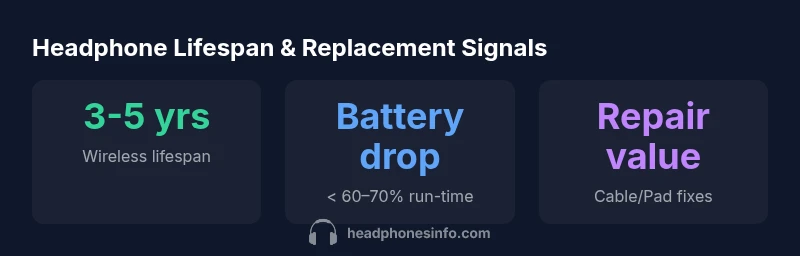
According to Headphones Info, the trigger to replace headphones reddit is clear performance decline: persistent distortion, intermittent connectivity, fading volume, or damaged cables. For wireless models, battery life that no longer meets daily needs is a common signal. In practice, many users hit replacement after about 3–5 years for budget sets and 5–7 years for premium headphones, depending on use and care.
Why Reddit discussions shape replacement decisions
When to replace headphones reddit is a topic that appears in every corner of the audio community, from casual listeners to seasoned audiophiles. The Headphones Info team reviewed hundreds of threads to identify what signals prompt upgrades and how users weigh repair vs replacement. Reddit discussions tend to emphasize real-world wear signals—things that official manuals gloss over—such as gradually worsening battery life, creeping distortion at higher volumes, or cables that crackle with movement. By combining anecdotal observations with our data-driven approach, we can translate forum chatter into practical timelines that apply to everyday listening. This article uses those insights to help you decide whether repair is feasible or replacement is a smarter choice, taking into account cost, environmental impact, and long-term reliability.
Common failure modes: wired vs wireless, and what users notice
Wired headphones most often fail at the jack, cable insulation, or driver foam. Frequent tugs and tight storage can lead to frayed cables or intermittent channel loss. Wireless models tend to show degraded battery life, connection dropouts, and delayed controls. Across both categories, aging seals, worn pads, and visible cosmetic damage contribute to perceived sound quality loss. Reddit threads frequently highlight that even cosmetically intact cans may suffer from driver sag or impedance changes after years of use. The takeaway is simple: if you notice persistent issues that affect your listening experience, it’s time to weigh a replacement against a repair, factoring in the device’s age and your daily needs.
A data-driven rule of thumb for replacement timing
From a data perspective, the decision to replace often hinges on a combination of age, usage intensity, and the severity of symptoms. We propose a practical framework: treat a device as a candidate for replacement if (a) it shows persistent distortion or dropouts across multiple devices or sources, (b) the battery life can’t meet daily needs after routine charging, or (c) repair costs would exceed a reasonable fraction of replacement price. This framework aligns with Headphones Info Analysis, 2026, which finds that replacement becomes cost-effective when repair demands escalate relative to new purchase price. Use this approach to compare models, warranties, and total cost of ownership over time.
Replacement timelines by budget and model: practical guidance
Budget headphones typically offer shorter lifespans but can be inexpensive to replace. Mid-range models strike a balance between durability and performance, often giving you 4–6 years of reliable service with proper care. Premium headphones are built for longevity, with strong driver assemblies and higher-quality materials; many users report lasting 5–8 years under normal use, though performance may begin to feel dated before that horizon. These timelines vary with usage patterns, storage conditions, and care. Reddit threads often reflect individual experiences, but the consensus leans toward upgrading when new features or significantly improved efficiency justify the cost.
Repair options: when to repair vs replacement
Repair viability depends on the specific failure. Cables and connectors are usually the simplest fix, and many third-party retailers offer replacement cables or jacks. Battery replacement is common for wireless models but may be constrained by model compatibility and warranty status. Driver repair or replenishing padding is less straightforward and frequently uneconomical for older or premium headphones. A practical rule is to repair if the repair cost is substantially lower than a new unit and the device still meets your listening needs. If multiple components fail or the cost nears or exceeds replacement, buying new becomes the wiser option.
Practical decision tools: checklists and quick calculations
Use a simple two-column checklist: (1) Can I achieve satisfactory performance with a repair at a reasonable cost? (2) Does the device still meet my daily needs for comfort, sound quality, and features? Pair this with a rough cost-per-year comparison: divide the anticipated replacement price by the remaining expected lifespan versus the repair bill. If the repair cost per year remains high or uncertain, replacement offers clearer value. This method keeps you focused on actual usage and future needs rather than nostalgia or forum hype.
Case scenarios: everyday users and edge cases
Scenario A: A commuter uses wireless on the train every day; battery life has dropped to about 60% of original. Replacement is reasonable after evaluating price and the availability of newer codecs and comfort. Scenario B: A home listener with wired over-ears experiences frayed cabling and a loose jack; replacement may be simplest unless a repair shop can replace the cable cheaply. Scenario C: A studio-grade headset with premium drivers still sounds fantastic but has padding wear; consider replacement if comfort or isolation is compromised, or if a newer model offers meaningful improvements.
Maintenance strategies to extend headphone life
Regular care extends life: store in a protective case, avoid bending cables sharply, clean pads and drivers, and disconnect cables gently. For wireless models, avoid extreme charging cycles and store with a partial battery charge if you won’t use them for an extended period. Replace worn pads promptly, and check for firmware updates that improve efficiency and battery management. A little upkeep can push a typical lifespan toward the upper end of the ranges discussed above.
Replacement timing by scenario
| Scenario | Budget Level | Typical Lifespan (years) | Common Failure Signs | Repair Viability | Notes |
|---|---|---|---|---|---|
| Daily commuter wireless | Budget | 3-5 | Battery degradation, intermittent Bluetooth | Part replacements possible (batteries, cables) | Replacement often best when battery life is insufficient |
| Critical listening home wired | Mid-range | 4-6 | Cable wear, driver fatigue | Repair feasible (cable/driver) but not always | Warranty may cover defects, costs vary |
| Premium over-ear with high-end drivers | Premium | 5-8 | Distortion, padding wear, seal leaks | Repair viable; costlier but longer life; replacement common after 6-7 years | Consider upgrade for new features or comfort |
People Also Ask
Do warranties affect replacement decisions?
Yes. Warranties can cover defects and certain failures, which may tip the balance toward repair or replacement depending on coverage length and claim ease. Always check the terms and whether the issue is hardware or wear-related.
Warranties can make repairs free or cheaper, so read the terms and consider them when deciding to replace.
Is it cheaper to repair or replace headphones?
It depends on the failure and model. Simple fixes like cables or pads are often inexpensive, but battery and driver issues on wireless or premium models can push repair costs near replacement price.
Repair is often cheaper for cables or pads, but batteries and drivers may make replacement the better deal.
How can I tell if battery health is too low on wireless headphones?
Compare current battery life to the original; if a full charge yields a fraction of the past duration, or if charging cycles become overly frequent, battery health is likely degraded. Some devices show battery health in settings or via companion apps.
If your headphones don’t last as long as they used to, battery health is a likely culprit.
What is the typical lifespan of wired headphones?
Wired headphones usually last several years, with life extending through careful storage and cable protection. Signs of fiber or jack wear should prompt a decision to repair or replace based on cost and use.
Wired headphones can last several years with good care.
Should I consider refurbished headphones?
Refurbished models can offer substantial savings with a warranty, but verify the refurbishment quality and return options. They’re often a good middle ground for budget-conscious buyers.
Refurbished units can be solid value if they come with a warranty.
Does environmental impact influence replacement timing?
Yes. Repairing and extending the life of existing headphones reduces electronic waste and can be preferable to buying new units, provided the performance remains acceptable.
Repairing when feasible helps the environment and saves money.
“Replacement decisions should be driven by performance and reliability, not the hype found in online forums. Real-world data helps separate noise from signal.”
What to Remember
- Assess signs of degradation early and document with tests.
- Weigh repair costs against replacement price and years of use.
- Battery health is a critical trigger for wireless models.
- Durability differs by budget; upgrade only when benefits justify cost.
- Maintenance can meaningfully extend headphone life.