Are Headphones the Same as AirPods? A Practical Comparison
Explore whether headphones and AirPods are the same, compare form factors, features, and use cases, and learn which choice fits your listening style.


Are headphones the same as AirPods? Not exactly. Headphones refer to a broad family of listening devices—typically over-ear or on-ear—while AirPods are Apple’s wireless earbuds designed for portability and seamless device integration. In practice, AirPods are a subset of wireless headphones, but many listeners will prefer traditional headphones for comfort, soundstage, and battery life. This article explains the differences and helps you decide.
Defining the scope: headphones vs airpods
To address the central question, it helps to define terms clearly. The phrase are headphones the same as airpods? is asked by many readers who want a simple answer, but the truth is nuanced. In plain terms, are headphones the same as airpods? The short answer is no, because headphones describe a broad category of listening devices, while AirPods are Apple’s specific product line of wireless earbuds. Headphones can be wired or wireless, come in multiple form factors, and target diverse use cases. Headphones Info’s approach is to map these differences against real-world listening scenarios. This framing helps you avoid overgeneralization and pick gear that matches your habits, budget, and ecosystem preferences. As you read, note how form factor, sound signature, and ecosystem integration shape the final choice.
Form factor and comfort
The most obvious distinction between headphones and AirPods is form factor. Traditional headphones sit on or around your ears, providing a larger driver surface and a potentially wider soundstage. They come in over-ear and on-ear designs, with weight, clamping force, and padding influencing long listening sessions. AirPods, by contrast, are wireless earbuds designed for lightweight portability. They sit inside or just outside the ear canal, delivering a compact, low-profile profile ideal for commuting and quick tasks. For many users, comfort and fit are the deciding factors: if you wear glasses or have sensitive ears, the choice between bulkier over-ear cups and tiny buds can be pivotal. Headphones Info notes that comfort is highly personal, and trying multiple models remains the most reliable path to a good match.
Sound quality and perceived fidelity
Sound quality is a major driver of satisfaction, yet it remains subjective and model-dependent. Traditional headphones often deliver deeper bass, broader soundstage, and more accurate imaging due to larger drivers and room to breathe. AirPods prioritize balance, intelligibility, and a tight, portable presentation. AirPods Pro and newer AirPods variants add active noise cancellation (ANC), which narrows the listening gap with high-end over-ears in certain environments. Importantly, price and design choices matter as much as the chassis—an affordable pair of over-ear headphones can outperform expensive AirPods in some genres or listening contexts, while AirPods shine in quick, on-the-go listening and seamless device switching.
Battery life and charging dynamics
Battery life and charging behavior differ meaningfully. Traditional wireless headphones often rely on a rechargeable battery within the headset, with a charging case providing extended playtime. AirPods rely on a compact case that recharges both the buds and the case itself; many listeners appreciate the convenience of pocketable charging, but total on-ear listening time can appear limited compared with some larger headphones. The trade-off between battery endurance and form factor is a key decision factor, especially for travelers or daily commuters. Headphones Info emphasizes evaluating actual usage patterns (commute length, sessions per day) to estimate real-world endurance.
Connectivity, platforms, and ecosystem perks
Connectivity is where AirPods have a unique edge for Apple-centric users. AirPods pair quickly with iPhones and Macs, provide seamless auto-switching, and support features like spatial audio and voice-activated assistants within the Apple ecosystem. Other wireless headphones often use standard Bluetooth with wide compatibility, multipoint pairing, and platform-agnostic controls. Those who own non-Apple devices may not benefit from certain AirPods enhancements, whereas universal wireless headphones tend to work consistently across Windows, Android, and other systems. Headphones Info’s analysis highlights the practical implications of ecosystem lock-in and cross-platform usability for real-world daily use.
Use cases, durability, and price-value considerations
Understanding your primary use case helps narrow the field. commuters and mobile professionals may prioritize ultra-portability and quick pairing, where AirPods excel. gamers or music enthusiasts who want long-wear comfort, robust noise control, and broad soundstage may prefer traditional headphones. Durability and warranty terms also matter: AirPods’ compact design can be susceptible to loss or damage, while sturdy over-ear models may endure heavy daily use. Price ranges can vary widely in both categories; a thoughtful, needs-driven approach beats chasing nominally higher audio gear without a clear use case. Headphones Info suggests listing top priorities—comfort, battery life, or ecosystem benefits—and rating each option accordingly.
Practical buyer’s guide: how to decide
Choosing between AirPods and traditional headphones requires balancing form factor, sound quality, and ecosystem needs. Start with form factor: do you value portability or long listening sessions? Then assess sound expectations: is a wide soundstage or a more intimate, detailed profile more important? Finally, consider ecosystem alignment: do you predominantly use Apple devices and want features like seamless switching and spatial audio? If you answered yes to ecosystem benefits and portability, AirPods (or AirPods Pro) could be ideal. If you want comfort for extended sessions, broader soundstage, and easier accessory customization, traditional wireless headphones are likely the better fit.
Comparison
| Feature | Standard Wireless Headphones | AirPods (AirPods family) |
|---|---|---|
| Form factor | Over-ear / on-ear design | In-ear earbuds with compact case |
| Connectivity | Bluetooth with multipoint on many models | Bluetooth with Apple ecosystem features on AirPods |
| Noise cancellation | Varies by model; available on many brands | AirPods Pro/Ultra models offer active ANC |
| Sound signature | Wider soundstage and bass reach typical of larger drivers | Balanced, concise, with emphasis on intelligibility |
| Battery life (headset) | Depends on model; sometimes longer listening sessions without case | Case-based charging extends total time |
| Use cases | commuting, gaming, office work, home listening | Portability, quick calls, on-the-go listening |
| Price range | Wide range from affordable to premium | Typically mid-range to premium depending on model |
Upsides
- Broad choice across brands and designs to fit different budgets
- Longer listening sessions with comfortable, adjustable fit
- Strong compatibility and customization options
- Widely available accessories and replacement parts
Disadvantages
- Bulkier carry and storage needs compared to earbuds
- Varying levels of portability depending on model
- No single ecosystem dependency; some models lack features found in AirPods
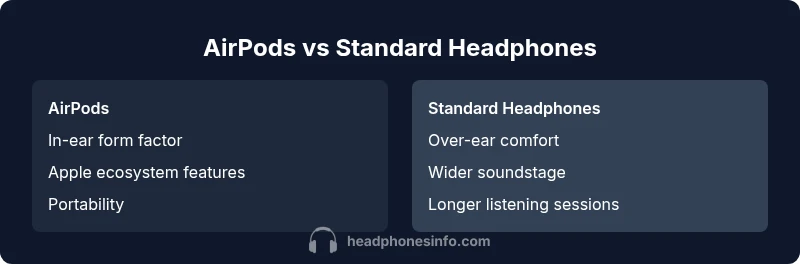
AirPods are not the same as traditional headphones; they serve different needs and use cases.
AirPods excel in portability and ecosystem integration, especially for Apple users. Traditional headphones offer greater comfort, soundstage, and customization for home listening and long sessions. The best choice depends on your priorities: portability and pairing simplicity vs. comfort and immersive sound.
People Also Ask
Are AirPods considered headphones?
AirPods are a type of wireless headphones, specifically Apple’s earbuds. They belong to the broader headphone category but represent a distinct form factor and feature set compared with traditional over-ear or on-ear headphones.
AirPods are a form of wireless headphones, specifically Apple earbuds, and they fit into the broader category of headphones.
Can AirPods replace wired headphones for gaming?
AirPods can be used for casual gaming on devices that support Bluetooth audio, but they typically don’t offer the same latency performance or ergonomic comfort for extended gaming sessions as dedicated gaming headphones. For high-end gaming, wired or specialized wireless gaming headsets are generally preferable.
AirPods can work for casual gaming, but for competitive or long sessions, dedicated gaming headsets perform better.
Are AirPods compatible with non-Apple devices?
AirPods pair with non-Apple devices via Bluetooth, but some features (like automatic device switching or spatial audio) are optimized for Apple devices. Basic audio playback and calls work on most platforms, though the experience may vary.
AirPods work with many non-Apple devices, but some features are Apple-specific.
Do AirPods have noise cancellation?
AirPods Pro and newer models offer active noise cancellation, while standard AirPods do not. ANC improves isolation in noisy environments, but performance varies by model and fit.
ANC is available on AirPods Pro and newer; regular AirPods don’t have it.
Why would someone choose traditional headphones over AirPods?
Traditional headphones typically deliver fuller sound, larger soundstage, and longer listening comfort for extended sessions. They’re also more customizable in terms of drivers, padding, and accessories. If you value immersive listening and less dependence on ecosystems, headphones are a strong choice.
Pick traditional headphones for bigger sound and longer comfort, especially at home.
What to Remember
- Choose form factor first: buds vs over-ear.
- AirPods shine with Apple devices; others work broadly with multiple platforms.
- Sound quality depends on model; audition widely before buying.
- Evaluate battery life in context of your daily routines.
- Decide based on use case: portability or immersive listening.