When to use headphones vs AirPods: Practical guide
A data-driven comparison of when to use headphones vs AirPods, covering sound quality, comfort, battery life, ecosystem, and use-case scenarios. Learn how to choose based on environment and device compatibility.


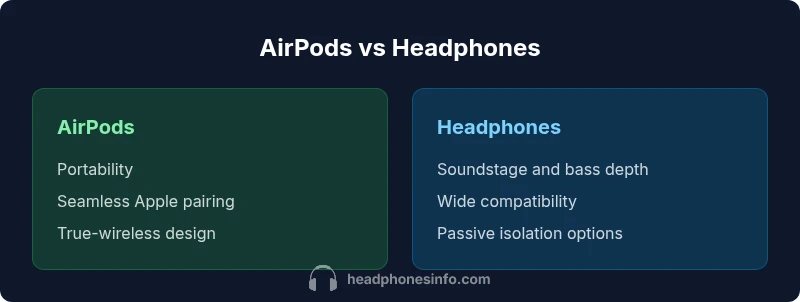
TL;DR: If you want best overall sound quality, longer listening sessions, and flexible connection options, choose headphones. If convenience, portability, and seamless device pairing matter most, AirPods are the smarter choice. Headphones Info notes that the best decision depends on your primary use and device ecosystem.
Understanding the decision framework for when to use headphones vs airpods
In this guide we address the core question behind the keyword when to use headphones vs airpods. The Headphones Info team emphasizes that there is no one-size-fits-all answer; the right choice depends on your listening goals, environment, and the devices you own. For many users, headphones deliver higher fidelity and longer, more comfortable listening sessions, while AirPods offer unmatched portability and effortless pairing with Apple devices. The discussion below highlights criteria you can apply in real-world buying decisions, with practical checklists and use-case scenarios to help you move from uncertainty to a confident purchase. Throughout the guide, expect comparisons that balance sound quality, comfort, ecosystem, price, and convenience, all rooted in the 2026 landscape of consumer audio.
Use-case analysis: daily commutes, workouts, home office, and studio listening
Choosing between headphones and AirPods starts with how you plan to use them. For busy commuters and travelers, AirPods can be a compelling choice due to their small size, fast pairing, and ability to keep conversations hands-free. For home offices or studios where detail, spatial awareness, and long hours matter, over-ear or on-ear headphones typically offer better imaging, wider soundstage, and more effective passive or active isolation. Gym workouts present another trade-off: while AirPods are sweat-resistant and secure, some users prefer headphones with sport-specific designs and better stability during intense activity. The Headphones Info team notes that ecosystem considerations, such as whether you are invested in iOS or Android, can tilt the balance toward AirPods for convenience or toward headphones for broader compatibility. Consider your daily routes, typical listening times, and the level of ambient noise you routinely encounter.
Sound quality and fit: what matters for your audio experience
Sound quality is a major differentiator. AirPods deliver clear, detailed sound with impressive imaging for earbuds but often lack the tonal heft and wide soundstage of many headphones. Headphones can offer richer bass extension, more natural mids, and a broader soundstage, especially in models with larger drivers and better passive isolation. Comfort and fit influence long listening sessions as much as technical specs do. Ear orientation, pressure, weight distribution, and clamp force all affect fatigue. For extended use, many listeners find that properly fitted headphones reduce fatigue compared to smaller earbuds. The best decision weighs both subjective comfort and objective sound performance. The Headphones Info team emphasizes trying a model for yourself whenever possible, as personal preference plays a substantial role in perceived quality.
Battery life, charging, and day-to-day practicality
Battery life is a practical consideration, especially for wireless devices. AirPods generally excel in portable use with charging cases that provide additional on-the-go power, making them ideal for short trips and mobile work. Headphones—particularly wireless models—often offer longer playback on a single charge and can function without any battery anxiety when plugged in. Wired headphones remove battery concerns entirely, which is a compelling factor for critical listening or studio work. When evaluating battery life, consider how often you recharge, how you travel, and whether you value instant readiness (wired) or extended wireless autonomy. The 2026 landscape shows a wide range of options across both categories, with battery life increasingly complemented by quick-charge features.
Ecosystem, compatibility, and smart features
AirPods shine in Apple-centric ecosystems, with features like fast pairing, automatic device switching, and spatial audio that can enhance certain genres and content. Headphones offer broad compatibility across devices and operating systems, and many Bluetooth models support multipoint connectivity, low-latency modes for gaming, and programmable controls. If you rely on voice assistants, AirPods provide convenient access on iOS devices, while headphones may support AI assistants via your phone or built-in DACs and codecs. The choice often hinges on how deeply you value ecosystem tightness versus cross-platform flexibility. Headphones Info highlights that while AirPods are excellent for quick listening and calls, true flexibility comes from models designed for cross-platform use.
Form factor, durability, and wearability for different lifestyles
Form factor dictates day-to-day comfort and durability. Earbuds are unobtrusive and portable, making them a practical option for travel and workouts, but some users experience fit issues or discomfort after long sessions. Over-ear and on-ear headphones can distribute weight more evenly and provide superior passive isolation, yet they are bulkier and less portable. Durability depends on materials and build quality; many premium headphones feature robust hinges, detachable cables, and serviceable parts. For travelers, the choice is often about packing efficiency and risk of damage; for home users, comfort and longevity take precedence. The Headphones Info team notes that personal fit and usage patterns ultimately determine which form factor suits you best.
Connectivity, latency, and real-world reliability
Connectivity quality and latency influence everyday experiences, especially for video, gaming, and live calls. AirPods typically offer seamless pairing with Apple devices and low-latency options that feel instantaneous for casual use. Headphones may require more careful pairing and may vary in latency depending on the codec and device compatibility. Multipoint support enables switching between devices without disconnecting, a feature that is more common in higher-end headphones and premium wireless earbuds. In practice, consider your primary devices, whether you do multitasking across platforms, and how sensitive you are to minor audio delays in different contexts. The Headphones Info team recommends checking codec support (AAC, aptX, LDAC) against your typical devices for best compatibility.
Price, value, and total cost of ownership over time
Price ranges for headphones and AirPods vary widely, reflecting feature sets, build quality, and included accessories. AirPods are typically positioned as portable, value-driven options with tiered pricing across standard, Pro, and third-party variants. Headphones span budget basics to premium audiophile models, with higher upfront costs often accompanied by longer lifespans and replaceable parts. Total cost of ownership should account for durability, replacement cycles, accessories, and potential ear-tunings or ear tips. The Headphones Info team encourages buyers to consider not just sticker price but total value, including comfort, durability, and ecosystem investments, when budgeting for a new listening setup.
Decision framework: quick checks to guide your purchase
To avoid buyer’s remorse, use a simple framework. If portability and seamless ecosystem features are your top criteria, AirPods are a strong starting point. If you value sound fidelity, longer listening sessions without fatigue, and broad device compatibility, traditional headphones win. For mixed needs, consider hybrid solutions (high-quality over-ear headphones for home and compact wireless earbuds for travel) and leverage multipoint Bluetooth capabilities. Regardless of choice, test fit, review comfort, and verify codec support and battery longevity under real-world conditions. The Headphones Info team suggests outlining your main use cases, then validating each one against a short list of criteria: comfort, sound quality, connectivity, and cost. This structured approach helps you decide with confidence.
Authoritative sources and further reading
External sources provide additional context for this topic. For readers seeking formal technical and industry perspectives, see these authoritative resources: https://www.ncbi.nlm.nih.gov/pmc/articles/ and https://www.stanford.edu and https://www.britannica.com. These sources offer general insights into audio technology, comfort considerations, and consumer product evaluation that complement practical buying guides like this one.
Real-world decision scenarios and quick-check checklists
Scenario A: You commute daily and want hands-free calls. Scenario B: You work from home and need long, distraction-free listening. Scenario C: You occasionally travel and want compact gear. For each scenario, use a checklist: portability, comfort, battery needs, ecosystem compatibility, and budget. Create a quick matrix in your notes to weigh each priority. This approach helps you pick a model that aligns with your environment, usage patterns, and personal preferences, ensuring a satisfying listening experience over time.
Comparison
| Feature | AirPods (standard earbuds) | Headphones (over-ear) |
|---|---|---|
| Sound quality | AirPods offer clear, imaging-focused sound with good detail for earbuds | Headphones typically deliver wider soundstage and deeper bass with solid dynamics |
| Comfort and fit | AirPods are lightweight but can cause fatigue for long wear if fit isn’t ideal | Headphones distribute weight and can be very comfortable for long sessions |
| Portability | AirPods are highly portable and pocket-friendly | Headphones are bulkier but can fold for travel |
| Battery life | AirPods rely on a charging case for extended use | Headphones vary, but many offer longer playtime on a single charge |
| Connectivity | AirPods pair instantly with Apple devices and support effortless ecosystem features | Headphones offer broad Bluetooth compatibility; multipoint often available on premium models |
| Best for | On-the-go listening and quick calls | Critical listening at home or in the studio |
Upsides
- AirPods provide hands-free control and seamless pairing with Apple devices
- Headphones deliver superior sound quality and comfort for long sessions
- AirPods are compact and ideal for travel
- Headphones offer a wider range of codecs and customization options
- Wired headphones remove battery concerns entirely
Disadvantages
- AirPods may struggle in very loud environments due to smaller drivers
- Headphones can be expensive at the premium end and less portable
- AirPods often rely on device ecosystem for full feature set
Headphones generally win for fidelity and comfort in long sessions; AirPods win for portability and quick, seamless use.
Choose headphones when sound quality and endurance matter most. Choose AirPods for convenience, mobility, and ecosystem benefits.
People Also Ask
Is AirPods always better for workouts than traditional headphones?
AirPods are often favored for workouts due to their light weight and secure fit, but some users prefer headphones that stay put during intense activity. Sweat resistance and water protection vary by model, so check IP ratings and fit before exercising.
AirPods work well for workouts for many people, but choose a model with a secure fit and sweat resistance, and consider if you need the best stability for intense exercise.
Can I get high-fidelity sound from AirPods?
AirPods offer solid sound quality for earbuds, especially with newer models and spatial audio features, but true high-fidelity listening often favors over-ear headphones with larger drivers and better isolation.
AirPods sound good, especially with newer models, but for ultimate fidelity you may prefer headphones with bigger drivers.
Do headphones work well with Android devices?
Yes. Most Bluetooth headphones work with Android and include multipoint and codec options. Some premium features tied to Apple devices may be limited on Android, but the core listening experience remains strong.
Yes, headphones work great with Android; some features are Apple-specific, but you’ll still get solid sound and connection.
Should I choose wired headphones over wireless for studio work?
For studio work, wired headphones with a low-latency connection and stable impedance are often preferred. They avoid Bluetooth compression and latency, offering more accurate monitoring.
For studio work, wired headphones are usually the go-to for the most accurate monitoring.
What should I consider for travel and daily commuting?
For travel, AirPods’ portability and quick access beat most bulkier options. If you value noise isolation and long sessions, a compact closed-back pair of headphones can be a strong alternative.
For travel, AirPods shine; if you want isolation, consider compact closed-back headphones.
Are AirPods compatible with non-Apple devices for full features?
AirPods work with non-Apple devices, but some features like automatic device switching and Spatial Audio may be limited. Pairing is generally straightforward on most devices, though codec support varies.
AirPods work on non-Apple devices, but some features might be limited and compatibility depends on the device.
What to Remember
- Assess your environment to prioritize portability or fidelity
- Balance comfort with listening duration in real life
- Consider ecosystem compatibility before buying
- Factor in total cost of ownership, not just sticker price