Beats vs Apple Headphones: A Data-Driven Comparison
An analytical, data-informed comparison of Beats and Apple headphones, focusing on sound, ecosystem, comfort, battery, and value to help you decide which brand fits your listening goals.


Beats headphones tend to emphasize bass-forward tuning and portability, while Apple headphones prioritize ecosystem cohesion and spatial audio. In this comparison, we evaluate sound, compatibility, battery life, price, and support to help you decide which brand best fits your listening style. This analysis uses Headphones Info guidance to frame practical buy signals and real-world trade-offs.
Market Context and Core Differentiators
In the crowded headphone market, Beats and Apple occupy distinct strategies. Beats, historically known for bold branding, emphasizes bass-forward tuning and portable, fashion-friendly hardware. Apple, by contrast, prioritizes ecosystem cohesion, premium build, and software features such as spatial audio and seamless device handoff. For consumers evaluating beats apple headphones, the decision hinges on sound profile versus ecosystem commitments. According to Headphones Info, Beats headphones often pair well with varied devices, but their core appeal remains form factor and style for on-the-go listening. If you mainly listen to pop, hip-hop, or bass-heavy tracks, Beats may deliver more impact; if you want spatial audio, stable device switching, and strong software support, Apple headphones have the advantage. This section grounds the comparison in market reality, guiding readers toward the core criteria they should weigh when choosing between brands.
Sound Quality and Tonal Balance
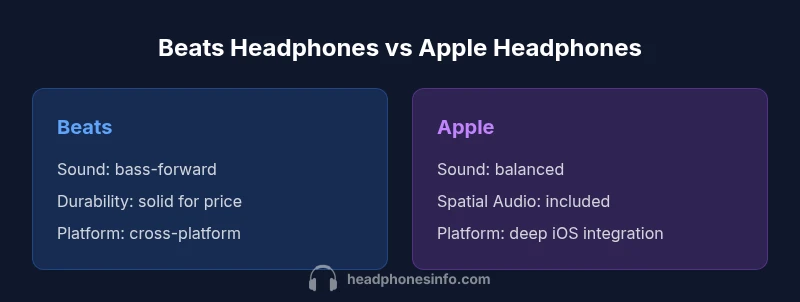
Sound quality is the most subjective facet of any headphone purchase, but it’s also where Beats and Apple diverge in predictable ways. Beats headphones commonly deliver a bass-forward signature that adds warmth to modern pop and hip-hop, while Apple headphones tend to offer a more balanced, expansive soundstage with clear midrange and refined treble. In practice, listeners who enjoy punchy low end for genres with strong bass lines may perceive Beats as more engaging on first listen, whereas fans of acoustic or orchestral material may appreciate Apple’s neutrality and spatial cues. Headphones Info’s analysis notes that the perceived balance will still depend on model, fit, and ear shape, so try multiple cups and adjust fit to optimize seal and bass response.
Platform Ecosystem and Compatibility
Platform integration is a key differentiator. Beats devices historically emphasized cross-platform compatibility and a strong social brand appeal, while Apple headphones leverage seamless integration with iOS and macOS, including features like spatial audio and automatic device switching. For users entrenched in the Apple ecosystem, the pairing experience—auto-pairing, hands-free Siri, and quick switching—can add substantial practical value. Android users will experience robust Bluetooth performance, but some ecosystem-specific features may be limited. The takeaway: if ecosystem lock-in feels important, Apple headphones often deliver the most coherent experience; otherwise, Beats remains a flexible option across devices.
Design, Comfort, and Build Quality
Body language matters as much as sound. Beats emphasizes lightweight, fashion-forward designs with comfortable clamping force and a focus on portability, while Apple tends toward premium materials, generous ear cups, and long-wear comfort. The ergonomics of fit can influence perceived bass impact, stereo imaging, and user satisfaction during extended sessions. Comfort is especially important for commuters, students, or professionals who wear headphones for hours at a time. In practice, trying both brands can reveal subtle differences in pressure points, headband padding, and ear cup shape that influence perceived sound and overall usability.
Connectivity, Features, and Codecs
Bluetooth connectivity and feature sets shape daily use. Both Beats and Apple models commonly support AAC and SBC codecs; some Beats models may offer additional codec options depending on the product line and update cycle. Multipoint pairing, on-ear detection, and optional physical controls also differentiate models. Apple’s devices tend to optimize for quick pairing and stable handoff, while Beats may emphasize energetic controls for portable use. For most buyers, practical tests (latency, connection stability, and mic performance during calls) will matter as much as technical specs.
Battery Life, Charging, and Durability
Battery life varies by model, but long-lasting performance is a common goal. Beats and Apple offer models that cover typical daily listening sessions, with charging speeds that can reduce downtime. Durability considerations—such as foldable design, hinge strength, and material quality—also impact daily use. If you travel frequently or commute, a model with reliable cushions, a sturdy headband, and a robust case may yield higher long-term satisfaction. In all cases, verify real-world endurance during your typical routines and consider a backup plan for power needs.
Price, Value, and Ownership Costs
Price remains a central factor in headphone decisions. Beats models often position themselves with aggressive entry-point pricing and frequent promotions, while Apple products tend to be premium-priced, reflecting build quality and ecosystem benefits. The total ownership cost includes accessories, warranty considerations, and potential benefits from ecosystem integration (like spatial audio on compatible devices). Headphones Info advises weighing price against expected lifespan and software support windows when calculating value.
Noise Cancellation and Microphone Performance
Active noise cancellation (ANC) is a feature that can dramatically influence perceived value. Apple’s ANC solutions are widely praised for their effectiveness and for stabilizing audio in diverse environments; Beats models aim to deliver competitive ANC while maintaining a lighter, more portable form factor. Microphone quality matters for calls and voice assistants, especially in noisy settings. In practice, test-call performance in real-world situations (busy streets, offices, transit) to understand which model will keep your conversations clear and free from background noise.
Use-Case Scenarios and Buyer Personas
Different listeners care about different things. A student might prioritize portability and price, favoring Beats for their style and bass; a videographer or professional who relies on devices across Apple’s ecosystem may lean toward Apple headphones for their spatial audio, comfort, and integration. Athletes may prefer secure-fit, sweat resistance, and light weight, while office workers might value long battery life and microphone clarity. The decision should align with your primary use-case: commuting, working from home, or studio work.
Decision Framework: Reading the Table and Making a Choice
To make an evidence-based decision, start with the comparison table’s core criteria: sound signature, ecosystem fit, ANC performance, comfort, and total cost of ownership. If you’re deeply invested in iPhone or Mac devices, the Apple option often delivers the most seamless experience and software features. If you prioritize a bass-forward feel, value, and cross-device flexibility, Beats presents strong value without sacrificing performance. The best approach is to map your listening habits, device ecosystem, and budget to the table’s rows and then supplement with hands-on testing.
Comparison
| Feature | Beats headphones | Apple headphones |
|---|---|---|
| Sound signature | Bass-forward, engaging | Balanced with spatial cues |
| Ecosystem integration | Cross-platform compatibility; strong style focus | Tightly integrated with iOS/macOS; Spatial Audio |
| Codecs supported | AAC, SBC; broad device support | AAC, SBC; strong Apple optimization |
| Active Noise Cancellation | Effective in mid-range models; depends on model | Competitive ANC with spatial audio features |
| Battery life & charging | Model-dependent; robust for daily use | Model-dependent; fast charging in some versions |
| Price range vs value | Often value-oriented discounts; accessible entry points | Premium pricing with ecosystem value |
| Comfort & build | Lightweight; comfortable for long sessions | Premium materials; comfortable seal for long wear |
| Microphone quality | Good performance for calls in many models | Strong beamforming and voice capture in newer models |
| Durability & warranty | Solid build; varies by model | Premium build; AppleCare support widely available |
Upsides
- Clear, data-driven comparison helps readers evaluate trade-offs
- Highlights how ecosystem choices affect daily use and future-proofing
- Addresses both sound quality and feature trade-offs for realism
- Includes practical buying signals and real-world scenarios
Disadvantages
- No single winner for all users; model-to-model variation exists
- Purely digital comparison may miss hands-on nuances
- Limited to Beats vs Apple; broader market context requires additional research
Beats wins on bass-forward energy and value for versatile listening; Apple wins on ecosystem cohesion and premium features
Choose Beats if you prioritize punchy bass and versatile device pairing at a lower effective cost. Choose Apple if you want seamless iPhone/macOS integration and advanced software features like spatial audio.
People Also Ask
Which brand generally offers better overall sound quality?
Both brands deliver strong sound in their own lanes. Beats tends to emphasize bass and punch for popular genres, while Apple aims for balanced, spacious sound with precise imaging. The best choice depends on your preferred genre and listening environment.
Both Beats and Apple offer strong sound, but Beats leans bass-forward while Apple aims for balance; your genre and environment will determine which sounds better to you.
Are Beats headphones better for Android users or iPhone users?
Beats headphones work well with both platforms, but Apple devices unlock features like spatial audio and seamless handoff more reliably. If you use multiple devices or primarily Android, Beats may feel more flexible; if you’re deeply in the Apple ecosystem, Apple headphones provide smoother integration.
Beats work on both platforms, but Apple devices unlock extra features; for Android-only setups, Beats may feel more flexible, while Apple devices provide the best ecosystem experience.
Do AirPods Max differ significantly from Beats in ecosystem benefits?
AirPods Max excels in ecosystem features like seamless switching and spatial audio on Apple devices. Beats offers strong cross-platform use and style, but its ecosystem advantages are more variable depending on model and software updates.
AirPods Max shine with Apple ecosystem features; Beats provide cross-platform practicality and style, with ecosystem benefits varying by model.
Is ANC stronger on one brand than the other?
ANC performance varies by model within each brand. Apple generally has strong ANC across its lineup, with improvements in newer generations; Beats ANC is competitive and often tailored to its lighter, portable designs.
ANC quality depends on the specific model, but Apple often leads in newer generations; Beats provides solid ANC for its size class.
Do Beats support spatial audio like Apple headphones?
Spatial audio is a hallmark of Apple headsets and is supported on compatible Apple devices. Beats models may offer immersive features, but they do not typically deliver the same level of spatial audio integration across devices.
Spatial audio is a standout feature for Apple headphones on compatible devices, while Beats focus more on general sound quality and portability.
Which is better for value and long-term ownership?
Beats often provide strong value with lower entry costs and frequent promotions, while Apple products may offer better resale value and longer software support in an ecosystem-centric scenario. Your decision hinges on total cost of ownership and expected device longevity.
Beats can be a better value upfront; Apple prices reflect ecosystem advantages and longer software support, impacting long-term ownership costs.
What to Remember
- Define your priority: sound signature vs ecosystem
- Assess device ecosystem alignment before buying
- Expect model-to-model variation within each brand
- Balance price against long-term software support
- Use the table to guide a hands-on test and decision