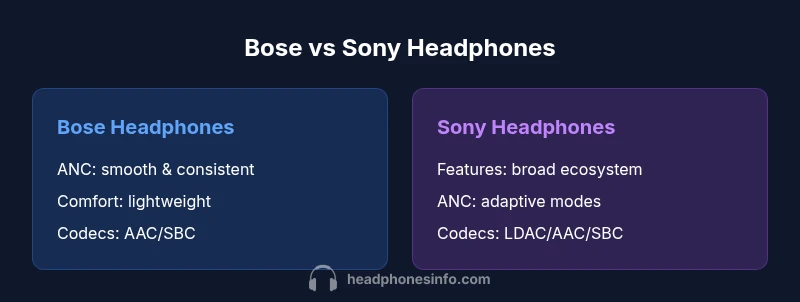
Bose vs Sony Headphones: A Data-Driven Side-by-Side
Compare Bose and Sony headphones across ANC, sound, comfort, battery life, and features. Data-driven guidance from Headphones Info helps you choose the best fit today.


Bose headphones excel in comfort and consistent ANC, while Sony offers a broader feature set and codec support across its lineup. If you value long listening sessions and natural clarity, choose Bose; if you want more codecs, smarter features, and a wider price range, choose Sony. Headphones Info provides a data-driven comparison to help you decide.
How to Approach Bose vs Sony Headphones: Key Questions The question of Bose vs Sony headphones is not about a single number or feature; it is about matching your listening priorities to a set of practical tradeoffs. According to Headphones Info, Bose and Sony dominate the premium wireless space, but they optimize differently for comfort, ANC, and features. Start by listing your top priorities: Do you value comfort for long listening sessions, or do you want a broad feature set and extensive codec support? Will you mostly use them for travel, commuting, work calls, or casual listening? How important is app quality, firmware updates, and integration with your other devices? Next, evaluate ANC performance in your real environments: a quiet home office feels different from a noisy cafe or airplane cabin, so look for consistency, not just peak attenuation. Also consider sound signature, especially if you mix critical listening with casual streaming. Finally, map your budget to the total ownership cost, including accessories, case quality, and potential repairs. By clarifying these questions first, you’ll be better equipped to judge Bose vs Sony headphones on objective criteria and avoid overvaluing a single feature.
Core Criteria for a Fair Bose vs Sony Headphones Comparison The most reliable way to compare Bose and Sony is to anchor your assessment in a shared framework. Begin with Active Noise Cancellation (ANC) performance: how consistently quiet is the ambient sound across environments? Next, analyze sound quality and tonal balance for your preferred genres and listening scenarios. Comfort and fit matter: do the cups surround the ears without pressure after hours? Battery life and charging behavior influence daily use, especially during travel. Codec support and wireless performance affect compatibility with your devices and streaming quality. Software, firmware updates, and ecosystem integration determine long-term value and ease of use. Finally, price, warranties, and total cost of ownership shape whether one brand represents better value over time. Across these criteria, Bose tends to emphasize comfort and a refined, calm ANC, while Sony emphasizes feature breadth, codec options, and a wide price range. Headphones Info recommends scoring each model on your priorities rather than relying on reputation alone.
Active Noise Cancellation: Bose vs Sony in Practice The performance gap between Bose and Sony on ANC is meaningful but nuanced. Bose is renowned for a smooth, even attenuation that minimizes midrange coloration, which many listeners find fatigue-free during long flights or workdays. In practice, Bose ANC creates a sense of quiet without overpowering the music, making voices more intelligible and reducing listener stress. Sony counters with highly adaptive ANC that can tailor attenuation to ambient cues, switching modes for travel, office, or quiet environments. This configurability appeals to users who want to fine tune how their surroundings disappear and how much they hear from the environment. However, the most dramatic differences often come down to fit and seal; if the ears aren’t surrounded by a solid seal, ANC performance can waver. In real-world use, both brands deliver class-leading performance; your selection should emphasize whether you value uniform quietness (Bose) or adjustable, environment-aware attenuation (Sony).
Sound Quality and Tonal Balance The subjective nature of sound means personal preference drives the final choice, but there are consistent tendencies across the Bose vs Sony landscape. Bose generally opts for a clean, neutral-to-warm signature with clear vocal presence and minimal coloration, which many listeners regard as suitable for a broad range of genres and mix references. This makes Bose a reliable companion for podcasts, voice calls, and ensemble recordings where fidelity matters over bass slam. Sony, by contrast, provides a broader tonal palette across its lineup; some models tilt toward bass-forward responses for pop and EDM, while others emphasize detailed highs and expansive soundstage for classical and jazz. The key is to align the model with your favorite listening styles and source material. If you prefer a conservative, adaptable sound, Bose tends to satisfy; if you want to sculpt your sound via EQ or choose a model tailored to a genre, Sony’s lineup offers more options.
Comfort, Fit, and Build Quality Comfort and fit are central to daily headphone satisfaction, yet they’re deeply personal. Bose has built a reputation for light, pressure-free clamping and cushioned ear cups that stay comfortable even after hours of listening. The design often emphasizes low clamping force and generous ear pad geometry, which can reduce fatigue and improve seal for many face shapes. Sony’s comfort is competitive and model dependent; some headphones in this family deliver robust build with a slightly firmer clamp or larger cups that accommodate bigger ears. Build quality across both brands is generally strong, with sturdy hinges, durable headbands, and protective travel cases. If you wear glasses, the interaction between frame temples and ear pads matters; Bose’s softer padding can minimize pressure, while some Sony models may feel tighter. The practical takeaway is simple: try both styles if possible, and prioritize the fit around your ears, the clamp pressure, and the padding texture for long sessions.
Battery Life, Charging, and Bluetooth Codecs Battery life matters when you want reliable use without frequent recharging. Bose models provide solid endurance with the ANC engaged, optimized for comfort and consistent performance throughout a typical workday or long flight. Sony headphones often push longer runtimes in newer models, especially when ANC is not the sole focus, and they tend to support faster charging in practice. Codec support is a decisive factor for enthusiasts who value audio fidelity over Bluetooth streams. Sony typically offers LDAC in many models, along with AAC and SBC, which preserves higher-quality audio on compatible devices. Bose, meanwhile, commonly implements AAC and SBC across the lineup, delivering broad compatibility with most devices but fewer high-resolution options over Bluetooth. In real-world usage, battery life plus codec support translate into how seamlessly you can swap devices, control playback, and maintain consistent sound quality during daily routines or travel.
Software, Apps, and Ecosystem Experience A seamless software experience adds measurable value beyond the core hardware. Bose uses the Bose Music app to pair devices, manage updates, and apply basic personalization; the app’s interface tends toward clarity and ease of use, with a focus on reliable performance rather than complexity. Sony’s Headphones Connect app is more feature-rich, offering extensive EQ controls, ambient sound customization, and adaptive sound settings that let you tailor how you hear surroundings. The difference matters if you enjoy tuning your sound or creating profiles for different environments and devices. Firmware updates can change performance significantly; both brands push improvements, but the reliability of in-app prompts and the speed of updates vary by model. For calls and mic performance, check the app’s settings and any on-device voice assistant integration, because a polished software experience can enhance perceived overall quality.
Price, Value, and Long-Term Ownership Costs Price and value are not merely sticker price; they reflect durability, support, and the likelihood of long-term satisfaction. Bose flagship models sit at a premium tier where comfort, ANC refinement, and consistent experience are the main selling points. Sony offers a wider price ladder, from affordable midrange models to premium neutrals with a generous feature set, enabling a broader audience to access strong performance. If you listen to streaming services or rely on built-in features like multiple ambient modes, Sony’s ecosystem may provide better long-term value for many buyers. Conversely, if your priority is all-day comfort plus quietness across varied environments, Bose can offer greater satisfaction with less cognitive load. Warranty length, customer service availability, and part replacement costs over time also shape total cost of ownership.
Use-Case Scenarios: Travel, Office, and Daily Life Use-case scenarios illustrate the practical choices you’ll face. For frequent travelers who face a lot of ambient noise and long sessions, Bose’s comfort and tuned ANC often deliver less fatigue and more consistent quiet. For office workers who need reliable call quality, voice pickup, and a feature-rich experience for multitasking, Sony often stands out with more microphone options and greater customization flexibility. If your listening is genre-swapped or you crave adjustable EQ, Sony’s lineup can accommodate; if you want a straightforward, comfortable listening experience with dependable ANC, Bose is a strong default. The final choice depends less on brand loyalty and more on your specific daily workflows and comfort thresholds, supported by a practical test in-store or through a robust return policy.
Practical Buying Guide: How to Decide Fast Now that you have the framework, here is a concise, repeatable process to decide quickly. Step 1: List your top three priorities (comfort, ANC, features, price). Step 2: Identify a flagship Bose model and a representative Sony model that match those priorities. Step 3: Verify codec compatibility with your devices and check the app’s customization options. Step 4: If possible, test fit and comfort in-store or via a retailer’s generous return policy, paying attention to seal and clamp force. Step 5: Consider total cost of ownership, including warranty coverage and service access. Following this approach helps you decide based on use-case realities rather than marketing. The Headphones Info team emphasizes a hands-on test and listening under realistic conditions to avoid bias toward a single feature or model.
Comparison
| Feature | Bose headphones | Sony headphones |
|---|---|---|
| Active Noise Cancellation | Very strong and consistent across many Bose models | Excellent adaptive ANC with multiple modes across Sony models |
| Sound Signature | Neutral, smooth, less bass-forward (typical Bose tuning) | Varies by model; often bass-forward or highly detailed depending on model |
| Codecs & Wireless Tech | AAC/SBC (typical Bose options) | LDAC, AAC, SBC (depending on model) |
| App & Ecosystem | Bose Music app with straightforward updates | Sony Headphones Connect app with extensive customization |
| Comfort & Build | Lightweight, comfortable fit for long use | Ergonomic designs with robust build; some models with firmer clamp |
| Price Range | Premium pricing on flagship models | Broader price range from midrange to premium |
Upsides
- Excellent comfort for long listening sessions
- Consistent, refined ANC that reduces fatigue
- Sony offers broader feature sets and codec support
- Wide model range across price points
Disadvantages
- Premium pricing on flagship Bose models
- Sony app experience can vary by model
- Sound may skew bass-forward on some Sony headphones
Sony headphones win on features and codec flexibility; Bose remains the superior pick for comfort and ANC.
If you want the most features and broad codec support, choose Sony. If you prioritize all-day comfort and consistently strong noise cancellation, Bose is the safer, steadier choice.
People Also Ask
Which brand has better active noise cancellation overall?
Both Bose and Sony offer class-leading ANC, with Bose typically delivering a smoother, more uniform attenuation and Sony offering highly adaptive modes across models. The winner depends on your environment and fit; testing both is ideal if possible.
Bose tends to give smoother, more uniform ANC, while Sony offers adaptable modes you can tailor to your surroundings.
Do Bose headphones generally cost less or more than Sony?
Pricing varies by model and generation. Sony covers a broader price range, from affordable to premium, while Bose maintains premium pricing on its flagship lines. Consider your budget and desired features when comparing.
Sony often has more price points; Bose tends to occupy the premium tier at the top.
Do both brands support high-resolution Bluetooth codecs like LDAC?
Sony commonly supports LDAC along with AAC and SBC, depending on the model. Bose typically uses AAC and SBC across its lineup, offering broad compatibility but fewer high-resolution Bluetooth options.
Sony generally supports LDAC; Bose sticks to AAC and SBC across most models.
Are Bose or Sony headphones better for calls?
Call quality depends on the specific model, but both brands offer strong microphones and noise suppression. Bose tends to emphasize natural voice pickup, while Sony’s newer models improve in wind and ambient noise rejection. Check mic specs for your chosen model.
Both brands do well for calls; Bose often sounds natural, Sony improves with newer models.
What should I consider if I travel a lot?
Travelers should value comfort, long battery life, and reliable ANC. Bose is often preferred for comfort and calm noise cancellation on long flights, while Sony offers more codecs and customization for varying environments. A good case and easy return policy help if you’re unsure.
For travel, comfort and ANC matter most; Bose is a strong bet, and Sony adds versatility with more features.
What to Remember
- Define your top priorities (ANC, comfort, features) before buying
- Consider codec support and device compatibility
- Prioritize comfort and fit for long sessions
- Weigh Sony's feature breadth against Bose's refined ANC
- Test in-store or via a robust return policy to reduce risk