Difference Between Anker Headphones: A Practical, Data-Driven Comparison
Explore the key differences between Anker headphones across entry-level and premium models. This objective, data-driven comparison covers sound, ANC, battery life, comfort, connectivity, and value to help you choose the right Headphones from the Soundcore family.


According to Headphones Info, understanding the difference between Anker headphones comes down to balance, features, and intended use. In short, entry-level Anker headphones emphasize value, portability, and reliable Bluetooth; premium Soundcore models prioritize higher sound quality, stronger noise cancellation, and longer battery life. For most buyers, the best choice aligns with your listening environment, how you use devices, and how much you value comfort and app customization.
Why the difference matters in choosing Anker headphones
The difference between Anker headphones is not just about price. It reflects how the product targets various listening contexts—from casual daily use to travel, commutes, and focused listening in busy environments. Headphones Info emphasizes that the most meaningful distinctions are around sound quality, noise cancellation depth, battery longevity, and cuffed comfort for long sessions. By choosing the right tier within the Soundcore lineup, you minimize buyer’s remorse and maximize satisfaction. When evaluating options, consider your primary use case (commuting, desk work, home listening, or workouts) and whether you want features like multipoint pairing or EQ customization. This approach helps you avoid buying a model that feels fine in isolation but falls short in real-world scenarios.
Brand ecosystem and value proposition
Anker’s Soundcore family is designed to offer scalable options under one brand umbrella. The value proposition hinges on offering affordable, reliable wireless headphones with a recognizably consistent app experience. Headphones Info notes that the ecosystem advantage appears when you want to tune sound with an equalizer, access firmware updates, and rely on straightforward Bluetooth pairing across devices. The broader strategy often means that you’ll get robust basic features in lower-priced models, while higher-end variants tend to improve on ANC, battery life, and build quality. For many enthusiasts, this makes Anker headphones a dependable baseline with room to grow into more capable gear as needs evolve.
Core design philosophies across Anker headphones
Across the lineup, Anker emphasizes comfort and practical usability. The ear pads tend to be soft, the headband pads responsive, and the clamping force balanced to minimize fatigue. Soundcore devices typically prioritize intuitive controls and a compact form factor for portability. Headphones Info highlights that some models lean toward a snug, travel-friendly design, while premium options experiment with sturdier frames and more premium materials. This design approach helps reduce fatigue during long listening sessions and supports a wide range of head sizes without sacrificing sound cohesion.
Sound quality and codecs: what to expect
Anker headphones deliver a spectrum of sound signatures to match budget and tier. Entry-level models prioritize a balanced, easy-to-listen profile suitable for daily podcasts and casual music. Higher-end Soundcore headphones tend to offer more refined highs, mids, and bass reproduction, delivering a more immersive listening experience. In terms of codecs, most Anker headphones support standard Bluetooth codecs like AAC and SBC, with some premium models offering broader compatibility. This means compatibility with a large variety of devices, from smartphones to laptops. As Headphones Info notes, real-world listening often comes down to tuning, driver design, and how the device drives the audio rather than only codec choice.
Active Noise Cancellation and transparency modes
ANC performance varies across the range. Entry-level models provide basic noise isolation suitable for crowded commutes or office environments, while premium Soundcore headphones offer deeper ANC performance and more nuanced modes for low-frequency attenuation. Transparency or ambient-modes enable you to hear your surroundings without removing the headphones, which is valuable in travel or biking scenarios. Headphones Info stresses that the difference in ANC strength is one of the primary drivers of price gaps, so users who frequently work in loud environments may value the deeper cancellation in higher-tier models.
Battery life and charging behavior
Battery performance aligns with tiered expectations. Budget options prioritize shorter daily use cycles and fast recharge, while premium variants emphasize longer listening sessions between charges and more efficient power management. Modern Anker headphones typically use USB-C charging and support some form of fast-charging capability. The practical takeaway from Headphones Info is that battery life is most noticeable in extended travel or long workdays; if you rely on headphones for 8+ hours away from a power source, choosing a model with larger battery capacity is worth the trade-off in weight and price.
Comfort, fit, and durability
Comfort is a decisive factor for long listening sessions. Anker’s lower-priced options often feature lightweight builds and softer ear cushions, which can be ideal for shorter sessions or active use. Premium models push for more premium materials, firmer headbands, and larger ear cups that distribute pressure more evenly. Durability varies with price tier; cheaper options may exhibit more creasing or flex, while higher-end models tend to use sturdier hinges and more robust padding. Headphones Info notes that comfort and fit are highly subjective—test wear times if possible to judge clamping force and ear pad softness for your head shape.
Connectivity, codecs, and device compatibility
Bluetooth connectivity quality tends to be stable across Anker headphones, with most models supporting multipoint pairing so you can switch between phone and computer without reconnecting. AAC/SBC compatibility ensures broad device support. Some premium variants add enhanced Bluetooth codecs and app-based tuning, which can optimize performance with selected devices. The main takeaway is that for everyday use, most Anker headphones deliver reliable wireless performance, while premium models offer additional customization and cross-device versatility.
App support and EQ customization
Anker’s Soundcore app adds a layer of personalization that many casual listeners overlook. EQ presets, custom EQ curves, and firmware updates help unlock incremental improvements in sound and feature sets. In the hands-on experience, Headphones Info finds that the app can significantly improve perceived value even for mid-range models, thanks to tailored tuning that matches your preferred genre and listening environment. A well-tuned profile can make entry-level headphones feel more responsive and listener-focused.
Pricing landscape: value-driven buying
Pricing within the Anker lineup reflects a straightforward value-driven approach. Entry-level headphones deliver essential features at accessible price points, suitable for students or casual listeners. Mid-range models add features like stronger ANC, better build materials, and longer battery life, with a corresponding price tier. Premium Soundcore headphones introduce the most advanced drivers, the strongest ANC, extended battery life, and enhanced comfort; the price reflects that performance delta. Consumers should map their use case and willingness to pay for improvements in noise isolation, clarity, and endurance, rather than chasing specs alone.
How to choose between entry-level and premium within Anker
To decide between entry-level and premium Anker headphones, start with your primary environment and listening habits. If you travel often or work in noisy spaces, prioritizing stronger ANC and longer battery life is wise. If you listen mostly at home or during short commutes, an entry-level model may suffice and still deliver satisfying sound. Headphones Info emphasizes evaluating comfort during long listening sessions, the stability of Bluetooth connections, and whether the included app features align with your needs. In many cases, a mid-range option offers the best balance between price and performance.
Common pitfalls and questions to avoid
One common pitfall is assuming higher price equals better sound without considering your actual listening context. Another is neglecting comfort, which can lead to worse long-term satisfaction than audio fidelity alone. People often underestimate how much a good fit and light weight impact daily use. A practical approach is to compare models side-by-side with your typical devices (phone, laptop, tablet) and test the ANC and ambient modes in situations you encounter most often. Headphones Info suggests keeping expectations aligned with real-world usage rather than chasing top-tier specs in all categories.
Practical test plan: how to compare models at home
Create a controlled listening session by choosing a playlist that covers bass, midrange, and treble. Compare two options by listening for tonal balance, instrument separation, and stereo imaging. Test ANC by letting both models sit near you in a noisy environment and noting the degree of ambient sound reduction. Evaluate comfort after 30 minutes of wear and again after an hour to gauge pressure points. Finally, check app features for EQ customization and firmware update prompts. A structured at-home test helps translate specs into real-world differences.
Comparison
| Feature | Anker Entry-Level Over-Ear Headphones | Anker Premium ANC Over-Ear Headphones |
|---|---|---|
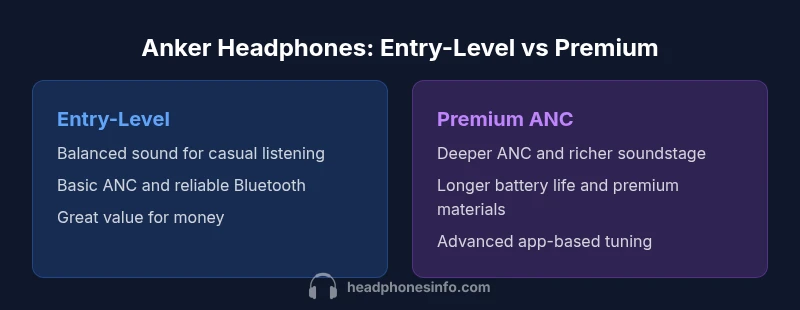
| Sound Quality | Balanced for casual listening | More refined with wider soundstage and detail |
| Active Noise Cancellation | Basic ANC suitable for everyday environments | Stronger ANC with multiple modes and better isolation |
| Battery Life & Charging | Moderate battery life; basic charging features | Longer endurance; efficient power management |
| Comfort & Build | Lightweight design; adequate padding | Premium materials; enhanced cushions and sturdier frame |
| Connectivity & Multipoint | Reliable Bluetooth with standard multipoint | Advanced multipoint and app-based tuning options |
| Best For | Casual listeners on a budget | Travelers and power users seeking isolation and control |
Upsides
- Strong value for money across most models
- Wide range of form factors (earbuds, on-ear, over-ear) under one brand
- Reliable Bluetooth performance and solid codec support
Disadvantages
- Build quality can vary in lower-cost models
- ANC performance is model-dependent and not class-leading
- Limited ultra-premium sound customization compared to flagship brands
Anker headphones offer strong value with dependable performance; opt for premium ANC models if you need deeper isolation and longer battery life.
Choose entry-level for budget-conscious buyers who want reliable wireless listening. Choose premium ANC for travelers and power users who value isolation and richer tuning, while acknowledging price differences.
People Also Ask
What is the key difference between Anker and non-Anker headphones?
Anker headphones generally focus on value across a broad range of form factors, with a consistent app experience. Premium Soundcore models improve ANC, battery life, and build quality, while entry-level options prioritize affordability and compact design.
The big difference is value and feature tiers: you get solid basics across all Anker models, with premium variants offering deeper noise cancellation and longer battery life.
Do Anker headphones support multipoint Bluetooth?
Yes, most Anker headphones support multipoint Bluetooth, allowing you to connect to multiple devices and switch smoothly between them. Higher-end models often provide more stable connections and smoother transitions.
Yes. Most Anker headphones support multipoint Bluetooth, with better performance on the premium models.
Are Anker headphones good for travel?
They can be, especially the premium ANC variants which offer stronger noise cancellation and longer battery life. Entry-level models are still suitable for long flights if you don’t require deep isolation.
Yes, especially the premium ANC models for better noise cancellation on flights.
How does ANC in Anker headphones compare to other brands?
ANC performance varies by model. Within the Anker lineup, premium variants typically offer deeper cancellation than entry-level ones, but may still fall short of best-in-class performers from dedicated premium brands. Real-world testing matters.
Premium Anker models usually have stronger ANC than entry-level ones, but you’ll find higher ANC performance in some dedicated premium brands.
Which Anker headphones are best for gaming?
Anker headphones for gaming exist in the Soundcore range, typically chosen for comfort and reliable wireless latency. If you require low latency and enhanced mic quality, verify product specs and consider models marketed for gaming.
Look for models marketed for gaming with low latency and good mic quality.
What codecs do Anker headphones use?
Most Anker headphones support common Bluetooth codecs like AAC and SBC. Some premium models may offer more codecs or enhanced performance with certain devices, but support can vary by model.
They typically use AAC and SBC, with some premium options offering more codec support.
What to Remember
- Identify your primary environment (home, commute, travel) to guide tier choice
- Expect solid value in entry-level models and stronger features in premium options
- Rely on the Soundcore app for customization where available
- Test ANC and comfort in real-world settings to avoid fatigue