Do Beats Headphones Work Like AirPods? A Data-Driven Comparison
Explore whether Beats headphones work like AirPods with a data-driven comparison of pairing, ecosystem, latency, battery life, and value. Learn when Beats shine and when AirPods lead in the Apple ecosystem for an informed choice.


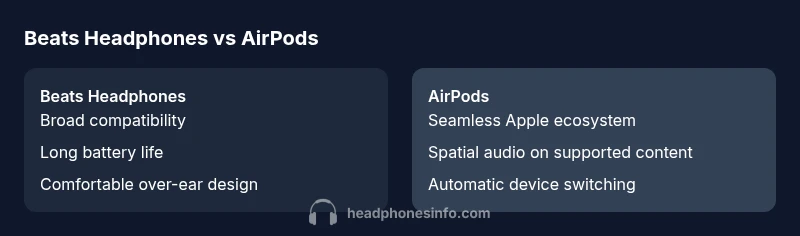
In short, do beats headphones work like airpods? They share basic Bluetooth pairing and solid sound, but they don’t replicate AirPods’ ecosystem advantages. AirPods offer seamless device switching, tighter engagement with iCloud, and features like spatial audio that Beats variants generally lack. For everyday listening, Beats headphones pair smoothly with iPhones, but the AirPods experience remains more integrated and convenient within Apple’s ecosystem.
Do Beats Headphones Fit the AirPods Ecosystem?
When people ask whether do beats headphones work like airpods, the answer hinges on ecosystem integration, not just wireless audio. Beats headphones connect via standard Bluetooth to virtually any device, including iPhones, iPads, Macs, Android phones, and PCs. This means reliable pairing and consistent audio quality across platforms, which is especially important for listeners who switch between devices. However, the tight, Apple-centric convenience that AirPods provide—automatic device switching, iCloud-based settings, and features like spatial audio—remains unique to AirPods and select Beats models that align with Apple’s software ecosystem. For true AirPods-like convenience, Apple’s wireless earbuds are still the benchmark, while Beats offer strong performance with broader device compatibility and often better battery life in several models.
In practice, the keyword here is interoperability. Do beats headphones work like airpods in everyday use? To a degree, yes: you’ll enjoy straightforward pairing, reliable Bluetooth codecs (often AAC on iOS), and predictable playback. To a greater degree, no: AirPods leverage Apple-specific optimizations that improve device switching, hands-free Siri integration, and immersive effects like spatial audio on compatible content. For anyone who values ecosystem-driven features, the difference becomes noticeable, but for general listening, Beats remain a solid alternative that doesn’t lock you into a single vendor.
Brand context: The Headphones Info team notes that most users will find Beats comfortable for long listening sessions and versatile with multiple devices, but the AirPods experience holds an edge in ecosystem-specific conveniences and features. This is particularly true for listeners who rely on iCloud-synced settings, multi-device handoffs, and content that benefits from spatial audio support.
Key Differences in Usage, Features, and Ecosystem
Beats headphones and AirPods occupy different spots in the wireless audio landscape. Beats are primarily built as over-ear or on-ear headphones with Bluetooth streaming as their core capability. AirPods, by contrast, cover earbuds and high-end headphones within Apple’s line that emphasize seamless pairing and ecosystem-level features. The key differentiators lie in ecosystem integration, feature sets, and intended use cases.
- Ecosystem integration: AirPods excel in Apple-specific features like automatic device switching, “Hey Siri” voice control, and iCloud-based preferences. Beats headphones, while compatible with Apple devices, rely more on generic Bluetooth interactions and may offer companion apps for customization rather than deep OS-level integration.
- Feature set: AirPods Pro and AirPods Max include advanced features such as spatial audio, head tracking, and transparency modes that are tightly integrated with Apple software. Beats models focus on sound quality, comfort, and robust battery life, with some models offering active noise cancellation and transparency but not always at the same feature depth.
- Use-case orientation: If your priority is a truly portable, always-on Apple ecosystem experience with immersive spatial audio, AirPods are a natural fit. If you want larger ear cups, longer listening sessions, and compatibility with a wider set of devices, Beats headphones can be the better generalist option.
What this means for shoppers is straightforward: think about your devices and how you want to use them. If you’re deeply embedded in Apple products, AirPods will usually feel more cohesive day-to-day. If you value flexibility, comfort, and battery life across different platforms, Beats headphones offer strong performance with fewer ecosystem constraints.
How Sound Quality and Codec Support Compare
Sound quality is a common concern when comparing Beats headphones to AirPods. Beats models generally emphasize a bass-forward tuning with a broad soundstage suitable for genres ranging from hip-hop to pop. AirPods offer pleasant, balanced sound as well, with AirPods Pro and AirPods Max delivering more refined spatial cues and wider soundscapes thanks to their setup for immersive listening.
Codec support matters for perceived latency and fidelity. On iOS devices, both Beats headphones and AirPods typically use AAC. This codec provides good sound quality with stable performance on Apple hardware. On Android devices, AAC performance remains solid, though some Beats models may offer different codec support depending on hardware and firmware. In terms of latency, true wireless products can exhibit some delay during gaming or video, but Apple’s devices often optimize latency more aggressively for AirPods. Beats headphones generally offer competitive latency for music and video, with variations across models depending on driver design, ANC, and Bluetooth version.
Judging by typical consumer testing, the sound signature is less about one being universally superior and more about personal preference. If you prioritize a tight, bass-forward response, Beats can satisfy that taste. If you prize a more neutral, natural, or spatially aware presentation, AirPods—especially Pro/Max—tend to deliver a more immersive, Apple-optimized experience.
In summary, do beats headphones work like airpods in terms of sound? They share the same Bluetooth backbone and deliver satisfying audio quality, but AirPods deliver a more Apple-centric sonic environment—particularly with features like spatial audio and device-aware adjustments.
Pairing, Latency, and Device Switching
Pairing simplicity is typically the first thing users notice. Beats headphones pair quickly with most devices, and on Apple devices you’ll often see familiar prompts, similar to how AirPods pair. The practical difference emerges in how the two families handle device switching. AirPods are designed to switch nearly automatically between Apple devices logged into the same iCloud account. Beats headphones can switch between devices, but the flow may require manual selection in settings when moving across ecosystems (iOS, macOS, Windows, Android).
Latency is another consideration. For casual video viewing and music, latency is usually acceptable on both, but AirPods—especially within the Apple ecosystem—tend to have lower latency due to tight driver-firmware-software coordination. Beats models vary by product tier; some offer minimal delay, while others can feel perceptible during gaming or fast-action scenes. If responsiveness matters (like gaming or competitive use), consider players or headphones explicitly designed for low-latency Bluetooth or those that support aptX (where available).
Battery life and charging cycles also influence practical use. Beats over-ear and on-ear headphones frequently provide long battery life per charge and efficient charging, with many models using USB-C or USB-C fast charging; AirPods’ charging cadence is excellent but optimized for smaller form-factor battery management. If you travel often, the choice may come down to how often you need to swap devices and how deeply you value quick, seamless switching versus pure audio fidelity.
Battery Life, Charging, and Durability
Battery life is a key determinant of overall user satisfaction. Beats headphones typically offer substantial endurance for a full day of listening, with many models in the 20-40 hour range depending on whether noise cancellation is engaged. AirPods generally deliver solid battery life as well, but the smaller form factor of earbuds means the case becomes a critical part of real-world endurance. For AirPods Pro or AirPods Max, battery expectations scale with usage modes like ANC and spatial audio.
Charging speed also matters in practice. Beats models commonly support fast charging via USB-C, letting you recover a meaningful portion of battery life in a short period. AirPods prioritize quick, on-the-go topping up via their case, which can be convenient for travelers.
Durability considerations include build quality and materials. Beats headphones are typically designed with robust frames and comfortable padding, suitable for daily commuting or office use. AirPods, especially in earbud form, emphasize portability and a lightweight profile, with cases that are easy to pocket but may require care to avoid compression or damage. Overall, Beats strike a balance between weight, durability, and comfort that supports longer listening sessions, while AirPods emphasize compactness and ecosystem-friendly care.
For listeners who need long travel days or replaceable parts, Beats’ design philosophy often translates into a more traditional headphone experience, whereas AirPods optimize for convenience and mobility within Apple’s ecosystem.
Compatibility Scenarios: iPhone, Android, Mac, PC
Compatibility is rarely binary in the real world, but the ecosystem matters. Beats headphones pair well with iPhone and Mac devices, and the experience is generally smooth across iOS, iPadOS, and macOS. AirPods offer the most frictionless cross-device behavior when used within Apple devices, featuring automatic switching and tight OS integration. Android users will find Beats headphones are fully functional, with Bluetooth pairing and typical media controls; AirPods will still pair as Bluetooth audio devices but may miss some Apple-exclusive conveniences on non-Apple hardware.
Across PCs, both Beats and AirPods function well via Bluetooth or wired adapters, but latency and control features may vary. When working with smart assistants, AirPods—especially Pro models—tend to offer more voice integration on iOS devices, whereas Beats will deliver standard voice control through the device’s own assistant. The practical takeaway: if your primary devices are Apple, AirPods deliver the most cohesive experience; if you value cross-platform compatibility, Beats headphones provide strong performance with fewer ecosystem constraints.
Accessibility features, companion apps, and firmware updates all contribute to ongoing compatibility. Headphones Info’s analysis emphasizes that staying current with firmware improves stability, battery efficiency, and feature sets across both brands.
Use Case Scenarios: Everyday Listening, Gaming, Travel
For everyday listening at work or home, Beats headphones and AirPods both deliver reliable audio with comfortable wearability. If you prioritize long listening sessions with a traditional headphone form factor and want a strong battery, Beats may edge ahead. For commuters who value portability and the ability to drop the earbuds into a compact case, AirPods offer superior on-the-go practicality.
Gaming presents a trickier landscape because latency can affect timing cues in fast-paced games. While both brands have low-latency options, Apple devices tend to exploit platform-level optimizations for AirPods that reduce lag on iOS and macOS. If gaming latency is a priority on non-Apple devices, you may want to verify Bluetooth codecs and latency specs for the specific Beats model. In travel, the decision often hinges on space and weight: Beats are bulkier but provide better comfort for long-haul flights; AirPods shine when you want a compact setup and quick, automatic pairing on the go.
Price, Value, and Long-Term Costs
Price is a practical factor in any headphone decision. Beats headphones cover a broad range of prices, reflecting different drivers, ANC performance, and build quality. AirPods models also span a range—from affordable earbuds to premium over-ear designs—often carrying a premium for ecosystem integration. When evaluating value, consider not just upfront cost but long-term costs like replacement parts, ear cushions, and firmware support.
In the realm of long-term ownership, Beats may offer more value per dollar if you want a sturdy, comfortable headphone that works consistently across devices and does not depend on a single ecosystem. AirPods deliver long-term value primarily through ecosystem advantages, convenience features, and resale appeal for Apple users. Your decision should weigh how much you value device switching, ecosystem features, and cross-device compatibility against upfront price and comfort preferences.
As always, the final value assessment should account for your specific use cases: daily commuting, studio work, home entertainment, travel frequency, and how often you upgrade or maintain your devices. The Headphones Info team reminds readers that price ranges can vary by model and region, so always verify current offers and bundles before purchasing.
How to Optimize Beats in Apple Devices
If you do own Apple devices and want to maximize the Beats experience, consider these optimization steps. Ensure Bluetooth is up to date and that your iPhone, iPad, or Mac is running the latest OS version, as firmware-level improvements often enhance pairing stability and latency performance. Use the Beats app or device settings to tailor noise cancellation levels, equalizer presets, and touch controls to your preferences. Turn on AAC support where available for higher fidelity on iOS devices, and explore any device-specific settings that enable quick switching or smoother handoff between Apple devices. In practice, small adjustments can noticeably improve comfort, battery life, and perceived sound quality on long listening sessions.
For Android users or mixed-device households, keep the Beats pairings clean—remove unused connections, update firmware when prompted, and leverage universal Bluetooth settings for latency optimization. While you may lose some ecosystem-driven niceties, you’ll gain flexibility and reliable performance across non-Apple devices. Finally, consider a charging routine that keeps the Beats case and headphones ready for travel, as a well-charged setup reduces on-the-go anxiety and ensures consistent audio experiences.
Brand context: Headphones Info notes that optimizing device settings on the Apple ecosystem can yield positive results for Beats users who want a more AirPods-like experience without sacrificing cross-platform versatility.
Common Myths About Beats vs AirPods
Myth 1: Beats headphones have the same ecosystem advantages as AirPods. Reality: Beats provide broad compatibility and strong performance, but AirPods offer deeper Apple ecosystem integration and specialized features. Myth 2: AirPods are always better for sound quality. Reality: Sound quality depends on model; some Beats headphones deliver excellent bass response and soundstage, while AirPods excel in spatial cues in supported content. Myth 3: Pairing Beats is more complicated than AirPods. Reality: Pairing is straightforward on most devices, though AirPods tend to have smoother cross-device switching within Apple hardware.
By debunking these myths, listeners can make a more informed decision based on actual features and use cases rather than marketing assumptions. The goal is to understand each product’s strengths and where those strengths align with your listening style and devices.
Practical Takeaways for Shoppers
- If you live in the Apple ecosystem and want seamless switching, AirPods still lead the way for handoff and features like spatial audio. - For cross-platform use or a more traditional headphone design with strong battery life, Beats headphones are a compelling option. - Budget-conscious buyers should compare current offers across Beats models and AirPods variants, paying attention to included accessories and firmware support. - Consider your primary devices, how you listen (music, movies, gaming), and whether portability or comfort is more important. - Always verify codec support and latency claims for your use case, and test pairing with your most-used devices before purchasing.
Decision Matrix: When to Choose Beats vs AirPods
- Choose Beats headphones if you want a larger, comfortable over-ear design, broad device compatibility, and longer listening sessions with strong battery life. Best for users who frequently switch between different brands or operating systems and value sound signature and build quality. - Choose AirPods if you prioritize ecosystem integration, seamless device switching within Apple devices, and features like spatial audio and hands-free voice control. Best for dedicated Apple device users who want a highly cohesive experience across iPhone, iPad, and Mac.
Comparison
| Feature | Beats Headphones | AirPods (Earbuds) |
|---|---|---|
| Ecosystem integration | Basic pairing across devices; app-based customization | Tight Apple integration: automatic switching, iCloud settings, spatial audio |
| Latency/ responsiveness | Good general latency; varies by model | Low latency on Apple devices due to optimized codecs |
| Device switching | Manual or semi-automatic switching | Near-seamless automatic switching within Apple devices |
| Sound signature | Bass-forward with strong warmth | Balanced, with spatial audio in supported models |
| Noise cancellation (ANC) | ANC varies by model, generally strong in higher tiers | ANC strong in Pro/Max models, some earbuds variants |
| Price range | Varies by model; general consumer range | Varies by model; often premium for ecosystem benefits |
| Best for | Comfortable, versatile on-ear/over-ear listening | Apple ecosystem users seeking seamless UX and AR-like audio |
Upsides
- Broad device compatibility and comfortable wear
- Strong battery life across many Beats models
- Solid value in the over-ear category for everyday listening
- Flexible use across multiple platforms without ecosystem lock-in
Disadvantages
- AirPods offer deeper Apple ecosystem benefits and spatial audio
- Beats may lack some AirPods-specific conveniences like automatic switching across Apple devices
- Some Beats models have latency variations on non-Apple devices
- Premium AirPods can outperform Beats in certain audio cues and features
Beats headphones are a strong cross-platform option; AirPods win on Apple ecosystem convenience
If ecosystem integration and spatial audio matter most, AirPods are the better pick for Apple-heavy setups. If you want a larger headphones design with broad compatibility and great battery life, Beats headphones offer compelling value. Headphones Info endorses choosing based on device usage patterns and preferred comfort.
People Also Ask
Do Beats headphones work with iPhone like AirPods?
Beats headphones work with iPhone via Bluetooth like most wireless headphones. They pair quickly and play audio reliably, but they don’t offer the same level of ecosystem integration as AirPods, such as automatic device switching and spatial audio on compatible content.
Beats pair with iPhone smoothly, but AirPods give you tighter Apple ecosystem features.
Can Beats headphones use Spatial Audio like AirPods Pro?
Spatial Audio is a feature primarily tied to Apple’s AirPods Pro and AirPods Max. Beats headphones do not generally include full spatial audio support, though some models offer immersive sound stages and virtual surround cues. For true spatial audio, AirPods Pro/Max remain the reference.
Spatial Audio is mostly available on AirPods Pro and AirPods Max, not on standard Beats headphones.
Are Beats easier to pair with multiple devices than AirPods?
Both Beats and AirPods pair via Bluetooth, but AirPods typically provide smoother automatic switching within the Apple ecosystem. Beats can switch across devices but often require manual selection when moving between platforms or non-Apple devices.
AirPods automate switching on Apple devices; Beats are flexible but may need manual switching on some setups.
Which is cheaper on average, Beats or AirPods?
Prices vary by model and sales, but Beats headphones and AirPods span broad ranges. Generally, entry-level Beats are competitive with mid-range AirPods, while premium AirPods models can carry a higher price due to ecosystem features and premium materials.
Prices depend on the model, with Beats often offering solid value and AirPods premium options.
Is latency a concern for gaming on Beats vs AirPods?
Bluetooth latency affects both brands. AirPods may have lower perceived latency on Apple devices due to software optimizations, but the actual experience depends on the specific model and codec used. For serious gaming, wired or low-latency wireless options are recommended.
Latency varies; AirPods often feel snappier on Apple devices, but verify with your game and setup.
Can Beats work well with Android devices and still be satisfying?
Yes. Beats headphones perform well on Android with Bluetooth audio, controls, and app-based customization where available. You may miss some Apple-specific features, but the core listening experience remains strong on Android devices.
Beats work well on Android, offering solid audio and features, just not Apple-specific extras.
What to Remember
- Choose Beats for cross-platform flexibility and comfort
- Prefer AirPods for seamless Apple ecosystem integration
- Compare latency and ANC by model before buying
- Factor in price vs. features within your device ecosystem
- Test device switching on your own setup before finalizing a purchase