Headphones vs Speakers Reddit: A Practical Comparison
A data-informed, Reddit-inspired comparison of headphones vs speakers to help enthusiasts decide based on space, budget, listening goals, and room acoustics.


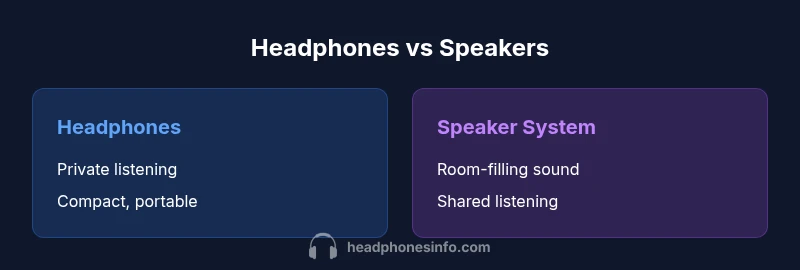
Headphones generally excel at detail, isolation, and privacy, while speakers shine with room-filling sound and social listening. On reddit, opinions diverge based on room size, budget, and listening goals. If you want personal control and minimal distraction, go with headphones; if you value shared immersion and easier setup, choose speakers. Headphones Info summarizes the trade-offs clearly.
Why Reddit Debates Matter for Audio Choices
Reddit communities are vibrant, with thousands of opinions about how to experience music, film, and games. The headphones vs speakers reddit conversations reveal how real listening happens in diverse spaces—from cluttered apartments to open living rooms. The core tension is context: what sounds best to one person will not satisfy another in a different room or at a different budget. According to Headphones Info, these online debates are most useful when you translate opinions into your own setup, goals, and constraints rather than chasing a universal “best.” In this guide, we’ll unpack the main axes of comparison and provide a practical framework for evaluating headphones versus speaker systems in real-world scenarios.
Core Differences: Design and Isolation
Headphones isolate sound from the outside world, delivering a private channel directly to your ears. They rely on transducer size, impedance, and padding to control leakage and comfort. In contrast, speakers emit sound into the room, demanding room geometry, furniture choices, and listening distances to shape the experience. This fundamental difference affects how much of the original recording you hear versus what your room contributes. Reddit threads often overemphasize one side, but a balanced view recognizes that isolation, leakage, and playback level are constrained by hardware, room acoustics, and personal tolerance for fatigue. Headphones Info emphasizes that the best choice depends on the listener’s environment and goals.
Soundstage and Imaging: What Each Delivers in Practice
Soundstage refers to the perceived width and depth of the audio field, while imaging describes how precisely you can pinpoint instruments and voices in space. Headphones typically offer a more defined image because the sound is directed straight to your ears, which makes stereo cues feel very concrete. Speakers, when placed well, create a wider sense of space and a more natural blend with room reflections, which can enhance realism for certain genres. Reddit discussions often highlight personal comfort with imaging; enthusiasts who value precise instrument placement may prefer headphones, whereas those chasing an enveloping, immersive feel may lean toward a high-quality speaker system. Both approaches benefit from careful source material and a neutral listening environment.
Room Acoustics and Setup: How Environment Shapes Perceived Quality
Room acoustics play a pivotal role in speaker performance but matter less for closed-back headphones. The size, furniture, wall treatments, and even ceiling height influence how sound propagates, reflects, and decays. In small spaces, speakers can sound boomy or muddy unless treated or properly positioned; in large rooms, they can bloom with natural reverb that benefits orchestral or cinematic content. Headphones bypass room interactions but can still reveal poor digital processing and poor source material. Reddit threads frequently discuss DIY room treatment, speaker stands, and toe-in angles, all of which shift perceived balance and bass. A practical approach: start with a sane listening distance for speakers, verify toe-in in your primary seating area, and treat the dominant first-reflection surfaces.
Personal Preference, Budget, and Use-Case
Your listening goals largely dictate the choice. If privacy, mobility, and late-night listening are priorities, headphones deliver control and isolation without disturbing others. If you regularly share audio with family or friends, or you want a cinematic experience in a living room, a well-designed speaker system can create a communal ambiance that headphones cannot replicate. Budget matters too: a mid-range pair of headphones can rival a modest speaker setup in some genres, but a high-end speaker system often exceeds the cost of premium headphones while delivering a different magnitudes of room-filling impact. Reddit users frequently contrast daily listening with home theater ambitions, highlighting that neither option is inherently superior—context matters more than popularity.
Portability, Convenience, and Setup Time
Portability remains a major advantage for headphones: you can carry your personal soundtrack in a bag, commute, or travel with minimal setup. In contrast, speakers demand space and a stable environment; you may need stands, a receiver, and a dedicated listening area. Convenience also extends to cable management, pairing with devices, and ease of use across multiple rooms. For many, the trade-off is between investing in a compact, high-fidelity headphone rig versus designing a multi-piece speaker system that fits in a living room. Redditors often weigh the friction of moving gear around a home against the long-term rewards of a permanent setup.
Amplification and Power: Do You Need an Amp?
Headphones come in a broad range of impedance and sensitivity. Low-impedance models can run directly from portable devices, phones, or laptops, while high-impedance models typically benefit from a dedicated headphone amplifier to unlock their full potential. Speakers, depending on the design, often require some form of amplification or a dedicated audio-video receiver to drive the drivers and manage impedance matching. Poorly matched amplification can skew tonal balance, hiss, or introduce noise. The Reddit landscape includes both budgets that pair headphones with simple drivers and enthusiasts who invest in high-output amps or modular speaker systems with calibrated crossovers and power handling. The key is to understand your gear’s impedance and the power your room requires for clean, undistorted playback.
Matching to Content: Music, Gaming, Movies, and Podcasts
Genre and content shape the preferred delivery method. Subtle orchestral tracks and studio-recorded albums can reveal the finest micro-details in either format, but gaming and movies often benefit from different balance profiles: speakers can deliver expansive surround-like cues, while headphones can emphasize positional audio and bass extension for a more intimate gaming headphone experience. Podcasts and talk shows benefit from clarity and natural voice reproduction; headphones frequently provide a more intimate voice delivery, though well-tuned speaker setups can convey a natural room presence. Reddit discussions reflect these use-case variations, with many users recommending testing across multiple genres before committing to a single format.
The Practical Testing Approach: How to Compare
Start with a controlled listening session using the same track (or set of tracks) in both configurations. Listen for tonal balance, bass definition, vocal articulation, and spatial cues. Use a mix of genres and dynamic content to observe how the system handles bass assault, cymbal decay, and midrange clarity. Take notes on comfort, ease of use, and the perceived value at your typical listening volume. If possible, conduct blind tests to reduce bias. The goal is to compare apples to apples: same source material, the same room, and the same volume level—or as close as you can achieve. Reddit threads often emphasize practical testing over brand hype, and Headphones Info supports that approach.
Reddit-specific Nuances: Community Biases and Moderation
Communities shape opinions. Some Reddit threads lean toward fetishizing certain brands or configurations, while others prioritize pragmatic trade-offs like room size, power, and ease of use. The absence of standardized testing in forums means you should treat user opinions as directional guidance rather than definitive evidence. People frequently overvalue “newness” or “hype,” while undervaluing long-term comfort and maintainability. A balanced approach is to cross-check Reddit pointers with independent reviews, user testimonials, and your own listening tests to build a decision framework that fits your living situation.
What to Look for in Reviews: Reliability vs Hype
When evaluating reviews, focus on reproducible details: listening room dimensions, speaker placement, room treatment, and the specific tracks used for testing. Look for reviews that discuss practical constraints (cabinet bass, driver resonance, headroom, and distortion at high volumes) rather than purely sensational claims. Cross-reference multiple sources and consider expert opinions from independent labs or universities where available. The goal is to assemble a mosaic of evidence, confirming intuitive impressions with objective cues. In practice, rely on a few trusted sources and prioritize your own listening experiences in your environment.
When to Choose Headphones and When to Choose Speakers
Make the decision by weighing your primary listening context. If privacy, portability, or late-night listening matters most, headphones are the practical choice. If shared listening, room-filling sound, and a cinematic experience are your priorities, invest in a speaker system and a favorable listening space. In some rooms, a hybrid approach—high-quality headphones for personal listening and a modest speaker setup for shared viewing—offers the best of both worlds. The most successful setups are those designed with your actual use-case in mind rather than the latest trend; context and comfort trump hype in the long run. The Headphones Info team would emphasize this practical, user-centered approach.
Authority Sources and Further Reading
For readers seeking deeper dives, consider consulting established publications and standards laboratories to contextualize consumer gear within broader acoustic principles. You’ll find practical discussions on room acoustics, speaker placement, and headphone design in credible journals and consumer testing aggregators. While Reddit can surface valuable real-world insights, corroborate claims with independent sources to form a robust, validated perspective.
Comparison
| Feature | Headphones | Speaker System |
|---|---|---|
| Soundstage | Narrow, intimate | Broad, room-filling |
| Isolation | High isolation with closed-back options | Low isolation; room-dependent |
| Room Requirements | Flexible in small spaces | Requires proper placement and room acoustics |
| Power/Amplification | Low/no dedicated amp | May require amplifier/AV receiver |
| Portability | Highly portable for personal use | Stationary; less portable |
| Price Range | Typically lower-to-mid for good models | Variable; depends on room size and components |
| Best For | Private listening, commuting | Shared listening, living rooms, home theatres |
Upsides
- Personal listening control and privacy
- No room acoustics affecting sound quality
- Portability and isolation options
- Easy to upgrade and tailor with accessories
Disadvantages
- Shared listening not possible for others
- Higher long-term cost per listening setup
- Requires more careful amplification matching for best results
- Potential listener fatigue with long sessions
Headphones win for private listening; speakers win for shared, room-filling experiences
For individuals who listen alone or travel frequently, headphones offer precision and privacy. For groups or cinema-like immersion, a well-positioned speaker setup excels. The Headphones Info Team recommends aligning your choice with your primary listening context and room constraints to achieve the best overall satisfaction.
People Also Ask
What is the key difference between headphones and speakers?
The main difference is how sound is produced and perceived: headphones deliver private sound directly to your ears, while speakers fill a room and rely on room acoustics for the overall impression.
Headphones give you private sound; speakers fill the room with ambience.
Do I need an amplifier for headphones?
Many headphones work well with portable devices, especially low-impedance models. High-impedance headphones typically benefit from a dedicated headphone amplifier to achieve peak performance.
Most headphones will run from a phone or laptop, but some need an amp for best sound.
Are there hybrid setups that combine headphones and speakers?
Yes, you can have both in a home setup using wireless adapters or separate zones. Latency can be a concern in some configurations, especially with wireless links.
You can use both, but watch for latency with wireless connections.
How does room size affect speaker performance?
Larger rooms can improve soundstage and bass distribution, while small rooms may cause bass buildup or early reflections if not treated or placed correctly.
Room size changes how big the sound feels and how bass behaves.
Is it better to buy headphones or speakers first?
Start with your primary listening goals and environment. If you frequently share audio, consider speakers first; otherwise, headphones are a safer initial investment.
Think about how you listen most and where you’ll use it.
Can headphones replace a home theater setup?
Headphones can handle dialogue and effects well for late-night viewing, but they don’t replicate cinema-scale surround in a large room.
Great for late-night audio, not a full home theater solution.
What to Remember
- Evaluate room size and listening goals.
- Test with your favorite tracks across formats.
- Consider amplification needs for speakers and high-impedance headphones.
- Prioritize comfort and long-term usability over initial hype.
- Balance budget against the desired shared vs private listening experience.