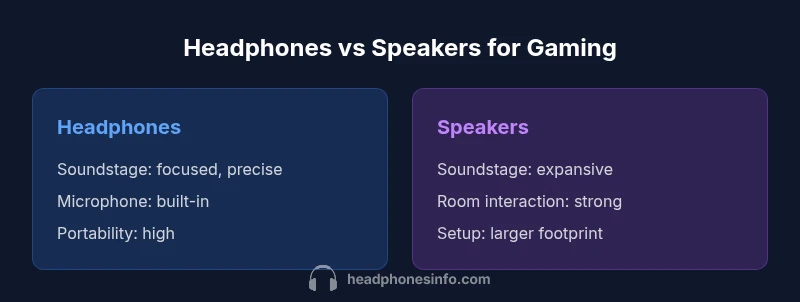
Headphones or Speakers for Gaming: A Compare Guide
An analytical side-by-side guide to choosing between headphones and speakers for gaming, covering sound quality, immersion, comfort, room setup, and buying strategies for 2026.


For most gamers, a gaming headset offers reliable directional cues, built-in chat, and consistent comfort across sessions. If you have a suitable room and prioritize cinematic or room-filling sound, high-quality desktop speakers can deliver a broader soundstage and deeper bass. Your choice should hinge on comfort, chat needs, room size, and how you balance immersion with practicality.
The core decision: headphones or speakers for gaming
Choosing between headphones and speakers for gaming is not just about sound quality; it’s about how you play. In many setups, the quick instinct is to grab a headset for the simplicity of mic pickup and portability. Yet, if you play in a room with space and can optimize placement, speakers offer a different kind of immersion, especially for cinematic titles or long single-player sessions. According to Headphones Info, the best choice balances room dynamics, chat needs, and long-term comfort. This guide dives into the nuances of both options, with practical criteria to help you decide based on your gaming style, gear ecosystem, and living space. The discussion also considers how acoustic treatment and furniture influence perceived sound, ensuring you know exactly what to test when you shop.
How we define gaming audio needs
To compare headphones and speakers fairly, we evaluate several consistent criteria: immersion and soundstage, directional accuracy for footsteps and gunfire, mic or chat quality, comfort during long sessions, room impact and acoustics, setup simplicity, and value for money. We rely on a framework that treats the user experience as a holistic system: the hardware, the room, and the software that drives the sound profile. This approach helps you map your priorities to concrete choices rather than relying on hype or numbers alone. Headphones Info Analysis, 2026, emphasizes that context matters as much as measurements when selecting gear for gaming.
Understanding gaming headsets for competitive play
Gaming headsets consolidate three critical assets into one package: (1) a pair of transducers tuned for quick, precise cues; (2) a built-in microphone for in-game communication; and (3) a form factor designed for long-lasting comfort. The best headsets achieve a balance between tight, controlled bass and clear mids for vocal clarity. They shine in competitive titles where directional audio helps locate enemies, and they simplify cable management and desk clutter. Comfort is non-negotiable in this category; you should test headbands, clamp force, ear cup padding, and weight distribution across different wearing periods. Durability and warranty also matter, given the wear-and-tear that accompanies daily gaming usage.
Understanding gaming speaker setups for living rooms or desks
Speaker configurations vary from compact 2.0 systems to immersive 5.1 or 7.1 arrays. A well-chosen speaker pair can deliver a wider soundstage and deeper bass, which enhances exploration and cinematic moments. However, speaker performance hinges heavily on room acoustics, the position of the listener, and what you pair with your computer or console. Subwoofers add impact, but they also require careful placement to avoid muddiness. For realistic directional cues, you’ll rely on stereo imaging and, in more advanced setups, DSP processing and virtualization features. Speakers demand attention to mounting or stands, cable routing, and, often, a separate DAC/amp to unlock their full potential.
Immersion vs precision: what matters most
Immersion comes from a sense of space and impact, while precision is about pinpointing where sounds originate. Headphones can deliver intimate accuracy and steady localization, which is invaluable for competitive gaming. Speakers, by contrast, foster a colossal room presence and natural reverb that can make games feel more expansive. The choice depends on your priorities: if you value rapid response and chat, headphones win; if you crave a cinematic atmosphere and shared listening, speakers excel. Some players even use both in hybrid setups to balance the benefits, leveraging headphones for competitive moments and speakers for story-driven sections.
Comfort, durability and daily use
Comfort is the bedrock of sustained gaming sessions. Headsets shine when you game for hours with a light, well-padded headband and breathable ear cups. The downside can be limited flexibility in headset geometry, potential heat buildup, and, for wireless models, battery longevity. Speakers remove the fatigue of wearing anything on your head but demand seating arrangements that maintain a stable listening position. Desk height, chair support, and distance from the speakers all influence perceived comfort and audio clarity. Long-term durability depends on build quality, while software features like room correction and EQ can help tailor the experience to your preferences.
Room acoustics and practical considerations
Even the most capable headphones or speakers can be underwhelming in a tough room. Hard surfaces reflect sound and can create harsh highs, while soft furnishings absorb bass, reducing warmth. A mid-size room with reasonable surface treatments often yields the best balance for both formats. If you choose speakers, consider speaker stands, isolation pads, or wall-mounting to reduce cabinet rattle. For headphones, a comfortable fit plus a good DAC/amp (if needed) can unlock more dynamic range. Software EQ, virtual surround, and game-provided audio options also play a significant role in shaping the final sound.
Budget tiers and value propositions
Budget considerations drive feature access and overall performance. Entry-level headsets typically emphasize affordability, built-in mic quality, and portability, while mid-range options improve drivers, comfort, and soundstage. For speakers, entry-level kits are compact and desk-friendly, but room-friendly performance often comes at a higher price, with better drivers, crossovers, and enclosure design. Premium gear emphasizes ultra-low distortion, expansive soundstage, advanced DSP, and robust build quality. The right choice aligns your budget with the level of immersion and chat ability you require, without compromising comfort or room compatibility.
Setup and practical integration: cables, software, and ergonomics
A clean setup reduces cognitive load and helps you focus on the game. Headsets typically offer plug-and-play USB or jack connections with companion apps for EQ and mic settings. Wireless headsets add freedom but introduce battery management considerations. Desktop speakers require a stable surface, proper cabling, and often an external DAC or amplifier to maximize performance. Both formats benefit from a thoughtful cable management plan and a straightforward, repeatable process for adjusting volume, mic mute, and EQ during play.
Use-case scenarios: when to pick which option
- Competitive multiplayer: a lightweight headset with a clear, consistent mic often wins due to reliable chat and precise cues.
- Story-driven or single-player experiences: a larger soundstage from quality speakers can deliver a more enveloping atmosphere and ambient detail.
- Couch co-op or shared space: speakers enable others to hear, while a wireless headset allows a player to move around without being tethered.
- Small rooms or shared environments: headphones minimize spill and keep the space focused on your game.
- Long-term ownership: durability, warranty, and software support should drive your choice as much as raw specs do.
Quick-start buying guide: 5 steps to pick
- Define your primary use case and room constraints. 2) List must-have features like mic quality or surround processing. 3) Determine if you want a fixed setup or a portable option. 4) Test comfort across sessions and measure comfort in both long and short durations. 5) Read independent reviews and verify compatibility with your platform and peripherals.
Putting it all together: decision framework
Your game type, space, and social needs form the backbone of your decision. If you want tight control over voice chat and precise cues for competitive play, a gaming headset is usually the better default. If you crave a broad, cinematic soundscape and share audio with others in the room, invest in a capable speaker setup with room optimization. The most robust approach may combine both: use a headset for competitive moments and keep a speaker system on standby for casual play and media consumption.
Comparison
| Feature | Gaming Headset | Desktop Gaming Speakers |
|---|---|---|
| Soundstage / immersion | Narrow, headset-defined soundstage | Wide, room-filling soundstage with space and placement |
| Directional accuracy | Strong for footsteps and gunfire in most games | Depends on room acoustics and DSP; can be superb with proper setup |
| Microphone quality | Built-in mic with convenient muting | No mic by default; external mic needed for chat |
| Comfort for long sessions | Lightweight, evenly distributed pressure | No headgear; comfort depends on chair and room ergonomics |
| Space requirements | Portable; plug-and-play | Requires desk space and appropriate placement |
| Setup complexity | Simple USB/3.5mm connection with software options | DAC/amp and proper placement improve results; more setup steps |
| Price range | Typically low to mid-range; wide variety | Rises with room size, drivers, and DSP features |
| Room acoustics impact | Minimal room considerations | Significantly affected by room characteristics |
Upsides
- Headphones offer consistent sound across rooms and setups
- Built-in mic simplifies communication in multiplayer
- Compact and portable; easy to store
- Speakers can deliver expansive soundstage for shared listening
- Room aesthetics are less constrained with headphones
Disadvantages
- Speakers require more room optimization and placement
- Headphones can be fatiguing over long sessions if poorly padded
- Speaker bass can overwhelm smaller rooms without treatment
- Headphones isolate sound, which can be isolating for others in the room
Headphones win for competitive play; speakers win for cinematic immersion in suitable rooms
Choose a gaming headset for precision, chat, and portability. Opt for speakers if you want an expansive sound experience and don’t mind optimizing room acoustics.
People Also Ask
What is the main difference between gaming headsets and speakers for gaming?
Gaming headsets provide tight, direct audio with an integrated microphone, making them ideal for competitive play and quiet environments. Speakers offer a wider soundstage and shared listening in a room, which benefits cinematic experiences and social gaming moments.
Headsets give you precise cues and mic chat, while speakers give you a bigger, room-filling sound for group play.
Are wireless options good for gaming?
Wireless headsets offer mobility and fewer cables but may introduce latency or battery concerns. For speakers, wireless setups exist but still require careful placement and potential buffering considerations. Check latency and reliability for your platform.
Wireless can be convenient, just watch for latency and battery life.
Do I need an external DAC or amp for good results?
Many headsets work well without extra gear, but high-end audio setups for speakers or audiophile-grade headphones can benefit from a DAC or amp to unlock dynamic range and clean power. Assess your current gear and room constraints before buying.
A DAC or amp helps if you’re chasing higher fidelity and louder, cleaner sound.
Can I use speakers for console gaming?
Yes, many speakers pair well with consoles, especially if they support HDMI ARC or optical input. You may need a soundbar or a separate receiver to optimize gaming modes and ensure voice chat compatibility.
Speakers can work with consoles, often with the right inputs and a soundbar or receiver.
What if I have a small desk or apartment?
In tight spaces, headphones are usually the safer bet due to limited speaker placement options and potential acoustic issues. If you still want speakers, choose compact bookshelf models and treat the room as much as possible.
Small spaces lean toward headphones, but compact speakers with some room tweaks can work.
What to Remember
- Prioritize mic quality if team chat is essential
- Test in your actual gaming space before committing
- Consider a hybrid approach for flexibility
- Room treatment can dramatically improve speaker performance
- Invest in comfort and build quality for long sessions