Earphones vs AirPods: A Comprehensive Comparison
Compare earphones and AirPods to identify value, durability, and ecosystem trade-offs. This Headphones Info analysis explains sound, cost, and convenience across wired vs wireless options.


To answer why are earphones better than airpods, wired earphones offer universal compatibility, minimal latency, and simpler maintenance, while AirPods excel in seamless Apple integration and true wireless convenience. For most listeners, the choice hinges on your device ecosystem and how you value durability, cost, and portability. This comparison explains where each option shines.
Why the question matters
As a consumer navigating the sea of portable audio, you may ask why are earphones better than airpods in everyday listening, travel, and work. The answer hinges on context, not slogans. According to Headphones Info, the most practical framework compares ecosystems, ownership costs, and daily utility. This article treats earphones as a broad class that includes wired earbuds and basic models, versus AirPods as a premium wireless option tightly integrated with Apple devices. By establishing clear criteria—connectivity, fidelity, durability, and value—we can map your routines to concrete choices. The Headphones Info team found that the strongest picks emerge when you align product type with how you actually listen, what devices you own, and how much you’re willing to invest upfront. In short, there is no universally perfect choice; there is a best fit for your life.
Design and build: wired vs wireless
Wired earphones excel in simplicity. They rely on a physical connection, which generally yields reliable signal transmission with minimal latency. In contrast, AirPods depend on Bluetooth and a compact wireless architecture that prioritizes portability and pairing speed. The materials and cabling of earphones can be upgraded or replaced, offering a straightforward path to longevity if you take care of them. AirPods, while compact and lightweight, rely on battery health and the durability of their charging case. From a design standpoint, wired models can vary widely—from slim, lightweight buds to rugged, sport-oriented drivers—whereas AirPods emphasize a clean, low-profile silhouette optimized for daily wear and quick stow-away.
Audio fidelity and perception
Sound quality is nuanced. Wired earphones often deliver higher fidelity potential when paired with quality drivers and an appropriate DAC or source, because there is less data compression and fewer wireless bottlenecks. AirPods are tuned for consistent, balanced playback across a wide range of portable devices, with a focus on clarity and a pleasing sense of space for casual listening. Perceived differences depend on the source, the listener’s preferences, and the fit of the earphones. Headphones Info analysis shows that when you demand imaging, dynamics, and low distortion at higher volumes, well-chosen wired earphones tend to edge ahead; for everyday listening and convenience, AirPods provide a compelling baseline.
Connectivity, latency, and pairing
Wired earphones use a direct electrical connection; there is effectively no pairing delay and almost zero latency when connected via standard ports. AirPods rely on wireless Bluetooth pairing, which introduces a small, often imperceptible latency that can matter in gaming or timing-critical tasks. The ease of pairing with AirPods is a strong selling point, especially on Apple devices, but it comes with the caveat that wireless pathways can be disrupted by interference or battery status. When you need stability and predictability, wired options win; when you want seamless wireless operation, AirPods shine.
Ecosystem and platform integration
AirPods thrive in ecosystems with strong device integration. If you own multiple Apple devices, AirPods unlock features like automatic switching, quick device transfer, and robust on-device controls. Wired earphones maintain broad compatibility across Windows, Android, macOS, and Linux, with adapters or native jacks, making them a safer bet for mixed-device households. The ecosystem advantage matters most when you rely on features such as hands-free voice assistants, spatial audio, or device-specific EQ presets. For users outside the Apple world, wired earphones offer smoother interoperability and fewer constraints.
Mobility, fit, and use-case scenarios
For frequent travelers or commuters, AirPods offer unmatched portability and a minimal footprint in a pocket or bag. If you value a snug, secure fit during workouts, many wired options provide heftier drivers and better passive isolation, but cables can move during activity. Consider how often you need to detach or switch devices; wireless models excel when you want freedom of movement and a quick, cable-free experience. For long flights or commutes, the choice often narrows to whether you want to minimize cable mess or maximize convenience.
Durability, maintenance, and care
Durability hinges on build quality and care. Cables can fray or kink with heavy use, and connectors may wear after repeated plugging and unplugging. On the other hand, AirPods contain delicate battery and wireless components that demand careful charging and storage. If you tend to misplace small items, the AirPods charging case can be a liability, but many users appreciate the protective enclosure. Effective maintenance for wired earphones includes cable management and occasional replacement of worn plugs; for AirPods, keeping the charging case clean and ensuring firmware updates helps sustain performance.
Price, value, and ownership costs
Wired earphones typically present lower upfront costs and simpler replacement parts, which translates into lower long-term expenditure for many listeners. AirPods demand a higher initial investment and ongoing costs for replacements or battery care. When you tally total cost of ownership, wired options often emerge as the most economical choice for people who do not rely on seamless wireless convenience or advanced ecosystem features. That said, AirPods deliver tangible value for users who prioritize mobility, instant pairing, and integrated controls within a single ecosystem. The decision hinges on how you weigh upfront cost, maintenance, and ecosystem benefits.
Environmental considerations and sustainability
From a sustainability perspective, wired earphones produce less electronic waste per unit due to their simpler construction and longer potential lifespan with proper care. Wireless devices like AirPods contribute more to battery waste and case production, though manufacturers are increasingly improving recycling programs. If environmental impact matters to you, factor in repairability, replaceable cables, and the availability of official spare parts when choosing between wired earphones and AirPods. Your choice can reflect both personal ethics and practical usage patterns.
Decision framework: mapping needs to options
To decide, start with your primary device ecosystem and listening context. If you value universal compatibility and minimal ongoing costs, wired earphones are often the better fit. If you prize effortless wireless use, quick pairing, and ecosystem advantages, AirPods are compelling. A practical rule of thumb is to map three questions to your decision: Do I need true wireless freedom or a reliable wired connection? Is my device ecosystem Apple-centric or multi-platform? Am I willing to invest more upfront for convenience and features? Answering these questions helps translate abstract preferences into concrete product choices.
Common myths and testing tips
A frequent myth is that wireless equals inherently inferior sound. This is not always true: sound quality depends on driver design, tuning, and source quality. Another myth is that all earphones are fragile; many wired models are designed for rugged use. A practical test involves listening to a track with well-recorded instruments, checking for detail in highs, mids, and lows, and evaluating how comfortable they are for extended periods. If possible, compare a wired pair with your AirPods side by side using the same device and volume level to get a clear sense of the differences in timbre, control, and isolation.
Next steps: how to buy and test
When approaching a purchase, set a budget and choose a few core use cases—commuting, workouts, studio listening, and travel—then test models that align with those scenarios. Read independent reviews focusing on drivers, impedance, and fit. If you own an iPhone or Mac, test the AirPods’ ecosystem features; if not, consider how wired options integrate with all your devices. Finally, consider buying from retailers with fair return policies so you can evaluate fit and comfort in real-world conditions.
Comparison
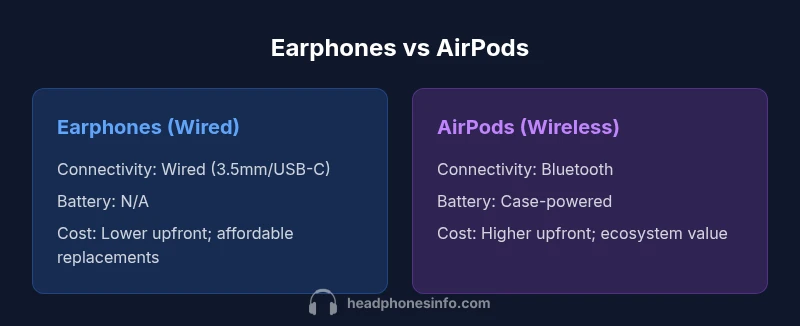
| Feature | Earphones (wired) | AirPods (wireless) |
|---|---|---|
| Connectivity | Wired (3.5mm/USB-C) or compatible jack variations | Wireless Bluetooth with pairing and case |
| Audio Fidelity | Potentially higher with quality drivers and DACs | Tuned for balanced portable sound |
| Battery Life / Power | N/A (no battery in standard wired models) | Battery-based with charging case and on-device battery |
| Portability | Typically lighter cables but bulkier with some builds | Very portable with compact wireless case |
| Durability & Maintenance | Cables can wear over time; replaceable parts | Fewer mechanical parts but battery/Case wear matters |
| Ecosystem Compatibility | Works broadly across devices with adapters | Best with Apple devices; seamless ecosystem features |
| Cost & Ownership | Lower upfront cost; inexpensive replacements | Higher upfront cost; ongoing accessory considerations |
| Water Resistance | Depends on model; many wired are not water resistant | Varies by model; Pro variants offer resistance ratings |
Upsides
- Lower ongoing costs for non-Eco users and universal compatibility
- No reliance on battery for core listening with wired earphones
- Wider device interoperability without requiring ecosystem locks
- Simple setup and minimal latency in wired configurations
Disadvantages
- Cables can tangle, fray, or break, impacting longevity
- Lesser convenience for true wireless mobility and quick access
- Limited use in workouts due to cable movement and snag risk
- AirPods may offer ecosystem-integrated features that wired can't match
Earphones generally offer better value and broader compatibility; AirPods excel in convenience within Apple ecosystems
Choose wired earphones if you want universal device support and lower long-term costs. Pick AirPods if you prioritize seamless wireless use and ecosystem benefits, especially on Apple devices.
People Also Ask
What is the main difference between wired earphones and AirPods?
The main difference is connectivity: wired earphones use a physical connection while AirPods rely on wireless Bluetooth. This affects latency, compatibility, and battery needs. Your device ecosystem often determines which is preferable.
Wired earphones connect with a cable, AirPods connect wirelessly. The choice affects latency, compatibility, and battery needs.
Are wired earphones capable of higher sound quality than AirPods?
Sound quality depends on drivers and source; wired earphones can deliver higher fidelity with quality components, while AirPods are tuned for balanced portable sound. In critical listening, wired models often edge ahead.
Wired earphones can sound better with the right drivers, though AirPods are tuned for everyday listening.
Do AirPods offer benefits that wired earphones can't match?
AirPods provide seamless pairing, true wireless convenience, and integration with Apple devices. These advantages are hard to beat for users within the Apple ecosystem.
AirPods win in convenience and ecosystem integration for Apple users.
Are wired earphones compatible with iPhones without adapters?
New iPhones often lack a headphone jack; wired earphones require an adapter or Lightning-compatible model. Check your device’s port and plan accordingly.
If your iPhone lacks a jack, you’ll need an adapter.
Which lasts longer, AirPods or wired earphones?
Lifespan depends on usage; cables can fray while AirPods rely on battery health and case durability. With careful handling, both can last several years.
If you’re careful, both can last many years, but cables wear out more quickly.
Should I choose earphones if I want to minimize cost?
Generally, wired earphones offer lower upfront and long-term costs, especially if you already own compatible devices. AirPods tend to cost more upfront and require battery care and replacements over time.
Wired options are usually cheaper over time.
What to Remember
- Match choice to your device ecosystem
- Weigh long-term costs against convenience
- Consider durability and maintenance needs
- Factor in portability and use-case for workouts or travel
- Test both options with your own content and devices