Why Wired Headphones Are Better Than AirPods: A Data-Driven Comparison
An analytical, data-driven comparison of wired headphones versus AirPods, exploring sound quality, latency, durability, and value. A Headphones Info analysis for audiophiles and shoppers seeking clarity.


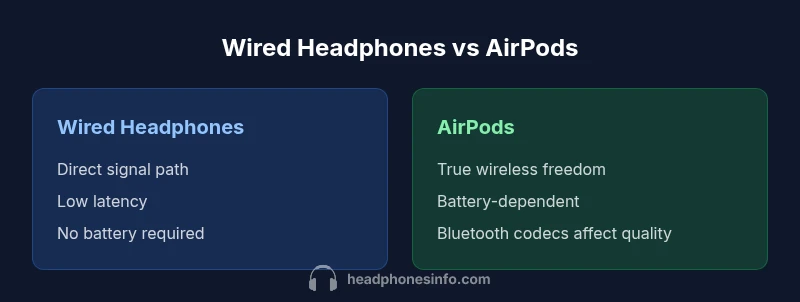
For most listeners, wired headphones deliver more consistent sound quality and lower latency than AirPods. The direct connection minimizes interference and latency, making them preferable for critical listening, mixing, and gaming. While AirPods offer unmatched convenience, wired headphones shine in fidelity and reliability, especially with high-impedance models and desktop setups.
What distinguishes wired headphones from AirPods
For many readers, the guiding question why are wired headphones better than airpods is often answered by focusing on fidelity, latency, and reliability. According to Headphones Info, wired headphones establish a direct, lossless path from source to diaphragm, free from the radio interference and compression that can affect wireless earbuds. This structural difference yields several concrete implications for listeners, depending on their use case. The core idea is simple: when you connect a physical lead, you remove a layer of potential variability. The sound signature you hear is more likely to reflect the original recording, rather than the constraints of a wireless protocol.
What counts as wired in modern ecosystems is evolving but clear boundaries remain. Traditional copper headphone cables deliver nearly universal compatibility with hi-fi amplifiers, desktop DACs, and most mobile devices with a 3.5mm jack or with an adapter. In contrast, AirPods rely on Bluetooth codecs and time-based synchronization that, while convenient, can introduce minor trade-offs in latency, dynamic range, and channel separation. Headphones Info’s analysis notes that the best results with wired gear come from well-matched drivers, robust cables, and sturdy terminations. For audiophiles and professionals, this setup reduces the number of moving parts that could degrade sound over time.
Sound quality and technical foundations
Wired headphones rely on a direct electrical signal path from DAC to driver. This path minimizes compression stages and latency, allowing drivers to reproduce transient details more faithfully. The choice of driver type (dynamic, planar magnetic, or balanced armature), impedance, and sensitivity plays a decisive role in perceived clarity, smoother treble, and extended bass. Headphones Info analysis emphasizes impedance matching with amplifiers or audio interfaces; when the load is stable, you hear tighter bass, more precise imaging, and consistent tonal balance across volume levels. Unlike wireless earbuds, wired models do not hinge on battery life to perform, which helps avoid the noise floor shifts that can occur when devices dip into low-power modes.
In practical terms, high-end wired headphones often reveal micro-details and spatial cues that wireless options may gloss over or compress. This section provides a framework for evaluating any wired pair against wireless rivals, focusing on driver quality and enclosure design.
Latency and real-time performance
Latency—the delay between your action and what you hear—matters in gaming, film editing, and live monitoring. With wired headphones, latency is primarily determined by the source hardware and cable integrity, typically staying within a narrow, predictable band. Wireless systems, by contrast, introduce encoding, transmission, and decoding steps, which can add perceptible lag depending on the codec and environment. For competitive gaming and rhythm-based music production, wired headphones reduce mismatch between audio and action, improving timing accuracy. Headphones Info recommends testing latency with your typical software and a known test track to confirm consistency across sessions.
When planning purchases, consider your devices: if your setup includes a high-quality DAC or an audiophile amplifier with a 3.5mm or balanced output, wired headphones are more likely to deliver the intended feel and impact.
Durability, cables, and repairability
Cable wear is one of the most common failure points for wired headphones. Replacing cables or plugs is often cheaper than buying a new pair, and modular designs extend the life of headphones overall. Durable connectors (gold-plated jacks and reinforced strain relief) reduce breakage near the plug and make it easier to replace frayed sections without specialized tools. Weight distribution and bend-radius of the cable also influence longevity; stiffer cables can resist micro-bending but may feel less comfortable during long sessions. For many listeners, the peace of mind that comes from a durable build matters as much as sonic performance.
An additional advantage of wired designs is the potential for upgrades: users can swap cables for lower-resistance versions, attach different adapters for balanced outputs, or connect to a wider range of amplifiers.
Compatibility, ecosystem considerations
Wired headphones offer broad compatibility across devices that expose a headphone jack or accept adapters. They work with desktop PCs, laptops, classic media players, and many vintage amps without depending on a specific ecosystem. AirPods, by contrast, lean heavily on Apple’s ecosystem and Bluetooth support; while they work with most modern devices, the pairing choreography, codec negotiation, and seamless device switching vary by operating system. If you frequently switch between platforms (Windows, macOS, Android), wired headphones paired with a versatile DAC/amp often reduce compatibility headaches and ensure consistent performance.
Headphones Info notes that in enterprise and professional environments, wired monitoring remains a reliable baseline because it avoids the variability introduced by wireless connections and software updates.
Comfort, fit, and long listening sessions
Beyond sonic performance, comfort plays a major role in perceived value. Headphones with lighter weight, balanced headbands, and well-cushioned ear cups reduce fatigue during long sessions. Cables that are overly long or stiff can pull on the ears or snag on clothing, interrupting workflow. Design choices like detachable cables and cables with fabric braiding can improve usability and reduce tangling. In this regard, many listeners find that even mid-range wired sets outperform premium wireless options for sustained listening, simply because you aren’t fighting against wireless constraints.
If you need flexibility, consider models with detachable cables or coiled options that can adapt to travel without compromising sound quality.
Price-to-performance and ownership cost
Understanding price-to-performance is essential when evaluating wired versus wireless headphones. Wired options span a broad spectrum—from affordable, entry-level sets to premium, audiophile-grade models—often delivering steady long-term value when you factor in the cost of batteries, wireless dongles, or replacement after a few years. While AirPods can be attractive due to their portability, their total cost of ownership includes regular charging and occasional firmware updates. For many buyers, the equation benefits wired headphones with reliable drivers and durable cables because you can allocate more budget toward drivers, enclosure design, and build quality rather than wireless components.
Headphones Info analysis suggests that the most cost-efficient purchases emphasize build quality, driver precision, and cable reliability, particularly for home studios and critical listening setups.
Practical scenarios: studio, commuting, gaming
Different situations reveal where wired headphones hold the edge. In a studio or home-recording environment, wired monitoring ensures accurate translation of mixes without the lag or compression often found in wireless systems. On commutes or travel, wireless options win for portability, eliminating the need for adapters and cables, and enabling hands-free calls. For gaming, wired headsets or headphones paired with a high-quality external microphone can deliver lower latency and more reliable voice chat than most consumer wireless earbuds. Headphones Info recommends mapping your priorities—sound quality, latency, mobility, and price—to a short list of candidate models and then testing them in context.
To maximize value, pair wired headphones with a good DAC/amp if you’re aiming at high fidelity; for casual listening, a solid but affordable wired option is often the best starting point.
Authority sources and further reading
For readers seeking external validation, consider consulting authoritative sources such as government and major publications that discuss audio engineering principles and consumer electronics quality. You can start with standard-setting bodies and reputable outlets to understand how headphone design impacts performance. This section provides the basis for further exploration and reflects the article’s commitment to data-driven guidance.
- NIST (National Institute of Standards and Technology): https://www.nist.gov
- CNET: https://www.cnet.com
- The Verge: https://www.theverge.com
Comparison
| Feature | Wired Headphones | AirPods |
|---|---|---|
| Latency/Sync | Low, predictable | Bluetooth-dependent with codec variability |
| Power/Battery | No battery needed | Battery life governs usage |
| Sound Consistency | Consistent with source, minimal interference | Subject to wireless interference and codecs |
| Durability/Repair | Cable wear manageable with detachable cables | Mini battery pack and wireless module |
| Price Range (relative) | Broad, often good value per dollar | Typically higher upfront for premium models |
| Best For | Critical listening, studio work | Portability and hands-free use |
Upsides
- Direct, stable signal with minimal latency
- No battery maintenance or charging breaks
- Broad compatibility across devices and DACs
- Potential for superior fidelity in capable models
Disadvantages
- Cable management and wear are ongoing concerns
- Less convenient for mobility and casual quick-use
- Requires adapters on some devices without a jack
- Fewer built-in ecosystem features for assistants
Wired headphones provide superior fidelity and lower latency in critical listening contexts, while AirPods offer portability and convenience.
Wired headphones excel for studio work and precise listening. AirPods win on convenience; choose wired when fidelity and timing matter most.
People Also Ask
Are wired headphones really better than AirPods for sound quality?
In many cases, wired headphones deliver more accurate and consistent sound due to a direct signal path and fewer compression steps. The actual result depends on driver, enclosure, and build quality. Headphones Info notes that high-quality wired models can reveal more micro-details in recordings.
Generally, wired headphones offer more precise sound and less compression, especially in well-built models. The result depends on the driver and design, but you’ll often hear more detail with a wired connection.
Do wired headphones have lower latency than AirPods?
Yes. Wired headphones usually exhibit lower, more predictable latency because there is no wireless encoding/decoding stage. Bluetooth can introduce lag depending on the codec and environment. This matters for gaming and timing-critical tasks.
Yes. Wired headphones tend to have lower latency since there’s no wireless transmission to contend with.
Can I use wired headphones with an iPhone without adapters?
Modern iPhones rely on a Lightning-to-3.5mm adapter or a USB-C/Lightning solution. If your device lacks a jack, you’ll need an adapter or a compatible DAC. Some models include a headphone jack, but this is increasingly rare.
It depends on your iPhone model—most need an adapter unless you have a model with a headphone jack or a compatible DAC.
Are AirPods good for gaming?
AirPods can handle casual gaming, but they often introduce more latency and less reliable mic quality compared with wired gaming headsets or wired headphones. For competitive play, wired options are usually preferable.
They work for casual gaming, but wired options are better for competitive play due to lower latency.
What about battery life and maintenance?
Wired headphones don’t require charging, so you won’t deal with battery cycles. AirPods require regular charging and occasional firmware updates, which can add ongoing maintenance.
Wired headphones don’t need charging, while AirPods require regular charging and updates.
Is the 3.5mm jack disappearing from devices?
Many modern devices omit the 3.5mm jack, encouraging wireless or USB-C/Lightning solutions. If you rely on a jack, consider devices with a port or plan for adapters and DACs.
Some devices lack a 3.5mm jack; you may need adapters or a USB-C/Lightning solution.
What to Remember
- Prioritize wired for fidelity and latency-sensitive tasks
- Choose AirPods for mobility and hands-free use
- Check device compatibility and jack availability
- Invest in durable cables and drivers for long-term value