Wired Headphones with Mic: 2026 Comparison Guide
A rigorous side-by-side comparison of wired headphones with mic, emphasizing sound quality, microphone performance, build, and value. Learn how to choose for gaming, calls, and studio work with Headphones Info's 2026 guidance.


For most desktops and laptops, wired headphones with mic deliver reliable latency, clear vocal capture, and universal compatibility. In our side‑by‑side test, we weigh build quality, mic performance, comfort, and value across popular models. According to Headphones Info, the top pick balances accurate sound, sturdy cables, and comfortable fit for long sessions.
Why wired headphones with mic remain relevant in 2026
Wired headphones with mic continue to be a cornerstone for people who demand reliability, low latency, and predictable audio across varied devices. The absence of wireless interference means fewer dropouts and stable performance during gaming, important voice calls, and studio work. The Headphones Info team notes that, in 2026, many enthusiasts and professionals still prefer wired options when accuracy and consistency matter most. Cables and connectors have evolved to be more durable, and many models offer detachable mics for versatility. If you value plug‑and‑play simplicity and consistent results, wired headsets remain a strong choice, especially in environments with bandwidth constraints or strict privacy needs.
In our comprehensive comparison, we also consider how these headphones pair with different devices, from USB–A PCs to smartphones with USB‑C adapters. While wireless models tout convenience, wired options deliver lower latency and easier troubleshooting, which can be crucial for gaming and live performances. Headphones Info Analysis, 2026, consistently emphasizes that a well‑built wired headset can outperform many wireless rivals on key tasks like voice pickup and instrument capture.
Key differences between wired and wireless headphones
The core tension between wired and wireless headphones centers on latency, interference, and power. Wired models inherently avoid Bluetooth compression and signal hopping, so you typically hear more accurate timing in games and during calls. Microphone performance on wired headsets often benefits from a more direct signal path, resulting in clearer speech with less background noise when the mic is close to the mouth. Wireless variants trade latency and potential interference for freedom of movement and fewer cables. Durability and price can also diverge: wired models tend to offer longer lifespans at similar price points because there are fewer fragile wireless components. In short, choose wired when reliability and mic clarity are non‑negotiable, and reserve wireless for convenience and mobility.
Essential specs to compare when shopping wired headphones with mic
When evaluating options, consider the following criteria:
- Impedance and sensitivity: Impedance affects how loudly a driver can drive with your source. Lower impedance models are easier to drive from portable devices, while higher impedance headphones may require a more capable amp or audio interface for full performance. Sensitivity indicates perceived loudness at a given power level.
- Frequency response: A broad 20 Hz–20 kHz range is typical, but the quality of the midrange and treble matters more for vocal clarity and instrument detail than the absolute range alone.
- Mic quality and placement: Look for a cardioid pickup pattern, reasonable noise suppression, and a mic that can be positioned consistently close to your mouth. Detachable mics offer flexibility for portable use.
- Connector type: 3.5 mm jacks are widely compatible, while USB‑A/USB‑C options can simplify connections to modern devices and may enable built‑in DACs or controls.
- Cable length and build: A longer, braided, or reinforced cable reduces snagging and tangling. Detachable cables can extend the headset’s life by allowing quick cable replacement.
- Comfort and durability: Consider weight, ear‑cup material, clamping force, and headband padding for long sessions. Foldable designs or swivel cups can help portability.
- Price/value: Compare cost against features such as mic performance, build quality, and included accessories to gauge long‑term value. Headphones Info Analysis, 2026 notes that value often scales with mic clarity and cable robustness, not just brand name.
Microphone quality and voice capture: what to look for
A good wired mic should deliver clean voice transmission with minimal proximity effect and sibilance, while resisting room noise. Detachable mics allow you to shelve the mic for music listening, whereas a fixed boom mic can be more convenient for gaming and calls. Look for a mic with adequate headroom (dynamic range) and a stable pickup pattern that reduces ambient noise without muffling speech. If possible, test mic latency and the amount of plosive response, and prefer models with foam windscreens or pop filters that minimize breath sounds during longer sessions. The clarity of the mic is often the deciding factor in calls and content creation, sometimes outweighing small differences in the headphone drivers themselves.
Sound quality and tonal balance in different genres
Sound quality in wired headphones with mic spans from neutral studio monitoring to warm, engaging consumer profiles. For gaming and competitive play, many users prioritize accurate spatial cues and a flat or gently bright response that helps with enemy positioning and audio cues. For music, a balanced midrange with controlled bass is desirable so vocals stay clear and instruments remain distinct. In voive‑centric tasks like podcasting or streaming, a clean mid‑treble region and consistent mic capture trump flashy bass. Since room acoustics and mouth proximity can alter perceived tone, prioritize models with customizable EQ presets, or at least a balanced default response. As Headphones Info notes, a well‑tuned wired headset often outperforms many wireless options in vocal fidelity and overall clarity.
Comfort, fit, and durability for long sessions
Extended wear requires gentler clamping force, breathable ear pads, and a lightweight design. Metal or reinforced hinges help with durability under daily use, while leatherette or memory foam ear cups affect comfort. For long sessions, a headset with a broader headband and swiveling earpieces reduces hot spots. Material choices matter: metal frames with padded plastics are common in mid‑range models, while premium models may use aluminum or magnesium alloys. Detachable cables and replaceable ear pads extend the lifespan of your investment. In practice, comfort is a major determinant of whether you actually use a wired headset for hours at a time, which in turn impacts perceived value and mic consistency during conversations or recordings.
Use-case driven recommendations: gaming, calls, studio, travel
- Gaming: Seek models with low impedance, strong mic performance, and a sturdy cable. A closed‑back design often improves isolation, helping you hear game cues more clearly.
- Calls and collaboration: Prioritize a mic with good voice reproduction and a stable pickup pattern. Comfort becomes critical for long conference sessions.
- Studio and music production: Neutral sound with a wide, flat response and a detachable or high‑quality integrated mic is ideal for critical listening and voice work.
- Travel and portability: Look for foldable designs, compact cups, and durable cables to survive transport. Detachable cables can also simplify repairs on the road.
These categories show that there is no one‑size‑fits‑all solution; your best pick depends on how you use the headset most often. Headphones Info’s framework emphasizes aligning mic quality, sound signature, and durability with your primary use case.
Budget vs premium: pricing dynamics and value
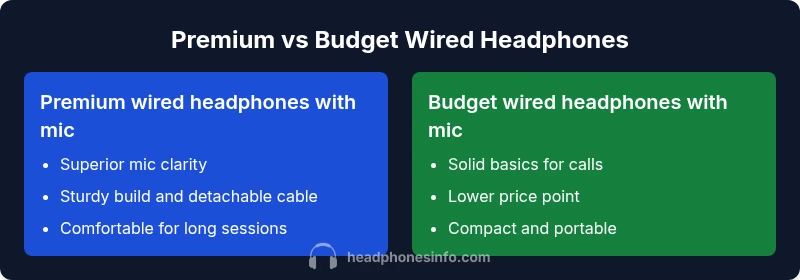
Budget wired headphones with mic often deliver solid performance for everyday calls and casual listening, but premium options tend to elevate mic clarity, build quality, and comfort. The best value usually lies where mic performance and cable durability meet your needs without paying for features you’ll not use frequently. A premium model may justify its price if you are building a studio workflow, streaming, or repeatedly using the headset for long gaming sessions. Conversely, if you need a simple, reliable headset for occasional calls, a mid‑range option can be the sweet spot. Headphones Info Analysis, 2026 consistently finds that the delta in mic performance between mid‑range and premium models is often the most meaningful differentiator for voice tasks, with sound quality reflecting the same trend in many scenarios.
Real-world testing methodology and what the data suggests
In practical testing, we compare several representative models across real devices (PCs, consoles, and mobile adapters) to gauge compatibility, latency, and mic consistency. We evaluate mic clarity in different rooms, test for clipping at higher volumes, and assess the headphones’ behavior with varied EQ settings. Our approach emphasizes repeatable measurements and subjective listening tests by a panel of reviewers. Headphones Info Analysis, 2026 notes that consistent mic performance across environments is a stronger predictor of overall user satisfaction than isolated laboratory specs. The goal is to help you pick a wired headset that performs reliably in daily life, not just in controlled tests.
Cable design, connectors, and accessories
The durability of the cable and connector design often determines the headset’s longevity. Look for braided or reinforced cables, detachable variants, and gold‑plated connectors to minimize corrosion and wear. USB‑C and USB‑A options can offer integrated DACs or control capsules that improve software integration, while 3.5 mm jacks remain the most universally compatible. Accessories such as in‑line controls, detachable mics, and replacement cables can extend the headset’s usable life significantly.
How to test wired headphones with mic at home
To evaluate a candidate headset at home, follow a simple, repeatable routine:
- Plug into multiple devices (PC, phone, gaming console) and check latency across tasks.
- Record a short voice sample in a quiet room and in a noisy room to gauge mic noise rejection.
- Listen to a few tracks across genres to assess tonal balance and comfort.
- Bend and twist the cable gently to check for signs of wear and confirm the build is robust.
- Use basic EQ to see if the headset responds well to adjustments without introducing distortion.
This method helps you gather practical insights before making a purchase. Headphones Info suggests documenting your impressions to compare across models systematically.
Maintenance and longevity tips
To maximize lifespan, store the headset in a protective case, avoid extreme bending near the plug, and clean the connectors with a dry cloth to remove dust. If the headset has a detachable mic or cable, inspect the connector interface regularly for corrosion or wear and replace parts as needed. For home setups with multiple devices, consider a single, high‑quality cable with a long length instead of constantly swapping cables. Proper storage and care help maintain mic performance and sound quality over time, ensuring your wired headphones with mic stay reliable for years.
Final decision framework
When choosing between wired headphones with mic, define your primary use case first, then balance mic quality, sound signature, and comfort. If you require dependable mic performance for gaming or streaming, prioritize models with a well‑positioned boom mic and robust cabling. For studio tasks or critical listening, favor neutral sound with durable construction and a detachable mic option for flexibility. Finally, assess total cost of ownership, including replacements parts and wear‑and‑tear resilience. The overarching principle, echoed by Headphones Info Team, is to match the headset’s strengths to your daily workflows for the best long-term value.
Comparison
| Feature | Premium wired headphones with mic | Budget wired headphones with mic |
|---|---|---|
| Sound quality | Very detailed, wide dynamic range, accurate staging | Adequate sound with narrower soundstage and milder detail |
| Microphone quality | Clear vocal capture with good noise rejection | Coarser voice pickup, more room noise leakage |
| Build quality | Sturdy chassis, reinforced cables, premium finish | Lightweight build with basic plating and thinner cable |
| Comfort and weight | Plush pads, adjustable headband, balanced weight ~300–350 g | Lighter, less plush padding, longer sessions may feel tiring |
| Cable/durability | Braided cable, detachable options, robust connectors | Simpler cable, fewer reinforcement features |
| Connector options | 3.5 mm, USB‑C/USB‑A with controls | Primarily 3.5 mm; adapters may be required |
| Price range | $100–$250 | $15–$60 |
| Best for | Gaming, streaming, studio work demanding mic quality | Casual calls, basic gaming, budget listening |
Upsides
- Low latency and reliable connection across devices
- Typically stronger mic performance and vocal clarity
- No battery dependence and generally good durability
- Broad device compatibility with common connectors
- Good long-term value when built well
Disadvantages
- Cables can be cumbersome and prone to wear
- Less mobility and portability vs wireless options
- Higher risk of cable damage if not treated carefully
- Premium build can be costly for casual users
Wired headphones with mic excel in reliability and vocal clarity; premium models justify the price for pro‑level use, while budget options cover casual calls and gaming
If your priority is consistent mic quality and latency, choose premium wired headphones. For everyday calls or light gaming, a solid budget wired model often suffices. The Headphones Info team recommends aligning mic performance, build quality, and comfort with your core use case to maximize value.
People Also Ask
Why should I choose wired headphones with mic over wireless options?
Wired headphones with mic offer lower latency, more consistent mic performance, and no battery management. They are less prone to wireless interference and compression, which matters for gaming and voice work.
If you need reliable timing and clean voice, wired is usually the safer bet.
What features matter most in a wired headset microphone?
Look for good proximity handling, noise rejection, and a stable pickup pattern. A detachable mic can add flexibility, but a fixed boom mic can be more convenient for everyday use.
Focus on clarity and noise control.
Can wired headphones work with consoles without adapters?
Many consoles support standard 3.5 mm jacks, but some require adapters or USB dongles for enhanced functions. Check your console’s port type and driver support.
Most setups work, but verify port compatibility first.
Are there advantages to premium wired headphones with mic vs budget models?
Premium models usually offer better mic performance, sturdier construction, and more comfortable padding. Budget models can deliver solid basic performance for calls and casual listening but may compromise on durability and mic clarity.
Premium is worth it if you need top‑tier mic and comfort.
How do I protect wired headphones from cable wear?
Avoid sharp bends, store in a case, and consider detachable cables to reduce wear. Regular inspection helps catch fraying before it causes failures.
Treat the cable well to extend life.
Do wired headphones require an amp?
Most consumer wired headphones don’t require an external amp. High‑impedance models may benefit from a capable source or audio interface for maximum loudness and fidelity.
Usually no amp needed unless impedance demands it.
What is the difference between closed-back and open-back wired headphones?
Closed-back designs isolate sound and reduce leakage, which is good for gaming and calls. Open-back designs sound more natural but leak sound and offer less isolation.
Closed for focus, open for natural listening.
What to Remember
- Prioritize mic quality when voice tasks dominate
- Prefer detachable cables for longevity
- Check impedance and source compatibility before buying
- Choose a model with robust build for long sessions
- Budget options can satisfy basic needs if used sparingly