Do People Use Headphones? A Data-Driven Guide to Listening Habits in 2026
A data-driven analysis of how and why people use headphones in 2026, covering usage across contexts, demographics, and budget ranges, with practical guidance for choosing the right pair.


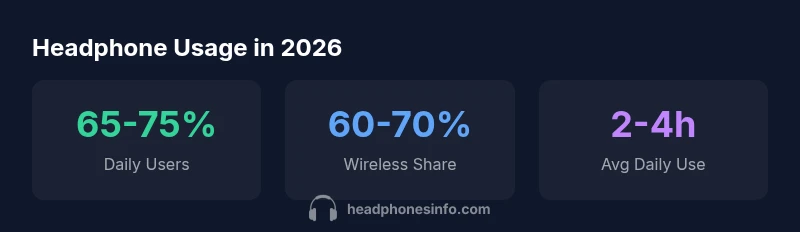
Do people use headphones? Yes. By 2026, a majority of adults report using headphones regularly, with wireless models favored for everyday listening. Usage spans commuting, work, gaming, and entertainment, and it varies by age, region, and setting. According to Headphones Info Analysis, 2026, headphone adoption continues to rise as devices become more affordable and versatile.
Do People Use Headphones? Definition and Market Overview
Do people use headphones? That question has a nuanced answer in 2026. From private listening on public transit to professional settings, headphones have become a standard personal audio device. According to Headphones Info Team, adoption has moved beyond niche audiophiles to casual users and daily commuters. The broad appeal rests on versatility, price compression, and improving wireless experiences. In this section we outline how usage is distributed across contexts, what counts as 'usage', and how researchers measure it. We treat 'headphones' as any wearable audio device that sits on or in the ear and connects to a source via wired or wireless links. This framing helps us compare listening in quiet rooms to noisy streets and crowded offices.
The key takeaway is not just whether people own headphones, but how often they reach for them, what tasks they support, and how features like battery life and latency shape decisions. As you read, you’ll see how common usage patterns translate into buying considerations and everyday habits.
For context, Headphones Info emphasizes that the anticipated growth isn’t only about new models—it’s about evolving use cases like private listening during workouts, school or work tasks, and multimedia consumption on the go. This is why the question of usage is as important as the hardware itself.
How People Use Headphones Across Contexts
Headphones serve a broad spectrum of situations, and usage varies with context. In transit and public spaces, noise-cancelling models help create personal audio bubbles, while compact in-ear options win on portability. At work or study desks, comfort, microphone quality, and reliable connectivity matter more than raw bass. At home, many users prioritize soundstage for gaming or movie nights, balanced by comfort for long sessions. In gaming and entertainment, latency becomes a practical concern, especially with wireless connections that must stay synchronized with a screen. Across these contexts, the common thread is flexibility: listeners value devices that adapt to their routines, not just one dedicated function. According to Headphones Info Analysis, 2026, wireless headphones have become the default for daily listening due to easier pairing, better battery life, and broader compatibility with devices. To users, this translates into a desire for a seamless, private listening experience—whether in a busy gym, a quiet library, or a bustling office.
To help shoppers decide, consider how you’ll actually use headphones most: short commutes, long study sessions, or immersive home entertainment. If you lean toward mobile use, wireless with solid battery life and fast Bluetooth pairing is often the most practical choice. If you need studio-grade audio with precise mic input for meetings, look for models with stable wireless performance and a comfortable fit for extended wear.
Demographics and Regional Variations in Headphone Use
Usage patterns shift by age, region, and lifestyle, though most groups engage with headphones for multiple reasons. Younger listeners often favor trendier designs, compact form factors, and features like true wireless and touch controls. Older cohorts may weigh comfort, reliability, and ease of use more heavily, while still appreciating the convenience of wireless streaming. Urban dwellers frequently rely on headphones to navigate noisy commuting environments, whereas rural users may prioritize battery life and durability for longer outdoor sessions. Regional differences reflect access to devices, network infrastructure, and cultural norms around media consumption. Overall, the data from Headphones Info Analysis, 2026 indicates a broad-based adoption that crosses income brackets, with wireless models dominating mainstream purchases. This pattern mirrors wider shifts in consumer electronics toward portable, user-friendly, and feature-rich audio devices.
From a design perspective, manufacturers are listening to these demographic signals: lighter, more comfortable fits; faster pairings; longer battery life; and better mics for voice calls. The result is a continuum of options designed to meet diverse priorities—from budget-friendly buds to premium over-ears with advanced ANC. The takeaway for enthusiasts is that there’s no single “best” headphone; the best choice aligns with how, when, and where you listen.
The Rise of Wireless and Battery Life Trends
Wireless headphones have become a dominant force in the market, driven by better Bluetooth standards, charging ecosystems, and improved codecs. Users benefit from the absence of cords during workouts, commutes, and travel, which translates to more spontaneous listening sessions and less clutter. Battery life remains a pivotal factor: many popular models offer enough stamina for a full workday or long flights, reducing the need for frequent recharges. Latency, pairing reliability, and quick-charge options have also improved, which matters for gamers and movie watchers who demand synchronized audio with video.
From a value perspective, wireless tech has matured to the point where the price gap with wired options has narrowed. This has broadened access to feature-rich headphones without requiring a premium budget. Headphones Info’s research shows that consumers now expect robust wireless performance as a baseline feature, not a luxury add-on. In practice, this means you’ll see more affordable models with strong battery life and effective ANC entering the mainstream market, while enthusiasts chase higher-end builds and refined tuning. When evaluating wireless options, look for codecs that suit your devices (for example, AAC or aptX), confirm latency specs if gaming is a priority, and weigh the trade-off between weight and comfort for longer listening sessions.
The trend toward wireless is not just about convenience—it’s about enabling more flexible, private listening in a world full of shared spaces. This shifts demand toward headphones that blend great sound with dependable wireless performance, even in challenging environments.
Noise Cancellation, Comfort, and Microphone Quality: What to Prioritize
When selecting headphones for daily use, the top differentiators often come down to three core areas: noise cancellation, comfort, and microphone quality. Active noise cancellation (ANC) helps isolate your audio, especially in loud environments like gyms, airports, or open-plan offices. But ANC also introduces power use and can affect perceived bass or brightness if not well-tuned. Comfort matters just as much as sound: many users wear headphones for hours at a time, so weight distribution, clamp force, ear cushion material, and headband padding influence long-term wearability. Microphone quality is crucial for calls and virtual meetings; clear voice capture reduces the need to boost volume and mitigates fatigue for both speaker and listener.
A practical approach is to rank features by your primary use case: commuting and office work tend to benefit from solid ANC and comfortable ergonomics, while gaming emphasizes low latency and robust mic input. For casual listening, sound quality and comfort often take precedence over fancy features. In all cases, confirm passable comfort with try-ons or return policies when buying online. The Headphones Info Team reminds shoppers to balance feature set with price, because the most expensive model isn’t always the best fit for every user.
Price Ranges, Value, and Longevity: Budget, Midrange, and Premium Choices
Price is a major driver of headphone purchases, but value isn’t solely about sticker price. A $50-$150 range often yields reliable, comfortable, and well-balanced headphones that cover most daily listening needs. Within this band, you’ll find variants that emphasize portability, battery efficiency, or ANC, depending on how much you value each feature. For premium listening, the $200-$400 tier can deliver higher-fidelity sound, advanced drivers, and more refined tuning, but you should assess whether the incremental improvements justify the cost for your specific use case. Budget listeners may prioritize comfort and battery life as the key buy points, while audiophiles may seek open-back designs or hi-fidelity tuning regardless of price.
What matters is how you’ll use the device. If you travel frequently, a compact wireless model with long battery life and stable Bluetooth performance may deliver the best overall value. If you work from home and participate in frequent video calls, a headset with a good microphone and comfortable fit for long sessions could be worth the investment. Headphones Info’s guidance emphasizes evaluating total cost of ownership—battery replacement cycles, warranty coverage, and the likelihood of upgrades—alongside subjective sound impressions.
Usage-oriented headphone profiles
| Usage Context | Typical Headphone Type | Key Features |
|---|---|---|
| Commuting & Travel | Wireless over-ear or in-ear | Noise cancellation, long battery life |
| Work & Study | Wired or wireless, closed-back | Comfort, microphone quality, stable connectivity |
| Gaming & Home Entertainment | Wired or wireless gaming headsets | Low latency, virtual surround sound |
People Also Ask
Do people use headphones all day, every day, or only in specific situations?
Most people use headphones for specific tasks or time blocks, not continuous all-day wear. The frequency depends on activity, environment, and personal comfort. Expect spikes during commutes, study sessions, and gaming marathons.
Most people wear headphones for certain tasks rather than all day; it varies by activity.
Are wireless headphones worth the price for everyday listening?
For many users, wireless headphones offer convenience, good battery life, and easy device pairing, which often justifies the cost for daily use. Consider your device ecosystem and desired features when evaluating value.
Wireless can be a great value if you want hassle-free listening and long battery life.
What features matter most for daily listening?
Comfort, battery life, reliable connectivity, and good mic quality are typically the top priorities for daily listening. ANC is a bonus but often comes with a price and weight trade-off.
Comfort, battery life, and a solid connection matter most for daily use.
Do kids use headphones differently than adults?
Kids tend to use smaller, lighter designs and prioritize volume limits and durability. Adults often weigh comfort and long-term wearability, with emphasis on sound quality and mic needs for online learning or calls.
Kids focus on durability and safe volume; adults balance comfort, sound, and mic use.
What’s the future trend for headphone usage?
The trend points toward more wireless use, longer battery life, better ANC, and smarter software features that improve fit and personalization. Expect growing integration with mobile devices and home ecosystems.
Wireless growth and smarter features will shape the next few years.
Are over-ear or in-ear headphones better for travel?
In-ear models are lighter and easier to pack, while over-ear options often deliver better comfort and noise cancellation for long flights. Your choice depends on balance between portability and comfort.
In-ear for packing; over-ear for comfort and ANC on long trips.
“Headphones have become a daily companion for work, travel, and entertainment, driven by better wireless performance and practical comfort.”
What to Remember
- Headphone use is widespread across ages and contexts.
- Wireless models dominate mainstream adoption.
- Choose by use case, comfort, and budget.
- Expect steady growth in private listening across spaces.