Truly Wireless Earbuds: A Data-Driven Comparison
A data-driven comparison of truly wireless earbuds, covering fit, sound quality, ANC, battery life, latency, and value to help you choose confidently.


Truly wireless earbuds offer freedom from wires with compact cases and Bluetooth connections. For most shoppers, mid-range models with reliable fit, solid battery life, and effective ANC deliver the best value. Premium models excel in sound details and features but cost more; your best pick depends on how you balance audio quality, isolation, and budget.
Why truly wireless earbuds matter in modern audio
Truly wireless earbuds have transformed how people listen on the go, whether commuting, working out, or taking calls. The Headphones Info team found that the best options blend comfort, reliable Bluetooth performance, and usable battery life with effective noise control. In practice, they deliver a compact listening experience that can rival larger over-ear models for many tasks. The real value comes from models that stay comfortable for long sessions, pair quickly with devices, and maintain consistent audio across environments. For audiophiles and casual listeners alike, the appeal rests in the balance between convenience and sound quality. As the market matures in 2026, you can expect tighter integration with smartphones, improved codecs, and smarter adaptive features that adjust to your surroundings.
Key criteria for comparing true wireless earbuds
When evaluating truly wireless earbuds, there are several criteria that consistently separate good from great. First, comfort and fit: a secure seal and light weight prevent fatigue during long listening sessions. Second, sound quality: look for a balanced signature with clear mids and controlled bass, plus a predictable response across genres. Third, active noise cancellation (ANC) and transparency modes: effective ANC reduces ambient noise, while transparency keeps you aware of your surroundings. Fourth, battery life and charging: per-earbud life matters, but the case should provide multiple charges. Fifth, latency and connectivity: low latency matters for gaming or video watching, while reliable pairing matters for calls. Sixth, durability and water resistance: sweat resistance is important for workouts and daily use. Finally, firmware updates and app support can extend features over time. Headphones Info analysis shows that the best value typically lies in models that deliver consistent performance across these criteria.
How to read specs and avoid marketing fluff
Marketing teams often highlight peak numbers that aren’t representative of daily use. To cut through the noise, compare real-world metrics and independent tests instead of claimed maxima. Start with battery life in typical listening scenarios (mixed music and calls) and check queue management in the app, EQ options, and codec support. Look for information about sudden drops in volume, frequency response consistency, and how ANC behaves with voice assistants active. Also consider fit-related metrics like ear tip options and the ability to wear with glasses or during workouts. In all cases, verify compatibility with your device ecosystem and whether the earbuds support convenient features such as multipoint pairing. This is where Headphones Info’s method—balancing ambition with practicality—helps buyers avoid overpaying for marketing gloss.
Fit and comfort: ergonomic design and seal
Comfort is a personal factor, yet there are common design themes that improve fit. Ear tips in multiple sizes, wing or stability fins, or a smaller housing can reduce pressure on the outer ear. A secure fit also improves passive isolation, which reduces the reliance on high ANC power and preserves battery life. For many users, lighter shells paired with silicone tips offer the best balance between seal and comfort. If you wear glasses or have active lifestyles, consider open-fit designs or models with adjustable tips and stabilizers. Remember that a good seal enhances bass perception and clarity, making long listening sessions more enjoyable. Headphones Info recommends trying several sizes and, when possible, testing in-store with your typical listening volume.
Sound quality and codecs: what to expect
Sound quality in truly wireless earbuds varies with driver size, tuning, and codec support. Look for a balanced soundstage, clean treble, and controlled bass without overpowering mids. Important codecs include AAC, SBC, and aptX or LDAC where available; these codecs influence latency and impedance handling. Real-world listening is influenced by driver technology, impedance matching, and the phone’s DAC. For casual listeners, a natural neutral profile is often preferred, while audiophiles may seek a warmer or more detailed signature. The Headphones Info team notes that codec choice matters most when streaming high-fidelity sources or using Apple devices with AAC optimization.
Noise cancellation and transparency: how it works
ANC performance depends on microphone quality, processing algorithms, and seal quality. Mid-range earbuds typically offer effective ANC for consistent environments like offices or planes, while premium models may suppress more low-frequency rumble. Transparency mode lets you hear surrounding sounds without removing the earbuds, which is handy for safety and quick conversations. When evaluating ANC, test with consistent background noise—air conditioning is a good baseline—and listen for any hiss or pressure sensation. Comfort and seal influence how well ANC performs; a better seal can allow the software to suppress noise more effectively without increasing driver pressure.
Battery life and charging: real-world expectations
Battery life varies by model and usage, including volume, ANC, and phone connection. In practice, most mid-range true wireless earbuds offer around 5–6 hours per charge with ANC enabled, plus the case for 2–3 full additional charges. Premium models may stretch to longer per-charge lifespans, but gains depend on trade-offs in weight, size, or case design. Charging cases commonly use USB-C and, increasingly, wireless charging. For daily commuting or workouts, prioritize total daily use rather than peak per-earbud figures. Efficient drivers, smart power management, and adaptive ANC contribute to longer endurance in real-world listening.
Connectivity, latency, and pairings
Stable Bluetooth connectivity and low latency are crucial for calls and video watching. Modern true wireless earbuds typically rely on Bluetooth 5.x or newer, with multipoint pairing that lets you switch between devices smoothly. Latency is more noticeable in cheap models, particularly when watching videos or playing games; premium models tend to keep latency within a comfortable range. Firmware updates can improve performance over time, so choose brands that offer reliable update support. A good pairing experience reduces drops and re-pairing, which saves time and ensures you stay in the flow whether on a call or during workouts.
Durability and water resistance for daily use
Daily life involves sweat, rain, and accidental splashes. Look for IP-rated resistance appropriate to your activity, at least IPX4 for workouts, and higher if you expose earbuds to moisture regularly. Robust build quality should extend to the charging case and hinges. Wireless earbuds should also resist wear from pocketing, headphones cables, and handling during commute. Real-world tests emphasize that water resistance should not be an excuse for neglect; proper care and storage extend the life of the devices. Brand-backed warranties and service options can also influence long-term value.
How to choose by use case: commute, workouts, home office
Your primary use case should guide your priority list. For commutes, a secure fit, reliable ANC, and call clarity matter most. For workouts, sweat resistance, secure fit, and durable cases are essential. For the home office, latency, multipoint stability, and voice pickup quality take precedence. If you listen at moderate volumes and value portability, mid-range models with solid ANC and a comfortable fit typically deliver the best balance of price and performance. If you crave ultimate audio detail, look to premium models with refined tuning, higher-fidelity codecs, and richer feature sets.
Testing tips before you buy: demos and trials
Whenever possible, test earbuds with your usual listening material and devices. Bring a favorite playlist and a few call scenarios to gauge mic performance. Check for comfort in both ears and during long listening sessions. If you’re shopping online, look for generous return windows and comprehensive reviews that test real-world use, not just specifications. Consider using trial or in-store demos to evaluate fit, ANC, and latency over several days. Headphones Info suggests focusing on a few key metrics: fit, comfort, ANC effectiveness, battery life, and the perceived sound signature across genres.
The verdict for different budgets
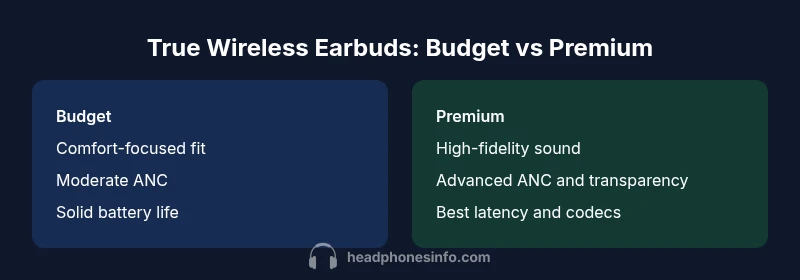
Budget-minded shoppers should prioritize a secure fit, dependable Bluetooth connection, and usable ANC rather than chasing peak specs. Mid-range models often deliver the best value, combining solid sound with practical features like multipoint pairing and good battery life. For enthusiasts who value fidelity and feature depth, premium true wireless earbuds provide higher-fidelity audio, tunable EQ, and advanced ANC, at a higher price. Always weigh price against expected daily use and long-term durability; the right choice aligns with your listening habits, environment, and budget.
Comparison
| Feature | Budget true wireless earbuds | Premium true wireless earbuds |
|---|---|---|
| Battery life per charge | mid-range | long-range |
| Charging case/charging options | standard USB-C case | USB-C with higher-capacity/optional wireless |
| Active Noise Cancellation (ANC) | absent/limited | present/high |
| Sound signature emphasis | neutral to bright | rich/broad with deeper bass |
| Fit and comfort options | basic tips, single size | multiple tips + fins |
| Connectivity | basic Bluetooth 5.x | advanced Bluetooth 5.x + multipoint |
| Durability/water resistance | standard sweat resistance | enhanced water/dust resistance |
| Price tier | budget-range | premium-range |
Upsides
- No wires for everyday portability
- Compact charging case fits in pockets
- Quick device switching with multipoint pairing
- Wide availability across brands and price points
- Easier to replace or upgrade than wired options
Disadvantages
- Quality varies more widely by price range
- Battery life per charge can be shorter than wired headphones
- Price premium for top-tier features and fit options
- Latency can be noticeable on cheaper models
Mid-range true wireless earbuds deliver the best balance of value and performance
Choose mid-range for everyday use with solid ANC and fit. Upgrade to premium if you prioritize sound fidelity and advanced features, and you’re willing to pay more for them.
People Also Ask
What are truly wireless earbuds?
Truly wireless earbuds are wireless earbuds that have no cords linking the two earpieces. They connect to devices via Bluetooth and rely on a compact charging case for power. This design emphasizes portability and convenience, with many models offering active noise cancellation, multipoint pairing, and app-based customization.
Truly wireless earbuds are two separate earpieces, no cable between them, connected by Bluetooth to your phone. They come with a small charging case for power and often include features like ANC and apps for adjustments.
Do all truly wireless earbuds have ANC?
Not all truly wireless earbuds include ANC. Entry-level models often skip ANC or offer basic isolation. If you want strong noise reduction, look for models advertised with active noise cancellation and check independent reviews for real-world performance.
Not every pair has ANC. If you want noise cancellation, check the specs and read reviews to confirm how well it works in typical environments.
Which codecs matter most for wireless earbuds?
Key codecs include AAC and SBC, with some premium models supporting aptX or LDAC for higher fidelity. The codec choice affects latency and audio quality; choose based on your device ecosystem and listening priorities.
AAC and SBC are common; premium models may add aptX or LDAC for better audio, especially if your device supports them.
How should I test fit before buying?
Try multiple ear tip sizes and ensure the earbuds stay secure during your typical activities. Move your head, walk, and jog while wearing them to check comfort and seal. If possible, use a store demo or extended return window to evaluate fit over several days.
Test different tips and try moving around—you want a secure fit that stays comfortable during daily use.
Are earbuds durable enough for workouts?
Yes, many truly wireless earbuds offer sweat resistance and some degree of water resistance. For workouts, prioritize IP-rated protection, a secure fit, and a robust charging case. Regular cleaning helps maintain seal and performance.
Most are sweat resistant, but check the IP rating and ensure a secure fit for workouts.
How do I choose between mid-range and premium models?
Mid-range models usually deliver solid sound, reliable ANC, and good battery life at a reasonable price. Premium models add finer detail, wider soundstage, customizable EQ, and stronger ANC. Your decision should hinge on how much you value audio fidelity and advanced features versus budget.
Mid-range gives great value; premium adds finer sound and features if you’re willing to pay more.
What to Remember
- Prioritize fit and comfort before features
- Test ANC and transparency in real environments
- Balance battery life with case capacity for your use case
- Consider codec support and latency for video/games
- Value matters: mid-range often beats high-priced hype