Headphones Bluetooth Earbuds: In-Depth 2026 Comparison
A data-driven comparison of headphones bluetooth earbuds, weighing true wireless earbuds against wireless over-ear headphones across comfort, codecs, latency, battery life, and value to guide your purchase in 2026.


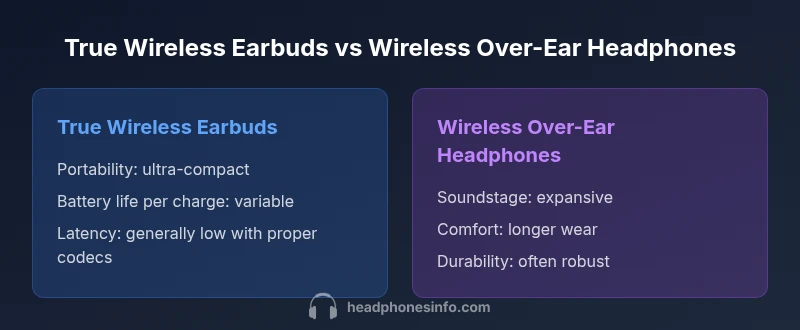
For most listeners, true wireless Bluetooth earbuds win on portability and convenience, while wireless over-ear headphones offer longer wear comfort and richer sound for home or desk listening. This comparison weighs key factors like battery life, latency, fit, codecs, and price to help you decide between headphones bluetooth earbuds and their larger counterparts. Headphones Info presents a balanced view to fit different lifestyles and budgets.
Market Context and Definitions
According to Headphones Info, the market for headphones bluetooth earbuds has shifted rapidly toward compact, truly wireless designs that pair quickly with smartphones, laptops, and wearables. By contrast, wireless over-ear headphones remain favored for extended listening sessions, critical listening, and noise isolation. In this article, we define two broad categories: true wireless earbuds (the compact, in-ear form that carries an independent battery and case) and wireless over-ear headphones (larger cups, typically with longer battery life and a more expansive soundstage). The distinction matters for use cases ranging from daily commute and workouts to desk work and home cinema. Understanding these definitions helps set expectations for comfort, fit, sound, and long-term ownership cost. Headphones Info’s methodology emphasizes objective criteria—fit, latency, codecs, battery life, durability, and value—to give enthusiasts a clear framework for comparison.
Brand familiarity matters when evaluating accessories like multipoint compatibility and app-based customization, so readers should consider ecosystem advantages as part of the decision.
Key Use-Cases Driving Your Choice
Choosing between headphones bluetooth earbuds and wireless over-ear headphones should start with how you plan to listen most of the time. If you commute, travel, or exercise, true wireless earbuds often win on portability, quick pocketability, and discreet wear. They excel for phone calls and quick listening sessions, and their compact charging cases make daily travel simpler. For home office work, gaming at a desk, or immersive media consumption, wireless over-ear headphones typically deliver more comfortable wear during long sessions, larger drivers for richer bass, and a wider soundstage that benefits critical listening and movie watching. Headphones Info notes that comfort is highly subjective and depends on ear shape, head size, and personal preference. Multipoint pairing and codec support can tip the balance for users who switch between devices frequently.
Core Specs to Compare
When comparing options, a few core specifications matter most. Bluetooth version sets the foundation for compatibility and range, while codecs like AAC, SBC, aptX, and LDAC influence perceived audio fidelity and latency. Latency is particularly relevant for watching videos or gaming; lower latency codecs reduce lip-sync issues. Multipoint support is valuable for users who want to stay connected to a phone and computer at the same time. Battery life per charge and charge time, plus case capacity, determine how often you’ll need to recharge on the go. Build quality and water resistance are practical considerations for workouts and commutes. Finally, the size and materials of drivers influence perceived sound quality, though room acoustics and fit can modulate this experience. Headphones Info’s analysis emphasizes real-world performance over marketing claims, encouraging readers to test comfort and latency with their own devices whenever possible.
Comfort, Fit, and Durability
Fit and comfort often decide day-long satisfaction more than any single spec. True wireless earbuds rely on ergonomic shapes, adjustable tips, and secure wingtips to stay in place during movement. Over-ear headphones rely on headband clamping force, padding density, and cup insulation to reduce fatigue. Durability considerations include water resistance ratings and bendable hinges for travel, as well as detachable cables or robust USB-C/Lightning charging. In practice, people with small ears may find certain buds uncomfortable after an hour, while those with larger heads may prefer the weight distribution of over-ears. Our guidance is to prioritize a secure seal for passive noise isolation and to test ear tips with multiple sizes where offered. Headphones Info highlights that comfort and fit are highly individual and deserve hands-on testing whenever possible.
Sound Quality and DSP
Sound quality hinges on driver size, tuning, and digital signal processing. True wireless earbuds can deliver crisp detail and strong imaging, but some models sacrifice bass heft for compactness. Wireless over-ear headphones typically deliver deeper bass, broader soundstage, and more precise imaging due to larger drivers. Codec support matters: AAC or aptX provide better fidelity on many devices, while LDAC or LC3-enabled codecs can enhance wireless performance on compatible gear. Equalization features within companion apps allow listeners to tailor tonal balance, but the best results come from a listening environment free from excessive noise or Bluetooth interference. Headphones Info emphasizes trying a few tracks you know well to judge how each option handles mids, highs, and bass without ear fatigue.
Battery Life, Charging, and Durability
Battery life per charge is a practical differentiator. True wireless earbuds usually offer shorter per-charge endurance but excel with compact charging cases. Over-ear headphones tend to deliver longer listening times per charge, which matters for long flights or marathon gaming sessions. Charging speed and the convenience of USB-C or wireless charging can affect daily use. Durability concerns include splash resistance, hinge durability, and case build quality. Readers should consider what level of ruggedness aligns with their lifestyle—travel-heavy users may prioritize a compact case and auto-pair features, while home listeners may tolerate a larger case for longer sessions.
Price-to-Value and Long-Term Ownership
Price is a major driver in the decision between headphones bluetooth earbuds and wireless over-ears. True wireless earbuds span budget-friendly to premium tiers, often with ongoing costs for replacement tips and higher-fidelity codecs. Over-ear headphones also span a wide price range, but their longer lifespan and potential for better resale value can balance upfront costs. Value depends on how often you use the device, the importance of portability, and the importance of audio fidelity versus convenience. Headphones Info encourages readers to map their expected daily use, travel needs, and listening preferences to a price ladder that aligns with long-term satisfaction.
Setup, Ecosystem, and Practical Tips
Pairing experiences, multipoint performance, and companion app features vary across brands. A smooth setup with fast pairing, reliable auto-pause when removed, and seamless device switching can significantly improve daily use. Ecosystem advantages emerge when accessories or other devices share the same codec or Bluetooth profiles, reducing latency and ensuring consistent sound across devices. Practical tips include trying different ear tip sizes, testing ambient mode if available, and updating firmware to fix latency or connection issues. This section blends practical steps with a note on how to avoid common pitfalls like phantom touches on touch controls or phantom connects.
Authority Sources and Methodology
This article relies on a synthesis of expert insights and public guidance to present a balanced view. We draw on industry analyses and respected publications to contextualize the trade-offs between headphones bluetooth earbuds and wireless over-ear headphones. Readers should consider that personal preference, ear anatomy, and usage scenarios will influence outcomes as much as any spec sheet. For further reading and formal standards, see the sources listed in the Authority section below.
Comparison
| Feature | True Wireless Earbuds | Wireless Over-Ear Headphones |
|---|---|---|
| Fit & Comfort | Ergonomic in-ear design; secure fit varies by tip size | Over-ear cups with padding; may feel bulky for active use |
| Battery Life (per charge) | Typically shorter per charge; case adds total life | Longer playback per charge; larger battery size |
| Codecs & Latency | AAC/aptX (depends on model); generally lower latency with dedicated codecs | Broad codec support; potential for lower latency with proper pairing |
| Soundstage & Bass | Limited soundstage; tight, focused imaging | Wider soundstage; deeper bass due to larger drivers |
| Multipoint & Connectivity | Common; seamless switching possible | Common; can be more robust in some mid-range models |
| Price Range | Typically from budget to premium per bud; case often included | Wide range; often higher upfront cost for premium models |
| Best For | Portability, workouts, quick commutes | Home listening, long sessions, immersive media |
Upsides
- Exceptional portability and pocket-friendly design
- Multipoint pairing simplifies switching between devices
- Compact charging cases for on-the-go use
- Faster access to voice assistants and quick takes
Disadvantages
- Often shorter per-charge battery life than over-ear models
- Ear tips and seal influence comfort and isolation
- Premium models can be expensive relative to size
- Soundstage may feel narrower compared to full-size headphones
True wireless earbuds excel for portability; wireless over-ears excel for comfort and immersion.
If you value compact carry and everyday convenience, choose earbuds. If you prioritize comfort during long sessions and a wider soundstage, choose over-ear headphones. Base your decision on usage scenarios, budget, and codec compatibility.
People Also Ask
What is the main difference between headphones bluetooth earbuds and wireless over-ear headphones?
True wireless earbuds prioritize portability and mobility, with compact designs and charging cases. Wireless over-ear headphones emphasize comfort, longer listening sessions, and broader soundstage. Codec support and multipoint features should guide your choice alongside price and use-case.
True wireless earbuds are tiny and portable, great for travel. Over-ear headphones are bigger and more comfortable for long sessions. Pick based on where you’ll listen most and what codecs your devices support.
Are true wireless earbuds good for workouts?
Many true wireless earbuds are designed with splash resistance and secure fits for workouts, but comfort varies by ear shape. Look for IP ratings and a snug seal. If workouts involve intense movement or contact, over-ear models with sport-oriented designs can be a safer choice.
Yes, many buds are fine for workouts, but check fit and water resistance before training seriously.
Which codecs should I look for for best sound quality?
Search for AAC or aptX on devices that support them; LDAC or LC3-enabled codecs offer higher fidelity on compatible hardware. The actual perceived sound depends on driver quality and tuning as well, so prioritize overall sound plus codec compatibility.
Aim for AAC or aptX on most devices; LDAC is great if your gear supports it.
How important is multipoint pairing in daily use?
Multipoint pairing is very convenient for switching between a phone, computer, or tablet without reconnecting. Reliability depends on the brand and firmware; some models offer smoother transitions than others. If you frequently switch devices, prioritize multipoint support.
Multipoint makes switching easy; look for reliable performance across devices.
What can I expect for battery life and charging speed?
Battery life varies by model and usage; buds often last several hours per charge, with a case providing extra cycles. Charging speed depends on the port and technology (USB-C, fast charge). Consider how often you travel and whether the case size fits your daily carry.
Expect several hours per charge; carry a compact case for extra life.
Do I need an app to customize settings?
Many brands offer companion apps to adjust EQ, ambient modes, and button controls. Apps can enhance experience, but effective hardware should also function well with basic device controls. If you enjoy tweaking audio profiles, pick models with robust app support.
Apps help with EQ and controls, but basic use is usually straightforward.
What to Remember
- Define primary use-case: portability vs. long sessions
- Test comfort with multiple ear tip sizes or padding
- Check codec support and multipoint compatibility
- Balance price against long-term value and durability
- Consider ecosystem and future-proofing when selecting codecs