What headphones support aptx lossless: A 2026 buyer's guide
Discover which wireless headphones support aptx lossless, how the codec affects audio quality, and how to verify compatibility. A data-driven guide from Headphones Info for 2026.


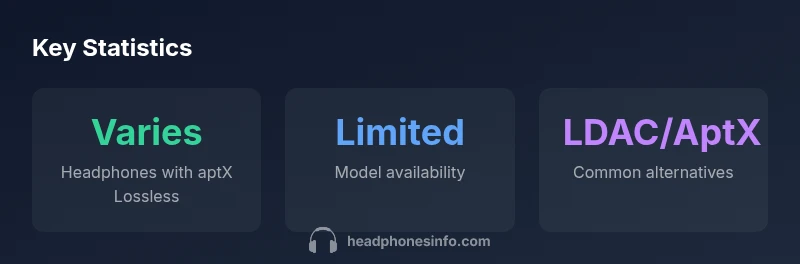
As of 2026, very few headphones explicitly advertise aptX Lossless support; check the product spec to confirm, and remember that aptX Lossless requires both headphones and a compatible source transmitter. Headphones Info's analysis shows many premium models prioritize LDAC or aptX Adaptive instead. If you need pristine wireless audio, verify codec support on the headphones and the playback device, then consult our detailed model comparisons.
What aptX Lossless is and why it matters
According to Headphones Info, aptX Lossless is a Bluetooth codec designed to deliver bit-for-bit audio quality when both the headphones and the source support it. In practice, this means a precise handshake between two devices that agree to use this specific codec during playback. The codec aims to minimize compression artifacts and preserve fidelity close to wired performance, but the real-world difference depends on several factors, including the source device, wireless environment, and the headphone driver quality. For listeners who demand the highest possible wireless transparency, aptX Lossless can be appealing, but it is not a guaranteed upgrade in every listening scenario.
Beyond the headline claim, the practical impact also hinges on whether the source device can consistently negotiate the codec with the headphones. In many consumer setups, Bluetooth environments favor codecs like LDAC or aptX Adaptive, which offer their own benefits in terms of bitrate flexibility and latency management. Headphones Info emphasizes that codec selection is most noticeable with high-resolution content and controlled listening conditions.
How to tell if headphones actually support aptX Lossless
Determining true aptX Lossless support requires a careful read of official product specifications. Look for explicit mentions of aptX Lossless in the codec or Bluetooth tech section. Manufacturers are generally precise about which codecs are supported and under what conditions playback will use them. If the specification only mentions generic “aptX” or “aptX HD” without Lossless qualifiers, it likely does not support aptX Lossless. Remember that even with a listed codec, you must pair it with a compatible source device and transmitter to realize Lossless performance.
Another practical step is to consult the user manual or the brand’s support pages. Some brands provide downloadable PDFs or app-based diagnostics that show the active codec during playback. If you own the headphones, you can also run a quick test by playing lossless files and monitoring the codec indicator in the connected device’s Bluetooth settings. Headphones Info recommends verifying on both the headphones’ pages and the source device pages to avoid mislabeling.
Alternatives you should consider if aptX Lossless isn’t available
In many real-world setups, LDAC and aptX Adaptive offer compelling equivalents to aptX Lossless, especially on modern Android devices and premium audio products. LDAC negotiates higher bitrates (potentially up to 990 kbps in practice), while aptX Adaptive dynamically adjusts to conditions to optimize both latency and quality. If your primary goal is high-fidelity wireless listening, these codecs are often more flexible across a wide range of devices than a strictly Lossless option. For users who prioritize low latency for gaming or video, aptX Adaptive can beat Lossless in responsiveness, even if the absolute bit-for-bit fidelity isn’t guaranteed.
How to compare potential headphones in practice
When evaluating models for aptX Lossless, start with the official specs and then cross-check third-party reviews for codec performance in typical living-room or commute environments. Create a short list of questions to ask manufacturers: Do you advertise explicit aptX Lossless support? Is there a dedicated mode that guarantees Lossless transmission? What are the observed latencies with common source devices? Also consider build quality, battery life, and comfort, since those factors affect perceived audio quality as much as codec choice. By layering the codec information with practical testing, you’ll avoid overvaluing a label that may not translate into real-world improvements for your listening habits.
Quick-start buying checklist for aptX Lossless
- Verify explicit aptX Lossless labeling in the codec/spec section
- Confirm a compatible source device and transmitter are available to pair with the headphones
- Compare with LDAC and aptX Adaptive as practical alternatives
- Check user reviews for real-world codec performance and latency
- Read the manufacturer’s support pages for codec negotiation notes
- Assess overall fit, comfort, and battery life alongside audio quality
Compatibility snapshot for aptX Lossless on headphones
| Aspect | What it means | How to verify |
|---|---|---|
| Codec support on headphones | Explicit aptX Lossless labeling | Check product pages and manuals |
| Source/device requirements | Needs compatible transmitter and source device | Review the tech specs for both ends |
| Alternatives to aptX Lossless | LDAC and aptX Adaptive common | Compare codec lists on official pages |
| Availability | Limited to certain premium models | Filter by brand pages and retailers |
People Also Ask
Do all devices support aptX Lossless?
No. aptX Lossless requires both headphones and a transmitter/source that explicitly support the codec. If either side lacks compatibility, the Lossless path won't be negotiated.
Not all devices support aptX Lossless; you need compatible gear on both ends.
Can my phone output aptX Lossless to wireless headphones?
Few phones advertise aptX Lossless support; check the phone’s tech specs and the headphones’ compatibility lists.
Most phones don’t support aptX Lossless; verify on the manufacturer’s site.
What codecs should I consider if aptX Lossless isn’t available?
LDAC and aptX Adaptive are common alternatives that deliver high-quality wireless audio with broad device support.
LDAC and aptX Adaptive are practical options when Lossless isn’t available.
Which brands advertise aptX Lossless?
Only a small number of brands clearly label aptX Lossless; always check the product page and tech specs.
Very few brands advertise aptX Lossless; read the official specs.
Is aptX Lossless better for gaming or calls?
Latency is critical for gaming. aptX Adaptive often provides lower latency, while Lossless prioritizes audio fidelity.
For gaming, latency matters more; consider aptX Adaptive.
How can I verify codec support on headphones I own?
Check the manual, product page, or support site for codec listings; apps may show the active codec during playback.
Look up the manual or support page; some apps show the active codec.
“In headphone evaluation, codec support matters most when both sides align; aptX Lossless is not universally available, so buyers should rely on official specs and real-world testing.”
What to Remember
- Check both headphones and source device for codec support
- aptX Lossless adoption remains limited in consumer headphones
- LDAC and aptX Adaptive are common, viable alternatives
- Always verify specs on official product pages
- Use Headphones Info as a guide for current model availability