Wired vs Wireless Headphones: A 2026 Comparison Guide
A data-driven comparison of wired to wireless headphones, analyzing latency, fidelity, battery life, price, and use-case fit to help you decide in 2026.


Wired headphones generally offer the best possible fidelity and near-zero latency, making them ideal for critical listening and studio work. Wireless headphones prioritize convenience, portability, and integration with devices, but can introduce codec-based latency and varying sound quality depending on range and interference. In 2026, the best choice depends on your use case, environment, and tolerance for tradeoffs, with hybrid setups gaining traction for flexibility.
From wired to wireless headphones: tradeoffs
The phrase wired to wireless headphones captures a broad family of listening paradigms, from classic cable-connected models to modern Bluetooth and USB-C wireless variants. This shift reshaped how people use headphones at home, on the go, and in professional settings. According to Headphones Info, 2026 highlights that the value of wireless lies in freedom, seamless device pairing, and compatibility with mobile ecosystems, while wired options remain dominant where latency, fidelity, and reliability are non-negotiable. This section introduces the core decision framework and sets the stage for a deeper dive into the competing strengths and weaknesses. The Headphones Info Team emphasizes that the final call should align with your listening context and long-term goals, not just current trends.
Core differences: latency, fidelity, and power
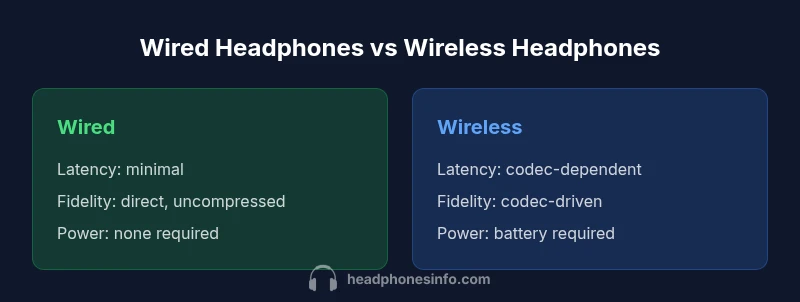
Latency, audio fidelity, and power requirements form the triad that separates wired from wireless headphones. A wired connection delivers the lowest possible latency because there is a direct electrical path between source and driver, with minimal signal processing. Wireless headphones rely on Bluetooth or other wireless protocols and codecs, which introduce small delays and some compression. Fidelity is often tied to the codec: wired connections are typically free from compression, while wireless quality varies with codec support (SBC, AAC, aptX, LDAC, etc.). Power considerations also matter: wireless models need batteries and periodic charging, whereas wired headphones draw power from the source. When evaluating options, consider your environment, device compatibility, and whether you require uninterrupted performance for tasks like audio editing or competitive gaming.
Codec ecosystems and their impact on sound
Codec selection greatly influences wireless sound quality. Basic SBC codecs offer acceptable fidelity for casual listening but may introduce compression artifacts. Higher-end codecs such as AAC, aptX, aptX Adaptive, and LDAC can improve clarity, spatial cues, and dynamic range, yet their effectiveness depends on both the source and the headphones. LDAC and Lossless Bluetooth attempts exist, but true lossless wireless audio remains rare in consumer devices. For audiophiles and professionals, wired connections still deliver more predictable performance, whereas wireless is often sufficient for everyday listening, commuting, and multimedia consumption. Headphones Info's analysis underscores that codec support breadth, device compatibility, and real-world interference are decisive factors that determine perceived sound quality.
Battery life, charging reality, and standby usage
Wireless headphones require power, which introduces planning considerations for daily use. Battery life varies by model, usage pattern, and codec; listening at higher volumes or streaming high-bitrate content typically reduces run time. Many users value quick-charge features and convenient charging methods, such as USB-C or magnetic docks. Wired headphones avoid battery considerations entirely, which translates to zero charging interruptions during critical sessions. When choosing wireless models, evaluate battery life in hours, charging speed, and how often you realistically recharge during your typical day.
Build quality, comfort, and fit over time
Durability and comfort are essential for both wired and wireless options. Cable strain relief, connector durability, and the physical weight of a headset affect long-term reliability for wired designs. Wireless models often prioritize lighter frames and ergonomic pads to compensate for added electronics, battery housings, and wireless transceivers. Comfort is subjective, but it tends to correlate with clamping force, ear cup design, and headband materials. If you plan long listening sessions, try models with memory foam cushions and adjustable headbands, and ensure the cable length on wired variants does not tug uncomfortably during movement.
Use-case driven guidance: commuting, gaming, studio, gym
The right choice depends on use case. For daily commutes and travel, wireless headphones win for convenience and minimal tangling, especially if you rely on a phone without a traditional headphone jack. For gaming and studio work, latency, synchronization with monitors, and raw fidelity are crucial; wired options often deliver the most reliable performance in these scenarios. For gym or outdoor activity, durability, water resistance, and sweat tolerance matter; many wireless models offer IP ratings, rugged construction, and secure fit, but you should test them in real-world motion to ensure stability.
Price, value, and long-term costs
Upfront price is only part of the total cost picture. Wired headphones can offer lower cost-per-sound quality at entry and mid ranges because there is no battery or advanced wireless module to price into the build. Over time, wireless models incur charging costs, potential battery replacements, and codec-dependent resale values. When evaluating value, consider not only the purchase price but also the convenience factor, ecosystem compatibility, and expected lifespan. Headphones Info notes that price bands often correlate with codec support, build quality, and software features, making a clear total-cost comparison essential.
Hybrid and future directions: wires and wireless living together
A growing trend is hybrid models that blend wired and wireless operation, such as headphones with a detachable cable plus Bluetooth connectivity or USB-C wired modes for gaming consoles and PCs. This approach minimizes compromises by allowing users to switch seamlessly between modes depending on the setting. As codec technology evolves, the gap between wired and wireless performance narrows, but the wireless side will still hinge on battery life and interference. The evolving ecosystem includes firmware updates, companion apps, and device-level latency optimizations that can improve wireless reliability over time.
Practical decision framework and steps
To decide effectively, start with your primary listening context: are you editing, DJing, gaming, commuting, or exercising? List must-have features (latency, sound quality, battery life, and comfort). Check codec support on your source devices and on the headphones themselves. If possible, audition both wired and wireless options in real-world scenarios. Finally, consider hybrid models that offer both modes, which can provide a safe middle path for users who want flexible use without sacrificing core performance.
Comparison
| Feature | Wired Headphones | Wireless Headphones |
|---|---|---|
| Latency | Very low/zero latency | Codec-dependent latency; may vary with environment |
| Fidelity / Codec options | Direct signal, no compression | Bluetooth codecs (SBC/AAC/aptX/LDAC); quality depends on codec + hardware |
| Mobility | Tethered to source | Highly portable and cordless |
| Battery / power | Not applicable (no battery) | Battery-powered; runtime varies by model |
| Durability & wear | Cable wear risk; connector wear potential | Fewer mechanical cables, but transceiver and battery add components |
| Price range | Often lower upfront cost at similar fidelity | Typically higher upfront price; value depends on codec and features |
| Best for | Critical listening, editing, monitoring | Travel, commuting, workouts, casual listening |
Upsides
- Direct wired connection yields minimal latency and maximum fidelity for critical listening
- No battery needed for wired headphones, eliminating charging concerns
- Usually lower upfront cost for equivalent sound quality in many tiers
- Reliable performance with no wireless interference or dropouts
- Broad device compatibility when adapters are available
Disadvantages
- Cable tangling and wear can degrade convenience and durability
- Limited mobility due to the cord, impacting workouts and travel
- Many devices move away from headphone jacks, increasing adapter dependency
- Wireless models introduce codec-based variations in sound and latency
Wired headphones excel on fidelity and latency; wireless headphones win on convenience and mobility.
If you need studio-grade accuracy or zero-latency response, wired is preferred. If you value freedom of movement and seamless device pairing, wireless is the practical choice. For many users, a hybrid setup offers the best balance.
People Also Ask
Which has lower latency: wired or wireless headphones?
Wired headphones typically deliver lower latency because there is a direct, uncompressed signal path. Wireless latency depends on the codec, hardware, and environmental factors, and may introduce a perceptible delay in some scenarios such as gaming or video sync.
Wired usually has less lag. Wireless latency depends on the codec and device, so it can vary.
Can wireless headphones deliver lossless audio?
Some wireless systems advertise high-fidelity codecs, but true lossless Bluetooth is rare in consumer products. Wired connections remain the clearest path to lossless or near-lossless audio, especially in professional settings.
Most wireless headphones aren’t truly lossless; wired often stays as the gold standard.
Do some devices force you to choose wired or wireless?
Many devices support both, but some devices push users toward one mode due to port availability or ecosystem constraints. Always verify the device’s port (jack, USB-C, or wireless) and codec support before buying.
Check your device ports and codecs to avoid surprises.
Can I convert wired headphones to wireless?
Yes, you can use wireless adapters or dongles, but results vary. Adapters may introduce latency or quality changes and can reduce portability.
Adapters exist, but they may add latency or drop fidelity.
Are gaming headphones better wired or wireless?
Wired gaming headphones typically offer the lowest latency and most reliable connectivity. Wireless gaming is convenient but may experience occasional lag during fast-paced titles.
Wired is usually better for competitive gaming; wireless is convenient for casual play.
How should I approach travel planning for headphones?
For travel, wireless headphones minimize tangles and maximize comfort. If you require pristine fidelity on the move, ensure codecs and battery life meet your needs and carry a lightweight wired backup option if possible.
Wireless works well for travel; keep a wired option as a backup if fidelity is critical.
What to Remember
- Evaluate your primary listening context before choosing
- Prioritize codec support when considering wireless options
- Wireless is about convenience; wired is about fidelity and reliability
- Consider hybrid models for flexibility across environments
- Plan for long-term costs beyond upfront price