Wireless Headphones Long Battery Life: A Buyer's Guide
Explore how to evaluate wireless headphones for long battery life with data-backed ranges, practical tips, and model comparisons to help you choose headphones that last all day.


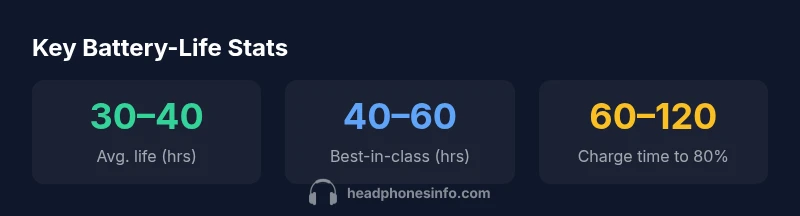
The typical wireless headset delivers 20–40 hours of playback per charge, with premium models reaching 45–60 hours under light use. Real-world life varies by features such as active noise cancellation, volume, and codec efficiency. For day-to-day use, target models in the 30–40 hour range for reliable, all-day listening. If you need steady performance for marathon travel or gaming, favor options with 40+ hours and quick-charge features.
Why wireless headphones long battery life matters
In the world of wireless listening, battery life is not just a convenience; it defines when you can enjoy music, podcasts, or calls without interruption. According to Headphones Info, a strong battery life is often the deciding factor for users who commute, travel, or rely on headphones for long workdays. This piece examines how manufacturers rate life, what you should expect in real-world use, and how to compare models without guessing from the box specs alone. For many listeners, the assurance of all-day comfort and reliability starts with understanding the trade-offs behind battery performance and feature sets. The focus here is on durable, practical guidance you can apply when you shop, test, and use wireless headphones long battery life in a typical day.
How battery life is measured and reported
Battery life claims come in two flavors: the manufacturer’s stated hours and real-world performance. Manufacturer ratings usually cover a specific set of conditions (e.g., moderate volume, ANC off, certain codec, no wind noise). In practice, listening volume, ongoing features like active noise cancellation, Bluetooth version, and even the codec can shorten life. Headphones Info Analysis, 2026, emphasizes that you should regard the official number as a baseline and expect lower results in strenuous scenarios. When you compare models, look for the margin between the rated hours and your typical usage. A 20–30% delta is common, depending on features.
Real-world factors that drain battery life
Real-world battery life rarely matches the spec sheet. Key factors include active noise cancellation (ANC) usage, maximum volume, codec efficiency (aptX Adaptive, LDAC, SBC), and whether you rely on features like transparency mode. External factors such as temperature and airflow also tax battery performance, especially in extreme climates. If you’re often listening at higher volumes, your headphones will burn through juice faster. Conversely, using a modest volume and turning off ANC when not needed can preserve life. Headphones Info’s research indicates that users who mix ANC on/off based on environment typically see a meaningful increase in usable hours across a workday.
Trade-offs: ANC, comfort, and battery life
A core tension in long-battery designs is balancing ANC effectiveness with longevity. Premium models that push battery life often rely on larger, heavier batteries or more efficient drivers to maintain sound quality. Some users prefer to disable ANC in situations requiring maximum battery life, while others value the quiet of ANC at the expense of a shorter day’s listening. If you want a blend of performance and endurance, seek models that offer adaptive ANC and an energy-saving mode. Headphones Info’s data suggests that moderate battery savings are achievable when you switch to a lower-power codec or disable features not needed in a given context.
How to compare battery life across models
Compare apples to apples by focusing on the same usage scenario: quiet listening at moderate volume with ANC off vs. full-featured usage with ANC on. When evaluating, check the official hours as a baseline, then read independent tests or user reviews that reflect your typical environment. For travelers and commuters, prioritize models offering 40+ hours in typical use, along with quick-charge capabilities. Real-world testing in-store or via home trials can help verify whether a model meets your daily needs. Headphones Info’s methodology relies on cross-model comparisons and consumer testing to present a more actionable battery profile.
Practical tips to extend wireless headphones long battery life
- Use adaptive ANC (or disable ANC when not necessary) to maximize endurance.
- Reduce volume to a moderate level; higher volumes dramatically reduce effective playback time.
- Choose codecs with energy efficiency in mind (e.g., SBC or modern low-power variants) when battery life is a priority.
- Leverage quick-charge options if you can recharge during brief breaks; even a short top-up can extend your day.
- Store and transport in a protective case to minimize battery degradation over time. Headphones Info’s practical tests show consistent gains when combining these practices.
Real-world scenarios and how to plan around battery life
A typical office worker may get 28–40 hours per week from a battery life-optimized pair, assuming daily commutes and mid-level usage. A traveler or gamer might demand 40–60 hours across several days, making a model with large battery capacity and fast charging more suitable. If you’re frequently charging mid-day, a model with 60–90 minutes to 80% can deliver surprising flexibility. The key is to map your typical week and then choose a model that comfortably exceeds those needs in the worst-case scenario. The Headphones Info team emphasizes aligning your expectations with real-world tests rather than relying solely on spec sheets.
Testing battery life before you buy
Whenever possible, test battery life under your own conditions: your volume level, your primary usage (music, calls, gaming), and the presence of ANC. If a store offers a battery-life demo, simulate your daily routines, including longer listening sessions, frequent pauses, and on/off cycling of ANC. Keep notes on how long you can go before recharging and whether quick-charge makes a meaningful difference for your schedule. This practical approach helps you pick a model that truly supports your everyday life, consistent with the Headphones Info Analysis, 2026 findings.
Estimated battery life across common headset categories
| Model Type | Real-World Battery Life (hours) | Charge Time (minutes) | Notes |
|---|---|---|---|
| Over-ear ANC | 25–40 | 60–90 | Common baseline life for midrange models |
| In-ear / On-ear | 18–28 | 45–70 | Typically shorter life due to smaller battery |
| Premium ANC models | 40–60 | 60–120 | Best-case battery life for premium tier |
People Also Ask
What is considered long battery life for wireless headphones?
Long battery life can mean 40+ hours of usable time in typical scenarios. Real-world performance varies with volume, ANC usage, and codec efficiency. Always test under your daily habits to confirm.
In practice, look for models offering 40 hours or more in typical use, and test them in your usual listening scenarios.
Do active noise cancellation and codecs affect battery life?
Yes. ANC generally reduces battery life because extra circuitry consumes power. Efficient codecs can also extend life by lowering power draw during streaming. Consider how you use these features when choosing.
ANC and codecs do affect battery life, so pick a model that fits how you listen most of the time.
How does Bluetooth version influence battery life?
Newer Bluetooth versions tend to optimize power use, but gains vary by chipset. In practice, models with modern Bluetooth plus good power management deliver longer life for similar use.
Modern Bluetooth helps save power, but you still want to test in your setup.
Can fast charging significantly extend daily use?
Fast charging can reduce downtime, allowing quick top-ups during the day. It doesn't multiply total battery life, but it can help you cover longer days without recharging between activities.
Yes, fast charging helps you refill quickly when you’re short on time.
Is battery life consistent across all use cases?
No. Battery life varies with volume, ANC, codec, and temperature. Expect longer life at moderate volumes with ANC off and shorter life with demanding features on.
No, it changes with how you use them, so test in your own setup.
What should I test in-store before buying?
Test listening time with your typical volume and activity, check how quickly they charge from near-empty, and verify if any power-saving modes affect playback when idle. Real-world trials are the best sanity check.
Test listening time at your normal volume and check charging speed in the store.
“Battery life is a moving target that shifts with usage patterns and features. Always corroborate official ratings with real-world testing.”
What to Remember
- Prioritize real-world hours over rated life.
- Balance ANC benefits with battery endurance.
- Use moderate volume to maximize listening time.
- Test battery life under your own usage conditions.
- Look for quick-charge and adaptive features to extend days.