Are Earbuds More Dangerous Than Headphones? A Safety Comparison
Explore whether earbuds are riskier than headphones for hearing safety. This analytical guide compares exposure, fit, and usage scenarios, with practical tips to listen safely across both forms.


Are earbuds more dangerous than headphones? Not inherently. The risk hinges on volume, listening duration, seal and fit, and user habits. When you compare earbuds and headphones, the decisive factor is safe listening practices across both form factors, not a fixed attribute of one device type.
Understanding exposure and risk: what earbuds vs headphones change
The central question in this topic is not a simple yes or no. The phrasing "are earbuds more dangerous than headphones" frames a comparison that depends on multiple interacting variables: how loud the device is played, how long the listener is exposed, how well the device seals the ear, and how often the user takes breaks. According to Headphones Info, risk assessment for earbuds vs headphones hinges on user behavior as much as device design. For audio enthusiasts who tune in at high volumes for hours, both earbuds and headphones can reach unsafe exposure levels if safeguards are ignored. Conversely, many people listen at reasonable levels with either form factor and experience minimal risk. The message is clear: form factor alone does not determine safety; volume management and listening habits matter most. To make informed choices, consider your typical listening contexts, the environments you frequent, and the devices you own as part of a broader safe-listening strategy.
Understanding exposure and risk: what earbuds vs headphones change
Comparison
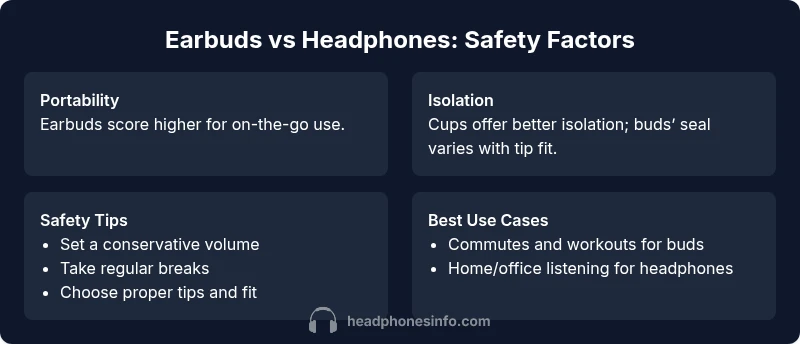
| Feature | Earbuds | Over-ear Headphones |
|---|---|---|
| Portability | High — compact, pocketable | Medium — bulkier, but easy to carry in bags |
| Isolation | Typically lower passive isolation; seal varies by tip size | Higher passive isolation with circumaural cups |
| Sound Leakage | Can leak more at high volumes due to near-ear placement | Less leakage when cups seal well |
| Control Accessibility | Inline controls on cords or touch sensors; easy to raise volume quickly | Larger controls; pressing can be deliberate but less likely to dial in extreme levels |
| Best Environments | On the go, commuting, workouts | Home, office, studio listening sessions |
Upsides
- Clear, actionable framework helps users assess safety without bias toward one form factor
- Highlights that risk is volume- and duration-driven, not inherently tied to earbuds or headphones
- Encourages consistent safe-listening practices for all devices
Disadvantages
- Can oversimplify by implying one form factor is categorically safer than the other
- May underemphasize model-level variations within each category
- Regulatory differences across regions can complicate a universal standard
Safety is device-agnostic when volume and duration are controlled
The form factor alone does not determine danger. Earbuds and headphones alike require mindful listening—set volume, limit duration, and take breaks. Selection should match your use case and comfort, guided by safe listening principles.
People Also Ask
Are earbuds inherently more dangerous than headphones for hearing health?
No. There isn’t a universal rule that earbuds are more dangerous. Risk depends on how loudly and how long you listen, plus seal, fit, and individual ear health. Both forms can be safe with proper volume control and breaks.
No—earbuds aren’t inherently more dangerous. The key is listening at safe volumes and taking breaks, regardless of device type.
What counts as safe listening volume and duration?
Safe listening prioritizes moderate volume, short exposure periods, and regular breaks. A practical approach is to keep volume at a level where you can clearly hear background sounds and your own breathing, and limit daily exposure to loud sound.
Keep it moderate, take breaks, and avoid listening at maximum volume for long periods.
Do open-back or open-ear designs affect safety?
Open-back or open-ear designs can reduce pressure buildup inside the ear but may change perceived loudness and ambient awareness. They are not inherently safer; the effect depends on the actual listening level and duration.
Open designs change how you hear surroundings and may affect perceived loudness, but safety still comes from volume and breaks.
How does duration influence risk for earbuds vs headphones?
Long listening sessions increase cumulative exposure risk for both earbuds and headphones. Short, frequent listening breaks are beneficial for all devices, reducing the chance of temporary threshold shifts or longer-term damage.
Length of time matters—short, spaced listening with breaks is safer for both.
Are wireless earbuds a safety concern compared to wired ones?
Wireless does not inherently raise risk; battery management and lithium-ion safety are separate considerations. The listening risk remains volume- and duration-dependent irrespective of wireless or wired connection.
Wired or wireless, the same safe-listening rules apply: watch volume and time.
Are there regulatory standards for safe listening?
Regulations vary by country, but many health organizations advocate limiting daily exposure and using volume-limiting features when available. Check local guidance and device settings for built-in safety tools.
Check local guidance and use device safety features when available.
What to Remember
- Choose safe listening habits for all devices
- Volume and duration trump form factor in safety
- Match device type to your activity to minimize risk
- Regular breaks reduce cumulative exposure
- Consider models with reliable volume limits and notifications