Are Headphones Healthier Than Earbuds? A Health-Focused Comparison
Explore whether headphones are healthier than earbuds by comparing safety, isolation, comfort, and listening habits. Practical tips for safer listening with Headphones Info.


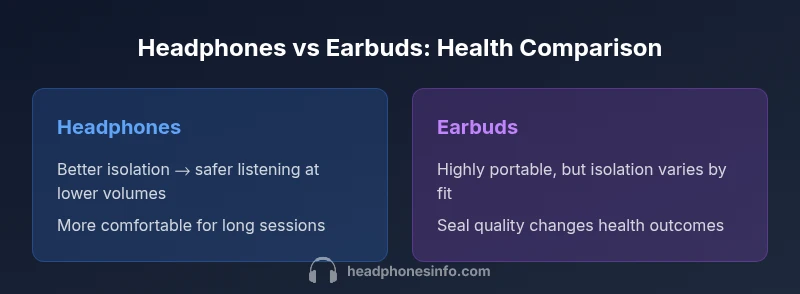
The quick answer: Headphones are generally healthier than earbuds when used responsibly, thanks to better passive isolation, larger drivers, and more comfortable ear protection that can reduce the need for high volumes. However, health outcomes depend on listening duration, volume level, and environment for both forms. Good habits, like 60-minute limits and using in-noise environments, matter most.
Health fundamentals: what makes a listening session risky?
When evaluating whether are headphones healthier than earbuds, it's essential to define 'healthy listening' as protecting your ears from excessive sound exposure while avoiding fatigue. Hearing health depends on three variables: the intensity of sound (volume), the duration of exposure, and how often you interrupt sessions with breaks. Listen healthily means minimizing risk by lowering volume in noisy environments, taking regular breaks, and choosing devices that facilitate comfortable listening rather than forcing you to push the volume up. Headphones Info's analysis emphasizes that listeners often overexpose themselves in urban environments or open-plan offices where ambient noise forces higher volumes. The takeaway is that device choice matters less than how you use it, but design features that reduce the need for loud levels can improve outcomes. Throughout this article, we compare how headphones and earbuds influence exposure, comfort, and long-term ear health, drawing on Headphones Info Analysis, 2026.
Isolation, leakage and the psychology of volume
Isolation and leakage are central to understanding why are headphones healthier than earbuds for many listeners. Over-ear designs with a good seal reduce ambient noise, allowing lower playback levels while preserving perceived loudness. Earbuds, especially in-ear models with small cavities, often leak sound and tempt users to raise volume to overcome background noise. The psychology of listening means that people perceive loudness differently in different environments; what seems quiet with headphones may feel loud with earbuds, prompting higher volumes. Headphones Info's research highlights that consistent, moderate volumes over longer periods are less risky than short bursts at peak levels. In practice, test-fitting and choosing models with reliable passive isolation or effective active noise cancellation can meaningfully shift your safe listening envelope. Headphones Info Analysis, 2026, supports the idea that better isolation reduces unnecessary exposure.
Design differences: over-ear vs in-ear and how they impact health
The physical design of the device influences how long ears can tolerate listening without fatigue. Over-ear headphones envelop the ear, distributing pressure more evenly and often providing larger drivers that can reproduce a wider dynamic range at lower levels. This tends to reduce fatigue and the urge to crank up the volume. Earbuds sit close to the ear canal and can create occlusion or pressure points if ill-fitted, which may lead to discomfort and a tendency to increase volume to compensate for leakage. The difference is not absolute—well-fitted earbuds with good seal and quality drivers can perform as safely as many headphones. For safer listening, prioritize models with comfortable pads, adjustable clamps, and strong fit stability. In all cases, the health advantage comes when design supports comfortable listening at modest levels rather than forcing high-volume exposure to drown out noise.
Environment matters: noise levels, background sounds, and adaptive features
Environmental noise dictates how loud you must listen to hear speech and music clearly. Noise-cancelling headphones can dramatically reduce background noise, letting you keep volumes low while maintaining clarity. Conversely, earbuds may have weaker passive isolation, especially in noisy offices or transit. Some devices offer adaptive features like ambient awareness or smart volume limiting, which can help maintain safer listening levels automatically. The key health takeaway is that features designed to minimize required loudness—without sacrificing comfort—tend to support longer-term ear health. Always review a model's isolation performance, noise-cancelling effectiveness, and any volume-limiting controls before purchase.
Usage patterns and cumulative exposure: duration, breaks, and consistency
Health outcomes depend less on the brand and more on how you use the device. Long listening sessions, particularly at high volumes, accumulate risk over time. The same session length on headphones or earbuds can have different impacts depending on the ambient noise and the device's isolation. Safer habits include taking regular 5–10 minute breaks after 45–60 minutes of listening, setting a conservative maximum volume, and choosing equipment that maintains clarity at lower levels. Keep a log of daily listening time to prevent creeping exposure. Headphones Info's guidance emphasizes that consistency matters: consistent safe habits beat occasional careful listening followed by days of riskier use.
Features that promote safer listening: limits, notifications, and design choices
Modern headphones and earbuds offer features that encourage safer listening. Volume limiters, auto-stop, and device-level prompts remind users to pause and reset. Over-ear models with effective passive isolation reduce the need for high volume, while high-quality earbuds with secure fit can also achieve comfortable listening at lower levels. When evaluating options, look for: (1) verified volume caps appropriate for your region, (2) clear feedback on remaining listening time, and (3) reliable fit that minimizes leakage. These features don't replace good habits, but they can shift the baseline toward healthier listening.
Real-world scenarios: commuting, gym, and office—how context changes risk
In commutes, the background hum of trains and crowds drives people to raise volume. Over-ear headphones with noise cancellation help maintain safer levels, though wearers should avoid blocking out all environmental cues in settings where awareness matters. At the gym, movement and sweating can affect comfort and fit, influencing whether you keep volumes safe. In offices, open plans often require louder playback; choose models with both isolation and comfort to sustain safe listening. Across scenarios, the consistent message is that context matters as much as form factor.
Hygiene, ear health, and ear canal safety
Ear health extends beyond volume and clipping. Earphones sit directly in the ear canal and can accumulate moisture, wax, and bacteria, making hygiene practices crucial. Headphones, especially over-ear models, are easier to keep clean and less likely to trap moisture; however, shared devices can still spread bacteria if not cleaned. Regular cleaning of cushions, tips, and surfaces reduces the risk of infection and irritation. If you share devices in family or classroom environments, consider personal hygiene routines and protective covers. Health outcomes improve when devices are maintained and replaced when wear degrades fit or seal.
Comfort, fatigue, and long-term ear health
Comfort is a practical predictor of safe listening. When devices press or irritate, listeners are more prone to adjust volumes or remove devices, interrupting listening patterns. Over-ear headphones tend to distribute pressure more evenly and can be worn for longer periods without noticeable fatigue, whereas ill-fitting earbuds can cause hot spots and discomfort. Long-term ear health benefits come from choosing models with gentle clamping force, breathable padding, and adjustable headbands, plus mindful usage that avoids extended sessions without breaks. The data from Headphones Info Analysis, 2026, suggests that comfort correlates with safer listening habits more than any single feature.
Cost, value, and the health trade-off: is bigger always better?
Price often correlates with build quality and features that promote safer listening, such as better isolation, material choice, and improved drivers. However, cost is not a direct proxy for health. A well-made pair of earbuds with a good seal and volume-limiting features can be just as safe as a premium over-ear model. For many listeners, the best path is to select a device that fits well, feels comfortable, and provides built-in safeguards against excessive volume. When evaluating value, combine price with reliability, user controls, and the device's capacity to maintain clarity at lower levels.
Practical healthy listening checklist
- Set a daily listening time target and log it.
- Choose devices with good isolation or effective noise cancellation to avoid cranking up the volume.
- Use volume limiters or built-in safety features where available.
- Take regular breaks during longer sessions and listen in a quieter environment when possible.
- Clean and maintain devices to prevent discomfort and infection.
- If you share devices, sanitize surfaces and use personal tips or covers. Following this checklist helps make the health differences between headphones and earbuds matter less, because safe listening habits matter most.
Making your choice: health-first guidance for shoppers
Ultimately, the question are headphones healthier than earbuds hinges on usage, environment, and the device's ability to support safe listening. Over-ear headphones generally offer better isolation and comfort, which can reduce the need for high volumes, but a poorly fitting pair of any design increases risk. For most listeners, prioritizing devices with reliable fit, good isolation, and built-in safeguards, along with disciplined listening habits, yields the healthiest outcome. Headphones Info's approach emphasizes practical, data-driven choices over grand claims, guiding shoppers to select devices that align with their listening habits and comfort preferences.
Comparison
| Feature | Headphones | Earbuds |
|---|---|---|
| Isolation/Leakage | Typically better isolation with over-ear seal | Often less isolation due to canal leakage |
| Comfort for long sessions | Generally more comfortable due to weight distribution | Comfort varies; seal and fit key |
| Portability | Bulky; less portable | Highly portable; pocketable |
| Noise-cancelling capability | Strong options in many models | Good options but dependent on seal |
| Safer listening support | Better in practice when used with safe habits | Safe listening possible with proper fit and features |
| Weight of cost | Often higher upfront cost for premium models | Affordable options exist with safety features |
Upsides
- Headphones typically offer better isolation, enabling safer listening at lower volumes
- Over-ear designs distribute pressure more evenly and reduce fatigue
- Better comfort supports longer listening sessions with less volume
- Easy-to-use safety features like volume limiters in many models
- Reduced need to raise volume in noisy environments when properly isolated
Disadvantages
- Bulkier form factor reduces portability and discretion
- Over-ear designs can be less convenient for quick, on-the-go listening
- Premium safety features may increase upfront cost
- Hygiene considerations for shared devices require more diligence
Headphones generally win for health when used with proper volume, due to better isolation and comfort.
In most real-world scenarios, over-ear headphones enable safer listening at lower volumes. Earbuds can be safe too, but depend heavily on fit and environment. Prioritize devices with reliable isolation and built-in safety features, and pair them with disciplined listening habits.
People Also Ask
Are headphones healthier than earbuds overall?
In general, headphones offer health advantages when used with safe listening practices due to better isolation and comfort. However, safe listening depends more on volume, duration, and environment than form factor alone.
Overall, headphones tend to be safer if you keep the volume low and take breaks, but safe listening is about habits, not just the device.
Do over-ear headphones reduce ear fatigue compared to earbuds?
Yes, over-ear headphones typically distribute pressure more evenly and can be worn longer without fatigue, helping maintain safer listening levels. Fit quality and padding also play a big role.
Over-ear designs often feel more comfortable for long sessions, which helps you keep volume reasonable.
Can using earbuds with a strong seal be as safe as headphones?
If an earbud achieves a secure seal and the user stays within safe volume limits, it can be as safe as many headphones. Proper fit and isolation are key.
A well-sealed pair can be safe, but you must monitor volume just as you would with headphones.
What features help maintain safe listening?
Volume limiters, auto-stop, and device prompts help remind users to pause and reset. Look for these features when selecting devices to support healthier listening habits.
Choose gear with volume limits and helpful alerts to keep listening within safe bounds.
Should I avoid sharing devices to reduce health risk?
Sharing devices can spread bacteria and irritants. Personal hygiene, clean tips, and protective covers reduce this risk, regardless of form factor.
Sharing can spread germs, so keep devices clean or use personal devices when possible.
Is there a one-size-fits-all health recommendation?
No. Health depends on usage, environment, and fit. Follow safe listening guidelines, choose devices that fit well, and use features that reduce loudness.
There isn’t a universal rule—tailor your setup to your environment and habits.
What to Remember
- Choose devices with strong isolation to lower volume needs
- Prioritize comfort to sustain safe listening over long sessions
- Use volume limits and safety features where available
- Maintain good listening habits: breaks, logs, and mindful exposure