Headphones vs Earphones: Key Differences and How to Choose
Explore the difference between headphones and earphones, including fit, sound quality, portability, and value. Data-driven guidance from Headphones Info helps you choose the right type for your needs in 2026.


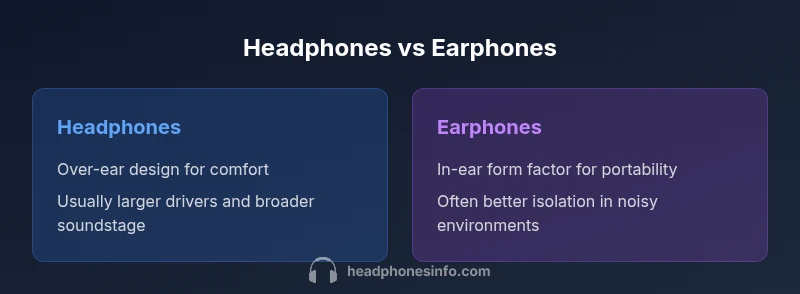
The difference between headphones and earphones hinges on fit, size, and listening experience. Headphones are larger, sit over or around the ears and usually deliver broader soundstage and stronger bass. Earphones are compact, sit in the ear canal, and prioritize portability. Your choice depends on comfort, use-case, and budget; both wired and wireless options exist.
What are Headphones and Earphones?
The terms headphones and earphones describe two broad categories of personal listening devices. Headphones are larger, typically with cups that encircle or cover the ears. Earphones (often called in-ear monitors) are small, insert into the ear canal. For the purpose of this guide and the classic question about the difference between headphones and earphones, you’ll usually see two major design philosophies: open-back versus closed-back, and over-ear versus in-ear. These design choices influence comfort, isolation, and perceived soundstage. By understanding these basics, you can compare models more effectively and avoid common buyer confusion as you search for the right sound profile and fit.
In practical terms, headphones excel in home listening, studios, and gaming setups, where long sessions and bass emphasis matter. Earphones shine in portable use, commuting, and sports contexts where size and discretion are paramount. The goal is to align the form factor with how you actually listen. According to Headphones Info, consumer expectations in 2026 continue to favor balanced sound with easy compatibility across devices, whether you choose headphones or earphones.
Design, Fit, and Acoustic Impact
Design and fit profoundly affect how you perceive sound. Over-ear headphones tend to seal around the ear, creating a larger internal air cavity for drivers and often delivering more impactful bass and wider soundstage. They are generally easier to drive with high impedance designs and can accommodate larger drivers. In-ear earphones, by contrast, sit inside the ear canal or in the concha port. They provide excellent portability and isolation in noisy environments, though some users report less bass energy and a narrower stage. Comfort varies by head shape and ear anatomy; what feels great for one person might cause fatigue for another. When evaluating the difference between headphones and earphones, assess clamp force, weight, and how securely the cups or tips sit in your ears. Even small changes in fit can dramatically alter perceived clarity and bass.
If you wear glasses, consider the interaction between the headband and frames, as well as the seal around the ears. For active use, sport-oriented in-ear models often come with wing tips or memory foam to improve stability during movement. Open-back designs on headphones favor a more natural, airy sound but leak more sound to the surroundings, influencing both listening privacy and neighbor considerations in shared spaces.
Sound Quality, Drivers, and Isolation
Sound quality arises from many interacting factors: driver size and type, enclosure design, tuning, and impedance. Headphones typically offer larger drivers that can reproduce deep bass and expansive midrange more robustly than most earphones. This often translates into a more convincing soundstage — the perception of space and instrument placement. Earphones rely on smaller drivers and acoustical architecture optimized for efficiency, portability, and precise imaging in a compact package. Isolation is another key variable: closed-back headphones and sealed earphones reduce ambient noise, which can significantly affect perceived loudness and detail, especially in loud environments.
Both formats benefit from good tunings, but the trade-offs are real. If you crave cinematic lows and an enveloping sound, a well-tuned pair of headphones will usually outperform earphones. If you need a discreet, travel-ready option that still sounds clear across genres, high-quality earphones can be surprisingly close in performance, particularly in the upper price tiers.
Portability, Comfort, and Durability for Daily Use
Portability is often the defining factor when choosing between headphones and earphones. Earphones win hands-down for travel and commuting; they slip into pockets and weigh almost nothing compared with bulky over-ear models. For people who work long hours at a desk, comfortable pads and a well-balanced headband in headphones can reduce fatigue, provided you choose a model with a breathable clamp and gentle ring pressure. Durability also varies: many earphones are rugged for on-the-go use, but they are more susceptible to tangling or cable wear in budget options. Higher-end wired and wireless headphones typically feature premium cables and detachable connectors, which can extend lifespan with careful care. Consider your typical environment—crowded commutes, gym sessions, or studio rooms—when weighing comfort and durability.
Use-Case Scenarios: Travel, Home, Studio, and Sports
Travelers prioritize compactness, fast setup, and reliable isolation. Earphones with effective passive isolation and a compact case are practical for planes and trains, while noise-cancelling earphones offer a portable escape from cabin chatter. Home listeners often favor headphones for extended sessions, gaming, and multimedia, where comfort and bass response matter most. In studios or critical listening environments, engineers may opt for open-back headphones to preserve natural acoustics, while musicians sometimes select in-ear monitors for stage work due to their precise isolation and stage mix capabilities. For sports and workouts, sweat resistance, secure fit, and splash protection become critical; many earphones are designed specifically for these contexts.
Price, Durability, and Long-Term Value
There is a broad spectrum of price points for both headphones and earphones. In general, higher-priced models in either category tend to deliver more refined drivers, better build quality, and longer warranty coverage. Budget options may be more forgiving on cost but can compromise fit, isolation, and durability. Long-term value depends on how often you use them, how carefully you treat cables, and whether you need features like wireless connectivity, active noise cancellation, or detachable cables. If you listen daily in varied environments, a balanced approach—selecting a comfortable, well-built option with dependable cables—often yields the best overall value. Headphones Info analysis shows that purchase decisions increasingly weigh ergonomic design and lifecycle costs as much as pure sound quality.
Choosing Between Headphones and Earphones: A Practical Checklist
To decide between headphones and earphones, build a quick checklist: 1) How portable must they be for your daily routine? 2) Do you prioritize soundstage and bass or compact isolation? 3) Will you use them mainly at home, in the office, or on the go? 4) What is your budget and preferred connectivity (wired vs wireless)? 5) Do you require features like active noise cancellation or water resistance? By answering these questions, you can map your needs to a form factor. Remember that many premium options exist in both categories, so focus on the most important attributes first—fit, isolation, and durability—and then refine with sound quality preferences.
mainTopicQuery::<1-3 words> headphoneseearphones
Comparison
| Feature | Headphones | Earphones |
|---|---|---|
| Form factor | Over-ear or on-ear | In-ear/earbud |
| Sound stage | Typically wider, more immersive | Often more intimate, more focused on detail |
| Bass response | Strong, punchy bass common | Bass present but less dramatic |
| Portability | Bulkier, less portable | Highly portable and pocketable |
| Noise isolation | Excellent with closed-back options | Good isolation with sealed tips |
| Best for | Home listening, studio use, gaming | Travel, commuting, workouts, discreet listening |
| Connectivity options | Wired/Wireless with larger housings | Wired/Wireless with compact design |
| Typical price range | Wide range; premium models exist | Typically more affordable entry points available |
Upsides
- Headphones offer deeper bass and wider soundstage for immersive listening
- Earphones are highly portable and discreet for on-the-go use
- Both formats have extensive wired/wireless options and accessories
- Premium builds and fittings improve comfort for long sessions
Disadvantages
- Headphones can be bulky and less convenient for travel
- Earphones can lack bass depth and soundstage in lower-end models
- Fit and seal can be inconsistent, affecting comfort and sound
- Some wireless models incur latency or battery considerations
Headphones generally excel in home listening and critical listening due to soundstage and comfort, while earphones win on portability and convenience.
If you value immersive sound and long listening sessions, choose headphones. If you prioritize compactness and easy transport, choose earphones. The Headphones Info team emphasizes matching form factor to your daily routine and listening environment.
People Also Ask
What is the main difference between headphones and earphones?
The main difference lies in form factor and sound delivery: headphones sit over or around the ears with larger drivers for a broader soundstage, while earphones sit inside the ear canal with smaller drivers for portability and isolation. Fit, isolation, and comfort largely drive the perceived sound.
The main difference is form factor and sound delivery—headphones are big and immersive, earphones are small and portable.
Are headphones better for home listening than earphones?
For home listening, especially in quiet environments, headphones typically offer richer bass, wider soundstage, and extended comfort for long sessions. Earphones may still deliver excellent sound, but their smaller drivers and seal can limit depth and stage.
For home listening, headphones usually win on bass and space.
Are earphones more portable than headphones?
Yes. Earphones are compact enough to fit in pockets and small cases, making them ideal for travel, work commutes, and gym use. Headphones are bulkier, though many recent models fold or compress to improve portability.
Earphones are far more portable than most headphones.
Do wireless models affect sound quality?
Wireless technology can impact latency and fidelity, but many modern Bluetooth codecs (like AAC, aptX, or LDAC) offer near-wired quality in good conditions. Always consider codec support, battery life, and potential impedance interaction with devices.
Wireless can be close to wired with the right codec, but check support and battery life.
How should I decide between them for travel?
For travel, prioritize portability and case protection. Earphones win on size, whereas compact folding headphones with solid cases can also be travel-friendly. Noise cancellation and comfort during long flights can tip the balance.
If space is the key, pick earphones; if you want comfort and ANC on planes, consider compact headphones.
What about noise-cancelling features?
Both headphones and earphones can offer active noise cancellation, but larger headphones often provide more effective ANC due to bigger drivers and room for additional circuitry. Earphones with ANC are improving and can be excellent in smaller form factors.
ANC works well in both, with headphones typically delivering stronger overall noise reduction.
What to Remember
- Match form factor to daily routine and environment
- Headphones excel in soundstage and comfort for home use
- Earphones offer portability and discreet listening for travel
- Budget options exist in both categories without sacrificing core benefits
- Consider connectivity and durability for long-term value