Headphones vs Earbuds: When to Use Each — A Practical Guide
A thorough comparison of headphones and earbuds, detailing sound quality, comfort, isolation, portability, and use-case scenarios to help you decide when to choose over-ear headphones or compact earbuds.


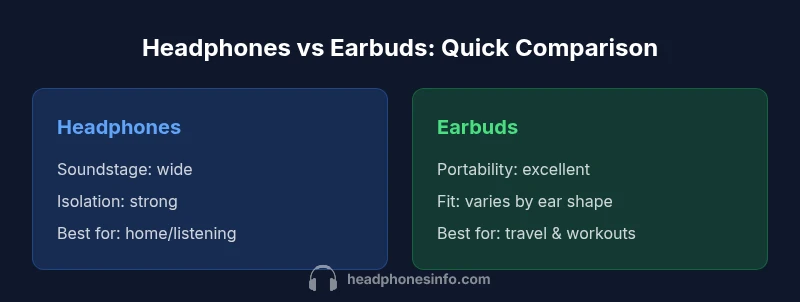
According to Headphones Info, your listening context and activity should guide the choice between headphones and earbuds. When to use headphones vs earbuds is rarely black and white; it hinges on sound quality needs, comfort, and how portable you require your setup. For home listening, gaming, or critical mixing, over-ear headphones are often preferred; for travel, workouts, or quick commutes, earbuds win on convenience. The Headphones Info team emphasizes testing both options in real-world scenarios to maximize value.
When to use headphones vs earbuds: A practical framework
If you're evaluating the practical differences between headphones and earbuds, your decision should hinge on listening goals, environment, and how you plan to use them. When to use headphones vs earbuds is not a binary choice but a spectrum determined by comfort, isolation, and sound reproduction. According to Headphones Info, a structured approach helps listeners pick the right tool for the moment. In home studios or late-night listening, over-ear headphones often shine due to their broader soundstage and lower listener fatigue. For a morning commute or intense workouts, earbuds offer stealth, convenience, and less bulk. The human ear and head shape also affect fit: some people find over-ears pressure uncomfortable for long periods, while others dislike the seal of in-ear designs. The key is to map your typical contexts—home, office, travel, gym—and align them with the strengths of each form factor. This section outlines core criteria you should weigh before purchasing or choosing on the fly, including sound quality, comfort, isolation, and practicality. By filtering options through real-world use, you can avoid buyer's remorse and maximize value over years of listening.
Sound quality and imaging: how design shapes listening
Headphones and earbuds translate audio through different driver sizes, housings, and enclosures, which shapes sound stage and bass response. Over-ear headphones typically house larger drivers and a sealed or open-back design that yields a wider soundstage, deeper bass extension, and more defined imaging. The result is a sense of space around instruments and a more immersive experience at home or in the studio. Earbuds use smaller drivers and in-ear enclosures that prioritize precision and immediacy over sheer scale. They often deliver crisp highs and detailed mids, which can translate to excellent vocal clarity and instrument separation for portable listening. However, due to their lighter physical presence, earbuds may feel constricted in bass and soundstage compared to open-back or closed-back headphones. The acoustic differences are not just about driver size—the mechanical design, impedance, and damping materials all influence how sound travels through air and into your ears. In practice, the choice depends on listening goals: if you crave cinematic immersion and bass weight, headphones are often the better pick; if you want a compact, responsive, on-the-go listening experience, earbuds can be more satisfying. Headphones Info emphasizes comparing actual listening results rather than relying on spec sheets alone.
Comfort and fit: long listening sessions
Comfort and fit are a critical, often overlooked, part of the decision between headphones and earbuds. Headphones typically offer generous padding on the ear cups and an adjustable headband, distributing weight across a larger area and reducing pressure on the ears during long sessions. The trade-off is bulk and sometimes heat buildup in warm environments. Earbuds, by contrast, are lightweight and discrete, which enhances portability but hinges on your ear anatomy. Clamp force, tip size, and tip material ( silicone, foam, or memory-foam tips) influence comfort and seal. A poor seal can lead to listener fatigue, reduced bass, and inconsistent imaging. Users who wear glasses or have smaller heads may find certain over-ear models less comfortable, while others enjoy plush cushions and breathable materials. The key is to try multiple models and, if possible, test with your typical wear pattern—sitting, standing, walking—to determine which form factor remains comfortable after extended use. Headphones Info recommends choosing models with adjustable ear pads and low clamp force when possible.
Isolation and leakage: keeping it private
Isolation performance hinges on enclosure and sealing. Closed-back headphones and well-sealed in-ear tips can block out ambient noise effectively, making them suitable for noisy environments or late-night listening. Open-back headphones sacrifice some isolation in favor of a more natural, airy sound stage, which is ideal for at-home listening where you won’t be disturbed by outside noise. Earbuds vary widely: premium IEMs with good ear tips can offer strong isolation and limited leakage, while generic earbuds with loose seals provide minimal noise isolation and more potential for sound leakage. If privacy matters (e.g., in a shared space or office), prioritize models with solid seal and closed-back design, or consider noise-cancelling options that complement a good fit. The result is a clearer listening experience with less environmental distraction, whether you’re in transit or at your desk. Headphones Info highlights testing several seal types to understand how isolation changes with fit.
Portability and convenience: daily carry
Portability is where earbuds shine. Their compact size, light weight, and tangle-free or simpler cables make them perfect for travel, workouts, and quick commutes. Headphones, especially larger on-ear and over-ear designs, sacrifice portability for comfort and sound quality but can still be manageable with foldable builds and compact carry cases. If you rely on public transit or need to stow gear in small bags, earbuds usually win; if your routine involves desk use, gym sessions, or film watching at home, a pair of well-fitted headphones can be a better long-term companion. Cable type matters too: wired connections avoid battery anxiety but add a cable snag factor; wireless options improve mobility but demand charging and can experience occasional latency or signal drop. Headphones Info notes that the best choice often balances daily carry needs with listening goals.
Use-case scenarios: music, work, travel, workouts
Different activities demand different form factors. For critical listening at home or in a studio, consider over-ear headphones with accurate response and comfortable wear. For daily commutes, workouts, or travel, earbuds provide stealth and convenience. In an office, a comfortable pair of closed-back headphones can reduce ambient distraction while maintaining sound clarity for meetings and calls. For gaming or video editing on the go, some wireless headphones offer latency-optimized modes, but wired options remain the gold standard for zero-latency performance. The overarching theme is to map your typical environments—home, office, gym, travel—and align them with the strengths of each form. Headphones Info encourages readers to build a decision matrix that weighs sound quality, comfort, isolation, portability, and budget before making a final call.
Wireless vs wired: trade-offs
Wired headphones and earbuds generally deliver the most stable, low-latency audio, which is crucial for critical listening, editing, and gaming. Wireless options offer freedom of movement and easier use on the go, but they can introduce latency, occasional dropouts, and require battery management. The best approach is to choose a primary setup based on your primary use case and then keep a secondary, travel-friendly option for gaps in availability. Some listeners opt for hybrid setups—high-quality wired over-ear headphones for home use and compact wireless buds for travel. Headphones Info suggests prioritizing models with robust Bluetooth codecs and reliable pairing if wireless usage is central, while ensuring a comfortable fit if you expect long sessions.
How to test and decide: a practical checklist
To select between headphones and earbuds, follow this checklist: 1) Define primary use cases (home listening, commuting, workouts, travel). 2) Assess sound quality priorities (bass weight, imaging, treble clarity). 3) Try fit across different ear shapes and head sizes; test comfort for at least 30 minutes. 4) Evaluate isolation needs and leakage tolerance. 5) Consider battery life for wireless options and weight for portability. 6) Compare build quality and durability, including cables, ear tips, and hinge design. 7) Check resale value and warranty. 8) If possible, audition multiple models in the same price tier. This pragmatic approach helps ensure your final choice aligns with real-world usage rather than specs alone. Headphones Info recommends a hands-on trial whenever possible to avoid post-purchase regret.
Brand landscape and trends: where the market is headed
The market continues to evolve toward hybrid models that blend the best of both worlds: comfortable over-ears that fold for travel and compact IEMs with improved bass response and isolation. Several brands are investing in durable materials, modular ear tips, and more energy-efficient wireless solutions to extend battery life without compromising sound. For listeners, this means more choices that fit specific contexts—from home studios to gym bag essentials. The core principle remains the same: prioritize your listening goals, test fit and comfort, and select a configuration that aligns with your everyday life. Headphones Info observes that consumer demand increasingly favors flexible setups that don’t force a one-size-fits-all solution.
Comparison
| Feature | Headphones | Earbuds |
|---|---|---|
| Sound quality and imaging | Typically wider soundstage and deeper bass with headphones | Detailed, focused sound with less space (earbuds) |
| Comfort and fit | Soft cushions and adjustable headband; ideal for long sessions | Lightweight and compact; comfort varies by ear shape |
| Isolation & leakage | Excellent isolation with closed-back designs | Moderate isolation; more leakage with loose fits |
| Portability | Bulkier; best for home/desk use | Highly portable; ideal for travel and workouts |
| Battery life (wireless options) | Generally longer battery life in wireless headphones | Limited battery life; frequent charging required for wireless buds |
| Best use case | Critical listening, studios, home theater | On-the-go listening, commuting, training |
Upsides
- Superior sound quality and wider soundstage with headphones
- Great comfort for long listening sessions
- Strong isolation with proper seal
- Wide price range offering value in multiple tiers
- Earbuds excel in portability and quick-use scenarios
Disadvantages
- Headphones are bulkier and less portable
- Earbuds may lack bass depth and soundstage in some models
- Wireless options require charging and can have latency
Headphones are the better all-around choice for home listening and critical listening; earbuds are best for portability and gym/commute scenarios
If soundstage, comfort, and immersive listening matter at home, choose headphones. If you need lightweight, discreet gear for travel or workouts, earbuds are the smarter pick. Use the decision framework to tailor your choice to your routine.
People Also Ask
Are headphones better for bass than earbuds?
In general, headphones with larger drivers and an enclosed design can reproduce deeper bass and more dynamic range. Earbuds can deliver solid bass too, especially premium in-ear monitors with good tips, but they often lack the weight and scale of over-ear designs.
Headphones usually deliver stronger bass due to bigger drivers and the enclosure, though some premium earbuds can approach that depth.
Do earbuds provide good noise isolation?
Earbuds can offer strong isolation when the tips seal the ear canal well. Quality matters more than form factor, and some high-end in-ear monitors seal more effectively than generic earbuds. If isolation is essential, prioritize models with good tip options and snug fit.
Yes, but it depends on tip fit and design; a good seal helps a lot.
Should I buy wireless or wired for each?
Wireless designs provide freedom and ease of use, but may introduce latency and require charging. Wired options offer reliable, low-latency performance and no battery concerns. Your choice should reflect how mobility versus stability matters in your routine.
Wireless gives you freedom, but wired is more reliable for critical listening.
What is the most comfortable choice for long flights?
Most travelers find over-ear headphones with soft padding and a light clamp comfortable for long flights. Earbuds can also be comfortable with well-fitted tips, but prolonged use may cause ear pressure for some people.
Over-ear headphones are usually the go-to for long flights because they feel more comfortable for extended use.
Can I use earbuds for critical listening or mixing?
Some premium earbuds and IEMs can deliver accurate sound, but many listeners still prefer headphones for critical listening and mixing due to imaging and overall response. If accuracy is essential, compare several models and consider headphones first.
You can, but headphones are often preferred for critical listening.
How do I test headphones or earbuds at home?
Start with a familiar playlist and compare tonal balance, imaging, and comfort across models. Check driver consistency, channel balance, and fit stability. If possible, listen in the same environment with similar gear to make a fair decision.
Test with a familiar playlist and pay attention to how both feel and sound.
What to Remember
- Assess your primary listening context before buying
- Choose headphones for home, studio, and immersive listening
- Opt for earbuds for travel, workouts, and quick commutes
- Balance comfort, isolation, and battery life when selecting wireless options
- Test fit and seal with your typical use case before committing