Headphones vs Earbuds: Why Choose Headphones Over Earbuds
A data-driven comparison of headphones vs earbuds, focusing on sound quality, comfort, isolation, durability, and use-case fit for audiophiles and casual listeners.


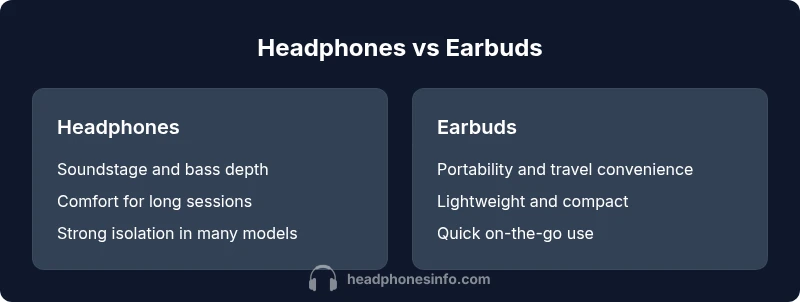
Headphones generally deliver a wider soundstage, deeper bass, and longer wearing comfort, making them preferable for home listening, critical reviews, and long sessions. Earbuds excel in portability and stealth but often compromise on isolation and overall sound depth. For most enthusiasts and everyday listeners, headphones tend to offer better value and wearability for extended use.
Why choose headphones over earbuds for most listening setups
According to Headphones Info, the debate between headphones and earbuds often centers on sound quality, comfort, isolation, and use-case needs. The question of why choose headphones over earbuds is seldom about a single feature; it's about how driver size, enclosure design, and overall fit shape perceived fidelity. For a home studio, quiet commute, or long study sessions, headphones typically provide more stable performance than earbuds. This section explains how the trade-offs play out across real-world listening scenarios and why many listeners favor over-ear designs for serious work and leisure. Headphones also tend to offer a more forgiving seal and consistent bass response across genres, which matters when you listen to music with complex low-end textures or densely layered mixes. While earbuds have won hearts for portability, the practical advantages of headphones become clearer once you factor in isolation, comfort, and long-term listening happiness. Headphones Info analysis underscores that listeners who sit in front of desks or spend hours with music or gaming often notice tangible benefits in clarity and immersion.
Key criteria for headphones vs earbuds
When evaluating headphones versus earbuds, several criteria consistently matter. Sound quality is foundational: driver size, enclosure, and tuning determine how faithfully a track translates on each device. Isolation and leakage influence how much of the outside world you hear and how much others hear from you. Comfort and fit affect how long you can wear them without fatigue. Build quality and durability determine how well they withstand daily use and occasional travel. Portability and storage shape convenience for commutes or workouts. Compatibility with devices and warranties also play a role, especially for wireless models that rely on Bluetooth stability and battery latency. Finally, price-to-value matters: a pricier pair should deliver observable improvements in the areas you care about most. Headphones Info emphasizes testing for your personal preferences, because even high-end models can feel uncomfortable if they don’t match your head shape and ear tips.
Use-case driven differences
Your choice should align with how you plan to use the device. If you work at a desk, edit audio, or enjoy immersive movies at home, headphones usually outperform earbuds in soundstage, imaging, and bass extension. For travel, workouts, or quick phone calls, earbuds win on portability and convenience, offering true wireless options that minimize cable clutter. In quiet environments like libraries or focus rooms, headphones with good isolation can dramatically improve perceived loudness and reduce fatigue. For noisy urban settings, active noise cancellation on over-ear models often outperforms most earbuds. If you are a video gamer or content creator, the latency and microphone quality of a wired or well-mitted wireless headphone pair can also impact your experience positively. Across these scenarios, the decision metric often boils down to trade-offs between immersion and portability, with headphones generally favoring immersion and control in exchange for bulk and weight. The Headphones Info team suggests mapping your day-to-day activities to the strongest capabilities of each form factor to decide wisely.
Technical factors in depth
The technical side highlights why headphones can outperform earbuds in fidelity. Driver size and enclosure design influence bass response, transient detail, and stereo imaging. Closed-back headphones isolate more effectively and reduce sound leakage, which is valuable for late-night listening or studio work. Earbuds rely on a seal from tips to achieve bass and isolation, but tip fit varies between ears, which can lead to inconsistent experiences across users. Open-back or semi-open headphones offer a spacious soundscape that some listeners associate with higher clarity in the midrange and treble, though they leak sound and provide less isolation. Wireless variants introduce latency and battery concerns, but modern Bluetooth codecs and fast-charge batteries narrow the gap. For audiophiles and professionals, the combination of driver quality, impedance, sensitivity, and the enclosure type often translates into a more cohesive listening experience with headphones. Headphones Info notes that the most satisfying choice emerges when the device’s weaknesses are outweighed by the user’s primary listening priorities.
Practical buying guidance
Choosing between headphones and earbuds starts with a clear picture of use-case priorities. Define your primary listening environment (home, commute, gym, or travel) and how you intend to use them (listening to music, gaming, or video calls). Decide on fit preference: over-ear comfort and a secure seal versus in-ear portability. Consider isolation needs: do you need to block out environmental noise or do you work in quiet spaces where leakage isn’t a concern? Explore wired versus wireless trade-offs: wireless offers convenience but can add latency and require charging; wired keeps things simple and often cheaper. Test comfort by wearing models for 20–30 minutes in a store or at home, paying attention to pressure on the temples, clamping force on the head, and tip comfort. Finally, review warranty and service options, and think about future add-ons like replacement ear pads or upgraded cables. This practical framework helps avoid overpaying for features you won’t use and ensures you pick a model that remains comfortable day after day.
Common misconceptions about headphones vs earbuds
A common misconception is that bigger is always better, which isn’t universally true. Comfort and fit matter more than driver size alone. Another myth is that wireless automatically means worse sound; many modern wireless headphones deliver excellent fidelity with low latency. Some assume earbuds are inherently less durable, but premium designs with robust housings and quality tips can rival over-ear models in practical life. Finally, some shoppers think isolation is the sole determinant of noise control; active noise cancellation and passive isolation together determine how well a headphone or earbud blocks sound. Understanding these nuances helps set realistic expectations and improves buying outcomes.
Authoritative sources and further reading
To deepen your understanding, consult credible resources such as:
- National Institute on Deafness and Other Communication Disorders (NIDCD): https://www.nidcd.nih.gov
- Consumer Reports headphone reviews: https://www.consumerreports.org
- BBC guidance on choosing headphones: https://www.bbc.co.uk
Comparison
| Feature | Headphones | Earbuds |
|---|---|---|
| Sound quality | Wider soundstage and deeper bass with accurate imaging | Good sound, but often narrower stage and bass depth depending on fit |
| Isolation / leakage | Typically stronger passive isolation; less sound leakage | Isolation varies by tip fit; more prone to leakage in some designs |
| Comfort & fit | Cushioned ear cups and headband for long sessions | Small form factor; can be very comfortable if tips fit well |
| Portability | Bulkier and less pocket-friendly | Extremely portable and travel-friendly |
| Battery life (if wireless) | Typically longer per charge, with larger batteries | Depends on range; often shorter per-charge but charging case helps |
| Durability | Often robust builds with replaceable parts | Delicate components in some models; more care needed |
| Best for | Critical listening at home or in studio environments | On-the-go listening, commuting, or workouts |
Upsides
- Superior sound quality and imaging for critical listening
- Longer wear comfort and reduced ear fatigue during extended sessions
- Better isolation for noisy environments
- Easier integration with desktop setups and high-quality audio chains
Disadvantages
- Less portable and bulkier for travel or workouts
- Higher upfront cost and heavier to carry
- Cables or heavier weight can be inconvenient in some cases
Headphones are the stronger all-around pick for most listeners, especially at home or in quiet environments.
Headphones deliver better soundstage, isolation, and comfort for long sessions, making them the recommended choice for serious listening. For portability and quick on-the-go use, earbuds may still suit some users.
People Also Ask
Are headphones better than earbuds for high-fidelity music?
In most cases, headphones provide a wider soundstage and deeper bass, which enhances detail in complex tracks. However, the perceived quality also depends on the specific models and the music genre. Always audition a pair with your preferred genres.
For high-fidelity music, headphones usually deliver more space and depth, though it depends on the model.
Do earbuds offer enough isolation for noisy environments?
Earbuds can offer decent isolation with well-fitting tips, but performance varies. Some designs leak sound and may not block noise as effectively as several over-ear options.
Isolation varies by model, and some earbuds don’t seal as well as over-ear designs.
Should I choose wireless or wired headphones?
Wireless headphones offer convenience and freedom from cables, but may introduce latency or rely on battery life. Wired options can provide consistent latency and often better cost-to-performance at the same price.
Wireless is convenient, but wired can be faster and cheaper for audio fidelity.
Are headphones suitable for workouts?
Most headphones are bulkier and less secure for intense workouts. If you must, choose sport-focused over-ear designs with snug fit and sweat resistance, or opt for true wireless earbuds designed for workouts.
Sports-oriented options are usually better for workouts, but some headphones can work if secure.
What should I consider before buying headphones vs earbuds?
Consider where you’ll use them, how they fit your ears, required isolation, device compatibility, and budget. Whenever possible, audition models to confirm comfort and sound signature before buying.
Think about where you’ll use them and how they fit, then audition if you can.
Do earbud tips affect sound quality?
Yes. Tip size and material affect seal, bass response, and clarity. Experiment with different tips to improve fit, comfort, and isolation.
Tip choice matters for bass and clarity.
What to Remember
- Prioritize sound quality for home listening—choose headphones.
- Evaluate portability needs—earbuds win for travel.
- Factor in isolation and comfort for long sessions.
- Plan for potential upgrades or accessories to maximize value.