DT 770 Pro 80 Ohm Review
In-depth, data-driven review of the DT 770 Pro 80 Ohm headphones, covering sound signature, build quality, comfort for long sessions, amp requirements, and ideal use cases for studio and casual listening.


The DT 770 Pro 80 Ohm delivers a reliable closed-back monitoring experience with strong bass, clear mids, and comfortable fit. It’s best for studio work, casual listening, and gaming in quiet environments, though its bass-forward tilt and clamp force may not suit all critical mix engineers. It remains easy to drive from many interfaces, but a small amp can unlock additional dynamics.
Audio Philosophy and Target Audience for the DT 770 Pro 80 Ohm
According to Headphones Info, the DT 770 Pro 80 Ohm occupies a niche as a closed-back monitor with forgiving bass that appeals to both musicians and editors. The design prioritizes isolation and a warm, intimate playback that helps when you work in busy studios or noisy rooms. In this review, we focus on the 80-ohm variant because it remains the most common choice for semi-professional studios and home projects where you want reliable performance without pushing into exotic impedance ranges. The headphone's heritage rests on Beyerdynamic's decades of studio-oriented engineering, and the 80-ohm version is a middle ground between portable readiness and serious monitoring. For listeners who favor a strong, controlled low end and clear, present mids, the 770 Pro's signature often feels forgiving to imperfect mixes. The fit is crucial: clamping force is noticeable but not crippling, and the velour pads maintain comfort through long sessions. Use-case alignment matters: if you need precise, flat mastering, you may want to supplement with a reference set; for casual mixing and tracking, these can be a reliable backbone.
This section sets the stage for how the DT 770 Pro 80 Ohm fits into professional and semi-professional workflows. Throughout this review, we assess performance against typical studio tasks such as tracking, editing, and light mastering, while also noting where non-studio listeners may best enjoy them. The Headphones Info team emphasizes that expectations should align with the headphones’ closed-back character, which naturally emphasizes isolation and bass presence rather than an ultra-flat, ultrastable reference curve.
weight
0
Upsides
- Closed-back isolation helps when recording in shared rooms
- Warm bass and clear mids suit a wide range of genres
- Detachable, durable cable and robust build for studio use
- Comfort remains solid for long sessions with velour pads
- Good value for the feature set given build quality
Disadvantages
- Bass can dominate if you mix/master very bass-forward tracks
- Clamping force is noticeable and may feel tight for some users
- Not ideal for critical reference listening or highly analytical work
- Requires a mid-range audio interface or amplifier for best dynamics
Best for studio monitoring and casual listening in controlled environments
The DT 770 Pro 80 Ohm offers a reliable, bass-leaning closed-back signature with strong isolation and long- Session comfort. When paired with a capable DAC/amp, it delivers solid dynamics suitable for tracking and editing in moderate to quiet rooms. It’s a strong value for audiophiles who want a durable, studio-tested headset for daily use.
People Also Ask
What is the impedance of the DT 770 Pro 80 Ohm?
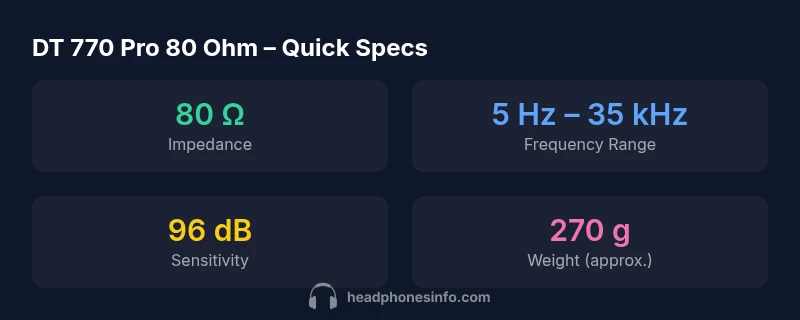
The DT 770 Pro 80 Ohm version has an impedance of 80 ohms, designed for studio use with a DAC/amp. It can be driven by many interfaces but benefits from additional headroom from a dedicated amp.
The 80-ohm version uses 80 ohms and sounds best with a DAC or amp. A simple audio interface will work, but for best dynamics you’ll want a small amplifier.
Are the DT 770 Pro 80 Ohm good for mixing or mastering?
They’re reliable for tracking and casual mixing due to their isolation and emphasis on mids, but they have a bass-forward tilt that may color low-end decisions. Cross-check with a reference headphone when doing critical mastering.
They’re decent for tracking and casual mixing, but you’ll want another reference pair to verify bass decisions.
Do they need an amplifier to perform well?
While they can be driven by many interfaces, a dedicated DAC/amp will improve headroom and dynamics, especially in busy projects. If your source is weak, you’ll hear compression and less slam in the bass.
An amp helps; you’ll hear more detail and more bass slam with a proper DAC/amp.
How do they compare to open-back models?
The DT 770 Pro is closed-back, offering isolation and more controlled bass at the expense of space and airiness. Open-back models tend to sound more expansive but leak sound and offer less isolation.
They’re closed-back, so expect more isolation but less spaciousness compared to open-back models.
Are they comfortable for long sessions?
The padding and clamp are comfortable for many users, though some find the clamp force a bit strong on first wear. The memory foam and Velour earpads help with comfort over hours of use.
Comfort lasts for hours for most people, though the clamp may feel snug at first.
Can they be used for gaming or multimedia?
Yes, they work well for gaming due to their immersive bass and solid soundstage for a closed-back design, but you’ll need a separate mic arrangement if you require in-game voice chat.
Good for gaming if you pair with a mic; the sound is solid for immersive play.
What to Remember
- Explore with a dedicated DAC/amp to unlock dynamics
- Prefer for controlled environments and non-mobile setups
- Expect a warm bass presence with clear mids
- Choose 80 Ohm for professional use; 32 Ohm for portable use
- Rely on detacheable cable and sturdy build for studio durability