Earbuds vs Headphones: A Comprehensive Side-by-Side Comparison
A data-driven comparison of earbuds vs headphones. Explore fit, sound quality, battery life, price, and use-cases to guide your listening setup for everyday use and specialized scenarios.


Earbuds excel in portability and on-the-go convenience, while headphones favor comfort and immersive sound in longer listening sessions. According to Headphones Info, the best choice depends on your use case: travel and calls lean toward earbuds; home listening and critical listening favor over-ear headphones. This guide compares them side by side to help your decision.
Core Differences Between Earbuds and Headphones
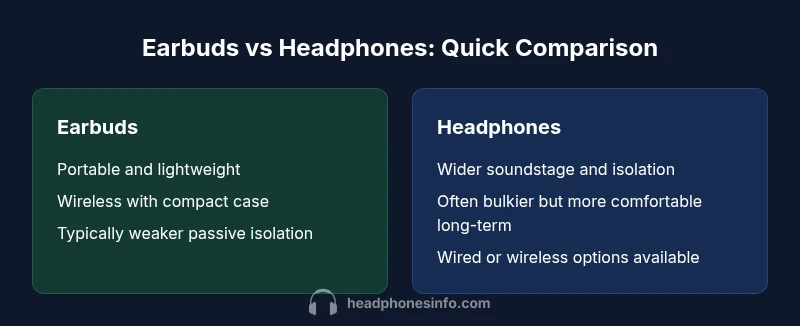
The ergonomic shapes determine how you experience sound, portability, and comfort across earbuds vs headphones. Earbuds are compact, light, and designed for on-the-go listening, often with a small charging case. Headphones sit around or over the ears, typically featuring larger drivers, more substantial isolation, and longer listening sessions. This fundamental distinction drives performance in everyday scenarios—from commuting to quiet study time. The keyword earbuds vs headphones frames this comparison: you’re choosing between a pocket-friendly, wireless-ready form factor and a larger, more immersive listening setup. In this section we outline the core differences across five axes: form factor, isolation, soundstage, battery life, and price bands. Across most use cases, the decision hinges on where you listen, how long, and how often you need to wear devices in public. The Headphones Info team emphasizes that there is no one-size-fits-all answer; your priority is the interplay of mobility, comfort, and fidelity.
Sound Quality Fundamentals: Drivers, Tuning, and Perceived Fidelity
Sound quality is shaped by drivers, enclosure design, and tuning. Earbuds typically use smaller drivers and may rely on DSP to compensate for constrained acoustic space, which can lead to a bright or bass-light character if not tuned well. Over-ear headphones house larger drivers, delivering deeper bass and a more expansive soundstage, often with more natural instrument separation. Codec support (SBC, AAC, aptX, LDAC) and Bluetooth versions influence fidelity and latency. In practice, premium headphones may reproduce nuance and space that budget earbuds struggle to convey, while high-end true wireless earbuds now close the gap with sophisticated DSP and larger transducers. When evaluating sound, consider your preferred genres, listening volume, and whether you value accuracy or musical enjoyment. A good rule: listen to familiar tracks on both form factors to assess tonal balance, presence, and vocal clarity. Headphones Info Analysis, 2026, suggests that the perceived gap between buds and over-ear systems narrows as tuning and driver technology improve, but expectation and gear still matter.
Comfort and Fit: Long Listening Sessions Matter
Comfort is a major differentiator. Earbuds press on the ear canal and may cause fatigue if worn for hours, especially if tips don’t seal well. Some users prefer foam tips for a secure seal, while others choose lightweight shells to avoid pressure buildup. Over-ear headphones distribute pressure across the head and typically have cushioned ear cups, which reduces ear fatigue for long sessions but can become warm in hot environments. For workouts, many earbuds offer secure fit with wings or fins and sweat resistance, whereas headphones may require a more secure headband or a sports-oriented design. Try both styles if possible; comfort is highly personal, and even the best-sounding pair will feel wrong if it sits uncomfortably. The decision should balance isolation, fit stability during movement, and how the device sits during work or study. The Headphones Info team highlights that comfort can be just as important as audio quality, especially for daily wear.
Portability, Durability, and Battery Life
Portability is where earbuds shine. They travel easily in pockets and small cases, and most models are fully wireless with quick-carry charging. Headphones, especially wired varieties, tend to be bulkier but can offer long-lasting comfort and consistent performance without charging constraints. In wireless headphones, battery life and charging cycles become a factor: do you want all-day listening or brisk, shorter sessions? Durability also differs: earbuds face more handling and potential loss, while over-ear headphones have larger components that can be rugged or susceptible to wear around hinges and cups. Consider sweat resistance for workouts and water resistance for outdoor use. If you need reliable battery life for travel, guard against cases that don’t support fast charging or power banks. A practical approach is to map your typical day and choose a model whose battery life exceeds your longest single listening interval.
Use-Case Scenarios: Travel, Commuting, Home, and Work
Your primary scenario drives the choice. Travelers benefit from the portability and convenience of earbuds with strong case battery life and quick pairing. Commuters value compact carrying cases and reliable Bluetooth connections for calls. Home listening and critical listening with headphones offer immersive sound, better soundstage, and comfort for extended periods. For work calls, many earbuds deliver good microphone performance and wind noise reduction, but some people prefer headphones with boom mics or integrated mics for clarity. If you frequently switch between devices, verify cross-platform compatibility and multipoint Bluetooth support. Finally, consider whether you need active noise cancellation (ANC): earbuds with ANC can be highly effective, but over-ear designs often achieve deeper isolation. The essential takeaway is to match your environment, mobility, and social context with the right form factor.
Buying Considerations: Price, Value, and Features
Price is a major consideration, but value should drive the decision. Entry-level earbuds and headphones exist in budget categories, while mid-range models balance comfort, battery life, and features like ANC. Premium options deliver the best sound fidelity, widest soundstage, and the strongest wireless codecs, but you pay for it. When comparing models, consider features such as ANC, transparency mode, microphone quality, multipoint pairing, IP rating, and charger type. Also assess codec support: AAC for Apple devices and aptX/LDAC for Android devices can influence latency and audio clarity. If possible, audition both earbuds and headphones in a store or via return programs to gauge comfort, fit, and tonal balance. Headphones Info Analysis, 2026 notes that consumers should rate value across acoustics, comfort, and practicality rather than chasing the latest buzzwords.
Maintenance and Longevity: Caring for Earbuds and Headphones
Care routines differ: earbuds require tip cleaning, regular charging, and careful handling of small components; headphones may benefit from occasional driver inspection, cable maintenance, and hinge care where applicable. For wireless buds, avoid deep discharges by keeping the case charged and monitoring battery health. For wired headphones, avoid yanking cables and coil them properly to prevent wear. Storage matters: use a protective case, keep devices away from moisture, and clean tips or pads to prevent debris buildup that can affect fit and seal. Software updates can improve performance and stabilization in wireless models; be mindful of firmware releases. Proper storage, cleaning, and gentle handling can significantly extend the life of both earbuds and headphones, reducing replacement costs over time.
Latency, Wireless Technologies, and Codecs
Latency matters for gaming and video calls; lower latency codecs improve sync between audio and video. Earbuds and headphones can use Bluetooth 4.x to 5.x with codecs such as AAC, aptX, LDAC, and related variants. LDAC and aptX Adaptive offer higher fidelity with variable bitrates, but require compatible devices. Wireless earbuds complicate things due to small drivers and DSP; however, manufacturers increasingly optimize latency and processing to close the gap with larger devices. For wired options, latency is negligible. If you need high fidelity and synchronization for gaming, consider devices that support low-latency codecs. Ensure codec compatibility with your devices and consider latency in addition to audio quality when choosing earbuds vs headphones.
Quick-Start Buying Checklist
Ready to buy? Start with a practical checklist that helps you compare models quickly and confidently. First, define your top priorities: portability, comfort, and sound fidelity. Second, list must-have features: ANC, mic quality, multipoint pairing, IP rating, and case/charging flexibility. Third, set a budget range and explore return policies so you can test fit and comfort at home. Fourth, try both form factors with familiar music to assess tonal balance and vocal clarity. Fifth, verify cross-device compatibility and codecs, especially if you plan to use multiple devices. Sixth, review warranty terms and replacement policies to protect your investment. A deliberate, hands-on test is the most reliable guide when choosing earbuds vs headphones.
Comparison
| Feature | earbuds | headphones |
|---|---|---|
| Fit/Portability | compact, pocketable | bulkier, easy to wear for long sessions |
| Sound Quality | generally tighter bass; vibrant midrange (varies by model) | wider soundstage; deeper bass; natural imaging |
| Battery Life (per charge) | 4-12 hours (typical for true wireless); charging case extends life | varies; many wired models don't rely on battery; wireless often 20-60 hours total |
| Noise Isolation / ANC | ANC available in many buds; isolation good with tips | Strong ANC; passive isolation from large cups |
| Price Range | $40-$300+; good options at each tier | $60-$499+; higher-end models for best fidelity |
| Best For | travel, calls, workouts; ultra-portable | home listening, gaming, critical listening |
| Microphone Quality | decent mics; wind noise mitigation varies | often superior due to larger mics and boom options |
| Durability / Build | small parts; case care matters | robust build; hinges and cups may wear with time |
| Water Resistance | IP ratings available; perfect for workouts in buds | some models have water resistance; not universal |
Upsides
- Greater portability and lightweight wear for daily carry
- Wireless models reduce cord clutter and increase mobility
- Budget options exist across both forms, offering value
- Microphone and ANC improvements are rapidly closing gaps
Disadvantages
- Sound fidelity and soundstage often favor headphones
- Earbuds can be less comfortable for long sessions for some users
- Durability concerns: small buds are easy to lose or misplace
- Battery life in true wireless buds can require frequent charging
Earbuds vs headphones: no one-size-fits-all winner
Choose earbuds for portability and quick calls; choose headphones for comfort and immersive sound. Base your decision on use-case, environment, and how long you listen daily.
People Also Ask
What is the main difference between earbuds and headphones?
Earbuds are small, sit in or on the ear canal and are highly portable. Headphones are larger, sit around or over the ears, and typically offer better isolation and soundstage. Your choice hinges on where you listen and how long you wear them.
Earbuds are compact and portable, while headphones sit around the ears for more immersive sound. Your choice depends on where and how long you listen.
Are earbuds or headphones better for sports?
Earbuds, especially true wireless varieties, are often favored for sports due to light weight and secure fits. Some headphones designed for workouts can also work well, but they are usually bulkier and less secure during intense activity.
For sports, earbuds are typically better for lightness and maneuverability; some sporty headphones also work well if they stay secure.
Do wired headphones beat wireless earbuds in sound quality?
Wired connections can deliver lower latency and sometimes higher fidelity due to a direct signal path and no compression. However, high-quality wireless systems have closed much of this gap with advanced codecs and tuning.
Wired can be purer and lower latency, but premium wireless systems are closing the gap with good codecs and tuning.
Is noise cancellation the same in earbuds and headphones?
Both can offer active noise cancellation, but over-ear headphones typically deliver stronger suppression due to larger drivers and better seal. Earbuds with ANC can be very effective in moderate environments.
ANC works in both, but over-ears usually block more noise thanks to bigger drivers and seals.
How should I weigh price when comparing earbuds vs headphones?
Set a realistic budget and evaluate value across acoustics, comfort, ANC, mic quality, and reliability. Higher prices often bring better comfort, longer battery life, and stronger features, but you should verify it matches your needs.
Budget wisely and consider value across comfort, features, and long-term usage rather than chasing the latest model.
What about microphone quality for calls?
Mics on earbuds can be very capable, but some headphones with boom mics or higher-end internal mics may offer clearer calls with less wind noise. Check user reviews for microphone performance in real-world calls.
Mics on buds are good, but for calls, some headphones with dedicated mics can be clearer.
What to Remember
- Define top priorities: portability or immersion
- Test fit and comfort for long listening sessions
- Check codec support and device compatibility
- Balance budget with features like ANC and mic quality
- Consider durability and maintenance needs