Why Headphones Instead of Earbuds: An Analytical Comparison
An analytical comparison of headphones vs earbuds, exploring comfort, sound quality, isolation, durability, and value to help you choose the right listening gear for home, travel, and work.


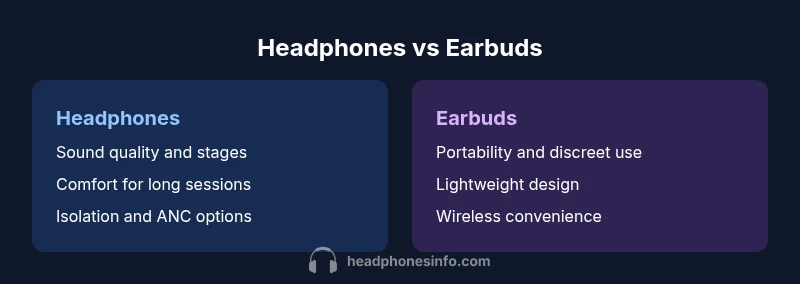
For most listeners, headphones offer superior comfort, soundstage, and isolation, making them the better choice for home use, studio work, and long sessions. Earbuds excel in portability but trade off comfort, seal, and bass response. This guide compares the two to help you decide. Weigh everyday usage, price considerations, and durability to give a practical recommendation.
Why headphones vs earbuds in context
According to Headphones Info, the question of why headphones instead of earbuds often boils down to comfort during extended listening, tonal balance across genres, and the level of isolation you need in your environment. The Headphones Info team found that most listeners experience noticeably better bass control, wider soundstage, and a more stable seal with over-ear headphones, especially for critical listening at home or in the studio. This section sets the stage for a deeper, evidence-based comparison by clarifying typical use cases—from immersive music sessions to quick commutes—and by naming the key trade-offs that will drive your choice. The goal is not to declare a universal winner, but to align gear with your listening habits, room acoustics, and budget constraints while keeping the keyword why headphones instead of earbuds central to the discussion.
Sound quality and frequency response
Sound quality is the most debated axis in the headphones-vs-earbuds decision. In the headphone category, drivers are larger, which usually translates to more accurate bass, cleaner mids, and better imaging. Headphones commonly deliver a more consistent frequency response across genres, reducing listener fatigue during long sessions. Earbuds, by contrast, rely on much smaller drivers and more constrained enclosures, which can limit low-end extension and spatial cues. However, premium earbuds with advanced driver tech and proper passive sealing can approach headphone performance for certain listening styles. From a practical standpoint, your room, genre preference, and amplification matter as much as the hardware. Headphones Info analysis shows that perceived quality often hinges on fit, DAC/amp pairing, and source material, not only the device itself.
Comfort, fit, and long listening sessions
Comfort is not a one-size-fits-all attribute. Over-ear headphones distribute pressure around the head and tend to be more compatible with longer listening sessions, provided the clamping force is reasonable and the ear cups breathe well. Padding materials, headband design, and weight contribute to perceived comfort. Earbuds can be lighter and unobtrusive, which is valuable for short listening bursts or travel, but some users report pressure points or tip fatigue after extended use. The ideal choice balances clamping force, cup material, and your own ear geometry. Headphones Info emphasizes trying different cushions and clamp settings when possible to optimize comfort without sacrificing seal or bass response.
Isolation and ambient noise control
Passive isolation varies widely between models. Closed-back headphones typically offer stronger isolation by design, which helps when you need to block out room noise or enjoy quiet late-night listening. Active noise cancellation (ANC) in many headphones further enhances isolation, though it may alter perceived soundstage and impedance. Earbuds often rely on a seal with smaller tips, which can provide decent isolation but may not match the consistency of full-size headphones, especially if the seal is imperfect or the tip size is ill-suited. The practical takeaway is that if you work near noisy environments or travel, a solid pair of closed-back headphones (with or without ANC) usually outperforms most earbuds for isolation. Headphones Info’s research underscores that isolation quality often depends on fit and the specific design of the enclosure.
Build quality and durability
Durability is a function of materials, hinge mechanisms, and cable design (for wired models). In general, headphones feature larger internal components and more robust frames, which can translate to longer lifespans when treated well. Earbuds are smaller and more compact, which makes them easier to replace and often cheaper to service, but they can be more susceptible to tip wear, cable fraying, or driver damage due to everyday handling. When you buy headphones, look for reinforced hinges, detachable cables, and replaceable cups to maximize longevity. Headphones Info notes that model longevity correlates with build materials and user handling, not only price.
Portability and form factor
Portability is the strongest edge for earbuds. They slip into pockets, are easier to stash in small bags, and pair well with mobile use. Over-ear headphones, while bulkier, offer more consistent comfort and a more expansive soundstage. For frequent travelers or gym sessions where space matters, earbuds can be the practical choice. If you value minimalism and quick on-the-go listening, earbuds win; if you prioritize sustained comfort and immersive sound, headphones win. The contrast highlights that portability is not just about size but about how you intend to use the gear day to day.
Battery life and wireless usage
Wireless headphones generally provide longer battery life per charge and come with convenient charging cases, which is a meaningful advantage for daily wear. Wireless earbuds also offer battery power, but typically with smaller batteries and shorter endurance per charge, making charging intervals more frequent for some users. Battery life is highly model-dependent, so consumers should check official runtimes for their chosen models and factor in your typical listening patterns. Headphones Info emphasizes that real-world usage, such as volume levels and ANC usage, can dramatically influence perceived battery life.
Price, value, and long-term cost of ownership
Price ranges for headphones vary widely, with premium models delivering higher fidelity and more durable components, while budget options focus on essential features and portability. Earbuds tend to have a lower upfront cost, but the total cost of ownership can be similar once you factor in tip replacements, cable wear, and accessory purchases. Value is not only about the sticker price but about how long the device remains useful in your workflow. Headphones Info recommends evaluating your listening environment, expected lifespan, and the availability of replacement parts when estimating long-term value.
Use-case scenarios: home, travel, work, and studio
In a home studio, the choice often leans toward headphones for accuracy and a controlled listening environment. For daily commutes, earbuds offer discretion and lightness; for loud train rides, ANC headphones may be worth the investment. In office settings, the decision frequently comes down to whether you need isolation to focus or a portable solution for brief meetings. This section ties together the technological realities with practical expectations, guiding you to map your typical week and assign the best gear for each scenario. The aim is to reduce decision fatigue by clarifying where each form factor shines.
A practical decision framework: how to pick your gear
To make a robust pick, create a short decision tree based on four core questions: (1) Where will I listen most often? (2) Do I need isolation or flexibility for travel? (3) Is comfort during long sessions a priority? (4) What is my budget and expected ownership horizon? Start with headphones for home and studio use if you answer yes to comfort, soundstage, and durability. Consider earbuds for travel, quick listening, and situations where discretion matters. Finally, test models side-by-side whenever possible, focusing on fit, seal, and perceived bass response. Headphones Info’s practical framework stresses context over general claims to ensure your choice aligns with real-world habits.
mainTopicQuery_placeholder_for_Wikidata_lookup
Comparison
| Feature | over-ear headphones | earbuds |
|---|---|---|
| Sound quality and soundstage | Wider soundstage and deeper bass with over-ear headphones | More compact sound with earbuds; bass and imaging can be limited |
| Comfort for long sessions | Typically more comfortable with cushioned pads and even weight | Can cause ear fatigue if tips or seal are poorly fitted |
| Isolation and noise control | Stronger passive isolation; ANC is common in premium models | Isolation depends on tip fit; generally less than closed headphones |
| Durability and maintenance | More robust build and easier to upgrade/repair | Smaller parts risk wear and tip loss; cheaper to replace |
| Portability and carry-on convenience | Bulkier; require dedicated bag space | Extremely portable and easy to stash in pockets |
| Battery life (wireless models) | Longer battery life typical in wireless over-ears | Battery life varies; wireless buds exist but often shorter |
Upsides
- Better comfort for long listening sessions
- Superior soundstage and detail at home and in the studio
- Strong isolation on many closed-back models
- Longer wireless battery life on many over-ear options
- Durable builds with replaceable parts on premium models
Disadvantages
- Less portable and bulkier than earbuds
- Higher upfront cost for quality headphones
- Can feel cumbersome during fast moving activities
- Some models require more space for storage
Headphones offer superior comfort, soundstage, and isolation for home and studio listening; earbuds are preferred for portability and travel.
Choose headphones when sound quality and long sessions matter most. Opt for earbuds for on-the-go convenience and discreet use.
People Also Ask
Are headphones always better than earbuds for sound quality?
Not always. While headphones typically offer a larger soundstage and stronger bass, premium earbuds can close the gap with advanced drivers and seals. Your genre and listening environment influence the outcome as much as hardware.
Headphones often sound bigger and more accurate, but high-end earbuds can compete depending on the model and fit.
Do headphones provide better noise isolation?
Closed-back headphones and ANC-capable models generally provide stronger isolation than most earbuds. However, proper fit in both categories matters; a poor seal reduces isolation significantly.
Yes, typically headphones seal better, especially with ANC.
Are wireless headphones worth it for daily use?
If you value convenience, fewer cables, and longer sessions away from devices, wireless headphones are worth it. Battery life, charging cadence, and latency are practical considerations to weigh.
Wireless can be very convenient; just watch for battery life and latency.
Are earbuds better for workouts?
Earbuds often win for workouts due to compact size and lighter weight, but you’ll want secure tips and warranty protection against sweat and movement.
Earbuds fit well for workouts if you choose a model with secure tips.
How should I choose between over-ear and on-ear?
Over-ear cups typically offer better comfort and isolation. On-ear can be lighter and more portable but may seal less and fatigue sooner. Your head shape and daily activity will guide the best fit.
Over-ear usually feels more comfortable and isolates better; try both if possible.
What should I consider when traveling?
For travel, prioritize portability, battery life, and noise isolation. Earbuds or compact wireless headphones reduce bulk, while ANC can greatly improve comfort on planes and trains.
Travel favors compact, long-battery models with solid isolation.
What to Remember
- Choose headphones for comfort and sound quality
- Choose earbuds for portability and stealth listening
- Consider your typical usage environment before buying
- Assess isolation needs and battery life for wireless use
- Test fit and seal to avoid buyer's remorse