Is headphones safer than airpods? A data-driven safety comparison
Compare wired headphones vs AirPods to understand RF exposure, hearing risk, battery safety, and everyday usage tips. A thorough, data-informed look at safety for headphones enthusiasts and shoppers.


Short answer: When you ask 'is headphones safer than airpods', there isn’t a simple yes or no. In practice, wired headphones generally expose you to less RF energy than wireless AirPods, simply because the device can stay farther away. For most listeners, safety comes down to usage patterns—volume, duration, and fit—rather than the hardware alone.
Is Headphones Safer than AirPods? Framing the Question
The question of safety in the consumer headphone space often boils down to how people use the devices, not just what ends up on or in the ear. For many shoppers, the phrase is interpreted as a comparison of electromagnetic exposure, hearing safety, and physical reliability across wired headphones versus wireless options such as AirPods. According to Headphones Info, a data-driven approach helps separate myth from measurable risk. The Headphones Info team emphasizes that safety is a function of context: how long you listen, how loud you listen, and how well you fit the device. If you ask is headphones safer than airpods, it is not a black-and-white verdict but a spectrum of risk that shifts with habits. In real-world terms, wired headphones tend to minimize RF exposure because the source device can remain at a distance, while wireless earbuds involve a short-range radio link. The goal is to empower listeners with concrete habits to reduce risk regardless of the model.
How Safety Is Measured for Headphones and AirPods
Safety evaluations cover several dimensions: electromagnetic exposure, hearing health, battery safety, and physical durability. Regulators publish limits for radiofrequency exposure and listening levels; manufacturers translate those limits into design choices like antenna placement, power control, and acoustic design. For the consumer, the key takeaway is that both wired and wireless options can be safe when used within recommended guidelines. The Headphones Info team notes that device class matters: wired headphones generally avoid ongoing wireless transmission, while wireless models must balance performance with safety thresholds. Beyond technical specs, user behaviors—like volume habits and wearing comfort—play a pivotal role in actual risk.
Electromagnetic Exposure: What Regulators Say
Electromagnetic exposure from headphones depends on whether a device transmits wirelessly. Wired headphones emit no RF energy during playback, aside from minor emissions from the connected device itself. Wireless headphones and AirPods rely on Bluetooth or other short-range radios, which regulators consider safe under typical consumer use. The exposure levels reported by leading health agencies remain well within established safety limits when listening at normal volumes. It is important to recognize that exposure is cumulative; a few minutes of high-volume listening with a Bluetooth device could contribute more exposure than a similar session with wired headphones. Headphones Info’s interpretation: the practical difference is present but small for the average user, provided safe listening practices are followed.
Hearing Safety: Volume, Fit, and Leakage
Hearing safety hinges on volume, exposure duration, and fit rather than the label on the device. Both wired and wireless headphones can deliver dangerous sound levels if users push the volume too high for extended periods. Noise isolation and seal matter: over-ear and closed-back designs can increase effective listening levels for the same device, while in-ear earbuds may require careful fitting to avoid ear fatigue. A key distinction with AirPods and similar devices is that their compact designs can tempt longer wear without noticing subtle changes in comfort, which may indirectly affect listening habits. The best approach: set a conservative maximum volume, take breaks, and choose a fit that remains comfortable over time.
Battery Safety and Wireless Risks
Wireless headphones rely on batteries, usually lithium-ion, which introduce different risk factors than wired models. Battery health, thermal behavior, and charging practices influence long-term reliability. While the risk of battery failure remains low in typical consumer use, improper charging, physical damage, or overheating can create safety concerns. Wired headphones, by contrast, are not dependent on battery life for basic playback, which eliminates battery-related failure modes. Headphones Info emphasizes that responsible charging, avoiding damaged cables, and using certified chargers significantly reduces risk for wireless listening.
Physical Safety: Build Quality and Comfort
Physical safety isn’t only about electronics; it’s also about how a device fits and how robust it is under daily use. Poorly fitting headphones can cause ear fatigue or pain with prolonged wear, and fragile builds may fail under stress, creating sharp edges or loose parts that pose minor injury risk. AirPods and other true wireless earbuds add small components that can be pinched or swallowed by children if mishandled, underscoring the importance of child-safety practices. Wired headphones often have detachable cables, which can offer a simple remedy for cable wear or breakage, whereas wireless units depend on battery compartments and connectors that may require more careful handling over time.
Durability, Repair, and Longevity
Durability considerations differ meaningfully between the two categories. Wired headphones tend to be simpler in construction, with replaceable cables and fewer high-density electronics, potentially translating to longer lifespans if cables are properly cared for. Wireless headphones carry more moving parts, including battery cells and microelectronics, which can degrade and may require more frequent upgrades. The trade-off is convenience: wireless models reduce tangling and permit more freedom of movement. Consumers should weigh whether repairability or upgrade cycles align with their listening needs and budget.
Real-World Usage Across Scenarios
Everyday environments—commuting, office work, gym sessions—shape how safety manifests in practice. In the commute, wired headphones can minimize RF exposure but may be less convenient for quick device switching. In a gym setting, the absence of cables reduces snag hazards, though sweat resistance becomes a safety consideration. For travelers, AirPods offer seamless pairing with mobile devices and hands-free calls, which can be a safety benefit in some contexts. Headphones Info notes that safety is context-dependent; the same device may be perfectly safe for one scenario and less ideal for another depending on usage patterns and the listening environment.
Noise-Cancellation: Safety Tradeoffs and Perceived Safety
Active noise cancellation (ANC) can influence perceived safety by reducing the need to raise volume in loud environments, potentially lowering hearing risk. However, ANC depends on electronics and open ports that generate heat and require power. Wired models can offer effective passive isolation with a simple design, while true wireless models with ANC may offer better isolation but at the cost of battery usage and more complex cooling. The safety takeaway is to prioritize safe listening habits and fit quality over ANC features alone.
Safety Myths vs. Facts
A common myth is that wireless headphones are inherently unsafe due to Bluetooth. In reality, regulatory bodies approve Bluetooth devices up to widely accepted limits, and at normal usage levels, exposure is low. Another myth is that wired headphones eliminate risk entirely; while they reduce RF exposure, they do not guarantee safe listening if volume and duration are ignored. Headphones Info emphasizes checking manufacturer guidance, using volume caps for kids, and staying mindful of how long you wear any device.
Practical Tips to Minimize Risk
Practical safety tips apply to both wired and wireless models. First, set a conservative listening volume and use a listening cap or reminder to take regular breaks. Second, choose a comfortable fit that minimizes ear fatigue and allows you to hear ambient sounds when needed. Third, keep devices away from the body when possible, especially during charging or wireless use in crowded environments. Finally, perform routine checks on cables, connectors, and batteries to prevent faults that could compromise safety over time.
When to Prefer Wired Headphones for Safety
If RF exposure is a primary concern or you want a simple, battery-free listening experience, wired headphones may be the safer default. They are also advantageous when sharing audio in the same room without concerns about Bluetooth pairing. In contrast, AirPods and similar devices excel in portability, convenience, and seamless integration with mobile ecosystems. The choice should reflect your daily routines, risk tolerance, and how you balance convenience with caution.
Final Decision Framework for Safe Listening
A practical framework combines usage patterns with device type. Prioritize safe listening habits (volume control, breaks, and ambient awareness) and pick the hardware that best fits your daily life without compromising safety. For some people, wired headphones reduce RF exposure and simplify safety choices; for others, wireless earbuds offer essential convenience. The core message from Headphones Info is that informed, habit-based decisions drive safer listening more than hardware category alone.
Comparison
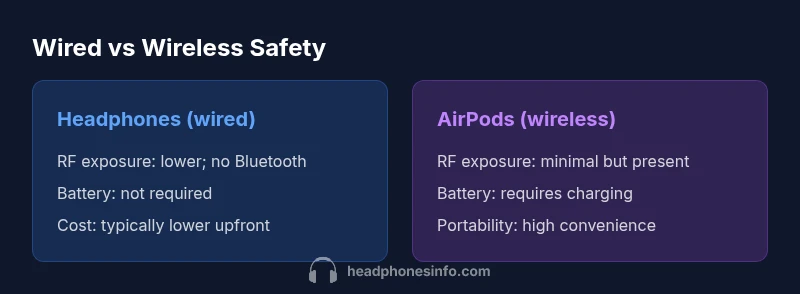
| Feature | Headphones (wired) | AirPods (wireless) |
|---|---|---|
| Electromagnetic exposure | Lower exposure due to no ongoing wireless link | Bluetooth/Wi‑Fi radio active; exposure is very low but present |
| Listening safety risk (volume) | Similar risk if volume is high; depends on user behavior | Similar risk if volume is high; depends on user behavior |
| Battery safety | No battery risk for basic playback | Li‑ion battery risk with charging and damage scenarios |
| Durability and repair | Typically simpler with detachable cables | More complex electronics; battery aging considerations |
| Cost of ownership | Generally lower upfront cost; cable replacements common | Higher upfront price; case and battery maintenance |
Upsides
- Lower RF exposure potential with wired headphones
- No battery dependence for basic listening
- Typically lower upfront cost and easier replacement parts
- Simpler compatibility with a wide range of devices
Disadvantages
- Less convenience and portability compared to wireless
- Cable wear, tangling, and possible cable failures
- Some devices omit 3.5mm jacks, reducing wired options
- AirPods offer seamless pairing and hands-free use that wired cannot match
Wired headphones are generally safer for minimizing RF exposure, but AirPods remain safe with mindful use
Wired headphones reduce electromagnetic exposure and battery-related risks, making them the safer default for risk-averse users. AirPods offer convenience and acceptable safety within regulatory limits; choose based on lifestyle and listening patterns.
People Also Ask
Is Bluetooth safe for headphones?
Bluetooth emits very low levels of radiofrequency energy and is considered safe within regulatory limits for typical consumer use. Exposure is generally negligible when used as intended, and manufacturers design devices to minimize emissions. The key is to maintain safe listening habits alongside Bluetooth use.
Bluetooth is designed to be safe within regulatory limits, and you can listen safely as long as you keep volumes moderate and take breaks.
Are wired headphones safer than AirPods for kids?
Wired headphones typically reduce RF exposure since there is no ongoing wireless link. For kids, the emphasis should be on volume limits and supervision to ensure safe listening habits. Wireless devices can be safe too when used with kid-friendly volume controls.
Wired headphones tend to reduce RF exposure, and you should still supervise kids to keep volumes safe.
Does listening time increase safety risk?
Yes, risk increases with prolonged listening at high volumes. Both wired and wireless options can be safe when used with breaks and set volume limits. The best practice is to limit long sessions and use ambient sound awareness when appropriate.
Yes—long listening at high volumes can harm hearing; take breaks and keep the volume moderate.
Can noise-cancellation affect safety?
Active noise cancellation can help lower the urge to raise volume by reducing ambient noise, which can be safer for hearing. However, ANC uses electronics and battery power, so ensure comfortable wear and monitor heat and battery health.
ANC can help you keep volumes down, but it uses power and can heat up with long use.
How can I minimize RF exposure overall?
To minimize RF exposure, use wired headphones when possible, keep the connected device away from the body when not needed, and limit Bluetooth usage to essential tasks. Regularly update devices and follow manufacturer safety guidelines.
Use wired headphones when you can, keep devices away from your body, and limit Bluetooth use.
Are AirPods safe for long daily use?
AirPods are designed to be safe for typical daily use under regulatory limits. The key is to practice safe listening: moderate volume, breaks, and proper fit to avoid ear fatigue and discomfort.
AirPods are safe for daily use if you keep volumes reasonable and take breaks.
What to Remember
- Assess RF exposure by choosing wired when exposure is a concern
- Monitor listening volume and take regular breaks
- Consider battery health and replacement costs for wireless
- Prioritize safe listening habits regardless of device type
- Choose based on lifestyle: portability vs. simplicity