What Headphones Get the Loudest: A Data-Driven Guide
Discover which headphones reach the highest SPL, how to compare loudness across models, and how to safely enjoy louder playback with Headphones Info’s data-driven analysis.


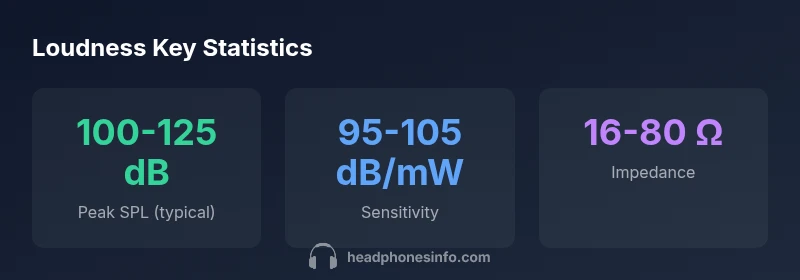
Headphones with the highest potential SPL typically reach peak 100-125 dB when driven by capable amplification. Real-world loudness depends on driver efficiency, impedance, and how the source matches the load. For fair comparisons, compare sensitivity (dB/mW) alongside the manufacturer’s stated max SPL and recommended operating range.
Understanding loudness measurements: SPL, dB, and metrics
Loudness is governed by sound pressure level (SPL), measured in decibels (dB). In practice, manufacturers report max SPL to indicate a headphone's loudness potential, but the numbers vary with test conditions. Sensitivity, expressed as dB per milliwatt (dB/mW), tells you how efficiently a headphone converts electrical power into sound. Impedance and the power available from your source further influence what you actually hear. When you compare models, focus on three numbers: max SPL, sensitivity, and impedance. A headphone with high sensitivity requires less power to reach a given loudness, but if it has high impedance, it may need a stronger source or an amp to unlock that potential.
Real-world loudness is shaped by the content you listen to, the dynamic range of the track, and how your source channels power to the drivers. Two headphones with similar sensitivity can feel different in loudness if one is paired with a weaker amplifier or has higher distortion at high SPL. Be mindful that peak SPL numbers assume ideal conditions and do not always reflect comfortable listening levels.
How max SPL is reported and why it's not the whole story
Manufacturers often publish a peak SPL under controlled test conditions, typically at a fixed frequency (often around 1 kHz) and a set input power. This figure describes what the driver could produce under ideal circumstances, not necessarily what you’ll experience in everyday listening. Factors such as summing loudness across frequencies, harmonic distortion, and the source’s ability to deliver power all shape the audible result. Because test setups vary, two headphones with the same advertised max SPL can sound differently when playing music with rich, low-frequency content. When evaluating loudness, compare max SPL alongside sensitivity and impedance, and consider realistic listening scenarios rather than relying on peak numbers alone.
Driver efficiency, impedance, and amplification: the triad that makes headphones loud
Loudness is primarily a function of driver efficiency (sensitivity) and how much clean power your source can deliver. Low-impedance headphones commonly reach higher SPL with mobile devices or small amps because they draw more current for a given voltage. In contrast, high-impedance models often need a stronger amplifier to achieve the same SPL. A practical takeaway: a highly sensitive, low-impedance design can produce loud output with a modest source, but if you pair it with a weak or noisy amp, the perceived loudness may not meet expectations. Matching headphones to an appropriate source is essential for unlocking their loudness potential without introducing distortion.
How to compare loudness across models: a practical framework
To compare loudness effectively:
- Look at max SPL and sensitivity (dB/mW) together rather than in isolation.
- Check impedance to understand power requirements and source compatibility.
- Consider the amplifier or DAC you’ll use; a capable source can unlock more headroom for high-impedance designs.
- Use an SPL meter at the listener’s ear with a steady test tone to validate real-world loudness under controlled conditions.
- Review distortion ratings at high SPL; lower distortion at high levels means you’ll perceive cleaner loudness.
- Remember that content and genre influence perceived loudness; a loud track with heavy bass can feel punchier than a high-SPL test tone.
Real-world factors that influence perceived loudness
Perceived loudness is not just dB on a meter. Content dynamics, equalization, and mastering choices shift how loud something feels. Streaming services apply loudness normalization, which can reduce peak levels even when a headphone could technically reach high SPL. EQ adjustments can also dramatically alter the energy distribution across frequencies, making some tracks seem louder than others without increasing the measured SPL. Content that emphasizes bass or has a wide dynamic range may challenge even efficient headphones to deliver consistent loudness without distortion. Finally, cabling and wireless codecs can introduce compression or losses that subtly affect how loud the music sounds in real listening sessions.
Safety-first approach: listening safely while chasing loudness
Pursuing loud playback should not come at the expense of hearing health. Use volume-limiting features on devices, especially when handing headphones to others or using headphones for long sessions. Take regular breaks during listening, and start with a modest volume, especially if you are testing new equipment. If you notice distortion or listener fatigue, reduce the level and re-evaluate with shorter listening intervals. The goal is to balance effective loudness with long-term listening safety, rather than simply chasing higher SPL figures.
The role of content and source material in loudness
Content quality and mastering influence how loud headphones can feel. A track compressed for loudness may push listeners toward higher volumes, while more dynamic material can feel equally loud without raising SPL as aggressively. Source quality, including DAC and streaming bitrates, also plays a role in the perceived loudness by preserving or eroding dynamic range. When shopping, consider not just the specs but how you typically listen—studio monitors, casual playlists, gaming broadcasts—and how your usual source chain (phone, desktop, dedicated DAC/amp) will interact with the headphones’ efficiency and impedance.
Loudness-factors by category
| Category | Typical Max SPL (dB) | Typical Sensitivity (dB/mW) | Impedance (ohms) | Notes |
|---|---|---|---|---|
| Entry-level wired | 90-100 | 85-95 | 16-32 | Budget option with modest loudness |
| Mid-range wireless | 95-110 | 90-100 | 14-32 | Common pairing with phones |
| High-end wired | 100-120 | 100-110 | 32-80 | Premium tuning with higher headroom |
| Gaming headphones (wired) | 95-115 | 95-105 | 24-48 | Built for immersive loudness |
People Also Ask
What does the term 'max SPL' mean for headphones?
Max SPL is the highest sound pressure level a headphone can produce under certain test conditions. It indicates loudness potential but does not reflect typical listening levels. Always view max SPL alongside sensitivity and impedance for a complete picture.
Max SPL shows how loud a headphone can get under test conditions, not necessarily what you’ll hear in everyday use.
Do wireless headphones get as loud as wired models?
Wireless headphones can reach high SPLs, especially with efficient drivers and strong sources, but power and codec constraints can limit maximum loudness compared with some wired designs. The best approach is to compare max SPL and sensitivity while accounting for your source.
Wireless can be very loud if the driver is efficient and the source can supply enough power.
How should I measure loudness safely?
Use a calibrated SPL meter placed at the listener’s ear with a consistent test signal. Compare multiple headphones using the same test conditions and refer to manufacturer curves for context. Avoid relying on impressions alone.
Use an SPL meter at your ear and compare headphones under the same test conditions.
Can listening to loud headphones cause hearing damage?
Yes. Prolonged exposure to high SPL can harm hearing. Use volume limits, take regular breaks, and monitor for fatigue or distortion. Safer listening preserves hearing while still allowing enjoyable volume levels.
Yes, high volumes over time can damage hearing; use breaks and limits.
What factors influence loudness more than brand?
Loudness is mainly driven by driver efficiency, impedance, sensitivity, and how you power the headphones. Brand name alone does not determine loudness. Compare specs and test with your source to gauge real-world results.
Loudness depends on efficiency, impedance, sensitivity, and power from the source, not brand alone.
Are there legal limits on headphone SPL?
There is no universal legal cap on headphone SPL. Safety guidelines exist to help consumers listen responsibly, and regions may publish recommendations for safe listening levels.
There isn’t a universal legal limit, but guidelines exist for safe listening.
“Loudness is driven by driver efficiency and the power you can deliver from your source; prioritize sensitivity and proper amplification when evaluating headphones.”
What to Remember
- Actively compare max SPL with sensitivity to gauge loudness potential
- Match impedance and source power to unlock headphone loudness
- Consider content dynamics and streaming normalization when evaluating real-world loudness
- Prioritize safe listening practices alongside loudness goals