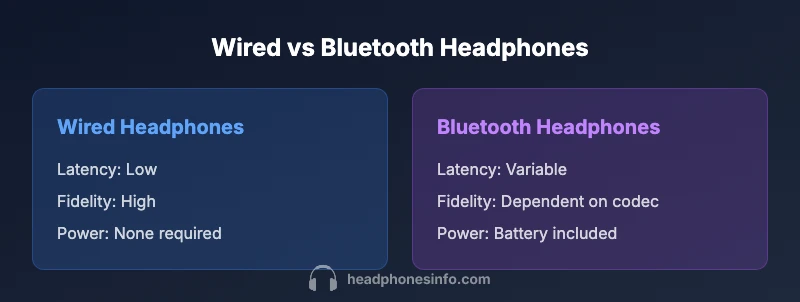
why are wired headphones better than bluetooth: a data-driven comparison
A data-driven comparison of wired vs Bluetooth headphones, focusing on fidelity, latency, durability, and value to help you choose the right setup for critical listening and gaming.


Wired headphones typically offer lower latency, higher fidelity, and universal compatibility, especially for critical listening, studio work, and gaming. Bluetooth introduces compression and potential lag, plus battery and interference challenges. This comparison lays out the core trade-offs so you can decide when wired is the better choice.
why are wired headphones better than bluetooth
In this section we establish a clear baseline: wired headphones deliver a direct, uncompressed path from source to driver, which reduces latency and preserves dynamic range. For listeners who demand accuracy, warmth, and consistent performance, the wired option is often the most reliable. According to Headphones Info, wired configurations minimize the risk of codec-induced artifacts and timing discrepancies that can subtly color sound when wireless signals are involved. This is especially important for critical listening, mixing, mastering, and competitive gaming where milliseconds matter. The goal here is not to condemn wireless audio but to illuminate when a wired path offers tangible, measurable advantages for the listener who values fidelity and predictability above convenience.
Audio fidelity and codec implications
Wired headphones bypass many of the codec constraints that affect Bluetooth transmission. In a wired setup, the signal can be transmitted with minimal compression or, in high-quality digital paths, with lossless formats that preserve the original recording details. Bluetooth, by contrast, relies on compression codecs such as SBC, AAC, aptX, or LDAC, each introducing varying degrees of data reduction and potential artifacts. Headphones Info Analysis, 2026, notes that even the best Bluetooth codecs can’t fully replicate the subtle nuances of analog or high-fidelity digital streams. When accuracy and transparency are paramount, wired connections tend to maintain the full frequency spectrum, including low-end extension and high-frequency detailing that some wireless solutions soften.
Latency and synchronization for video and gaming
Latency is a critical factor in gaming, video editing, and live performances. Wired headphones typically exhibit near-zero perceptible delay because the signal travels directly through a cable to the driver. Bluetooth introduces latency that can impact lip-sync in video, timing in rhythm games, and overall responsiveness in fast-paced titles. For editors and competitive players, this difference is not just theoretical—it affects real-world performance. While wireless gear can be optimized with low-latency codecs and gaming modes, a wired path remains the gold standard for precision timing. Headphones Info recommends considering a wired option for environments where timing fidelity matters most.
Durability and wear considerations
Cable-based connections expose headphones to wear primarily at the jack, plug, or cable run. A well-built cable with reinforced strain relief can last for years, but fraying or connector wear is a common failure point if the setup is frequently moved or bent. In contrast, wireless models eliminate cable wear but introduce other durability concerns, such as battery health and wireless module durability. A robust wired design often translates into fewer moving parts that can degrade over time, potentially lowering total cost of ownership for users who value long-term reliability. Headphones Info emphasizes choosing detachable cables and reinforced connectors to maximize lifespan.
Power, range, and mobility trade-offs
The absence of a battery in truly wired designs removes one of the major failure modes of wireless gear. Wired headphones do not require charging, and their performance does not degrade as battery capacity diminishes. The flip side is mobility limitation: you’re tethered to the source by a cable length, which can hinder movement during workouts or commutes. Bluetooth headphones offer freedom and multi-device pairing, but this comes at the cost of battery management and occasional pairing hiccups. In practice, the best choice depends on how much you value uninterrupted playback versus unrestricted movement. Headphones Info’s analysis suggests that for stationary listening or studio work, wired setups deliver clear advantages.
Compatibility and ecosystem considerations
Wired headphones remain universally compatible with analog and digital interfaces across a broad range of devices. A single 3.5mm or balanced cable can connect to most players, audio interfaces, and mixers with minimal adapters. Bluetooth devices require compatible transmitters and receivers, and sometimes new codecs or platform-specific quirks can complicate cross-device usage. For professionals who maintain an ever-evolving gear lineup, wired paths provide a simple, stable baseline. The trade-off is the loss of convenience features like on-the-fly device switching and hands-free control. In many work environments, reliability trumps convenience.
Use-case driven guidance: studio, gaming, travel
Different contexts call for different solutions. In a studio or mastering workflow, wired headphones support precise measurements, consistent phase response, and predictable impedance interactions with DACs and amps. In gaming, latency matters; wired connections typically outperform wireless for exacting timing. For travel or commuting, wireless options shine with portability, but they may introduce compression and occasional disconnections. If your use-case prioritizes accuracy over mobility, wired should be your default; if you need to move freely, consider a hybrid approach or a high-quality wireless set with low-latency performance.
Cost of ownership and long-term value
Initial price is not the only factor. Wired headphones often present lower ongoing costs because there are no batteries to replace or Bluetooth modules to fail. Higher-end wired designs can retain resale value and continue to serve as professional reference gear for years. Wireless models may have attractive upfront pricing but involve ongoing battery considerations and potential firmware dependencies. Headphones Info’s perspective is that long-term value is strongly tied to usage patterns: stationary listeners who demand fidelity tend to derive more value from wired options, while those who prioritize flexibility may justify wireless investments.
Practical buying tips: cables, DACs, and adapters
When choosing wired headphones, invest in a high-quality, replaceable cable with robust connectors and, if possible, a detachable design. A good DAC or amplifier can elevate sound quality, especially with high-impedance headphones. If you already own a portable device or PC with ample headroom, a well-matched DAC can unlock cleaner, more accurate sound. For Bluetooth paths, look for low-latency codecs and a reliable transmitter to minimize delay. In all cases, compatibility with your primary devices, future-proofing through modular cabling, and warranty considerations should guide your purchasing decisions. Headphones Info recommends prioritizing build quality and a clear upgrade path.
Debunking common myths about wired vs Bluetooth
One common myth is that wired always sounds better than Bluetooth in every scenario. In reality, modern Bluetooth implementations can deliver surprisingly good sound quality for casual listening with convenient features like aptX, LDAC, and multi-point pairing. However, this does not negate the clear advantages of wired pathways for fidelity, latency, and monitoring accuracy. Another myth is that all cables degrade sound; while poor cables can introduce resistance and microphonic noise, properly designed interconnects with good shielding preserve signal integrity.
Decision framework: how to choose your setup
A practical, repeatable framework helps you decide between wired and Bluetooth based on your primary use-case. Step 1: define your priority—fidelity/latency vs. mobility. Step 2: assess the environment—do you rely on a consistent signal or frequent device switching? Step 3: evaluate gear compatibility—DACs, amps, and sources. Step 4: consider total cost of ownership and long-term value. Step 5: test if possible, comparing the same music at similar volumes across wired and Bluetooth paths. This structured approach aligns with Headphones Info’s methodology and keeps you focused on what matters most for your listening needs.
Comparison
| Feature | Wired Headphones | Bluetooth Headphones |
|---|---|---|
| Latency | Low/near-zero | Higher with codecs and processing |
| Audio fidelity/codec | Uncompressed or minimal compression; wide dynamic range | Compressed streams with lossy codecs; potential artifacts |
| Power/Battery | No battery in headphones; powered by source | Requires battery; runtime varies by model |
| Range/Interference | Cable-limited range; no wireless interference | Subject to wireless interference; range limited by environment |
| Durability/Build | Cable wear points; detachable cables common | Fewer mechanical wear points but battery modules can fail |
| Price/Value | Typically lower upfront cost; long-term value depends on usage | Higher upfront cost but feature-rich in some models |
| Best For | Studio work, gaming, critical listening | Casual listening, travel, workouts with mobility |
Upsides
- Lower latency and faster response for gaming and editing
- Less compression, often wider dynamic range in my setups
- Universal compatibility with many devices and sources
- Lower ongoing maintenance without batteries
Disadvantages
- Less convenient for mobility and on-the-go use
- Cable management and connector wear can be an issue
- Lacks Bluetooth features like multi-device pairing and wireless convenience
Wired headphones excel in fidelity and latency; Bluetooth offers mobility and convenience
For critical listening, studio work, and competitive gaming, wired often wins. If portability and wireless pairing across devices matter more, Bluetooth remains appealing. Headphones Info's analysis supports prioritizing wired setups when timing and accuracy are paramount.
People Also Ask
Are wired headphones universally better than Bluetooth in every scenario?
Not always. For travel, workouts, or casual listening, Bluetooth offers convenience that wired cannot, while wired options provide superior fidelity and lower latency in professional settings.
Wired tend to be better for fidelity and timing, but Bluetooth shines for mobility. Your context matters.
Do wired headphones require a DAC or amplifier?
High-impedance wired headphones often benefit from a dedicated DAC or amplifier to unlock full resolution and voltage headroom. Many listeners can start with a decent portable DAC, then upgrade as needed.
A DAC or amp can improve sound, especially with demanding headphones.
Can I use wired headphones with a Bluetooth adapter?
Yes. A Bluetooth transmitter can add wireless capability to wired headphones, but expect some latency and potential codec choices that may affect fidelity.
You can add Bluetooth, but it may reintroduce latency.
Do wired headphones degrade faster than wireless?
Cables and jacks are wear points on wired headphones, but with careful handling and detachable cables, lifespan can be very long. Wireless components introduce battery degradation risk over time.
Wires wear out; batteries age in wireless gear.
What should I test when comparing wired vs Bluetooth?
Test latency with video and games, listen for frequency balance and detail, and compare practical comfort and weight. If possible, compare the same source material at similar listening levels.
Check timing, detail, and comfort across both paths.
What to Remember
- Prioritize wired for studios and gaming where latency and fidelity matter
- Bluetooth excels in mobility and multi-device pairing
- Assess DAC/amp needs for high-impedance wired headphones
- Consider total cost of ownership based on usage