Are Earbuds the Same as Hearing Aids? A Comprehensive Comparison
Explore the critical differences between earbuds and hearing aids, including regulation, amplification, fit, safety, and costs. Learn when earbuds work for listening and when a hearing aid is the right choice for hearing loss.


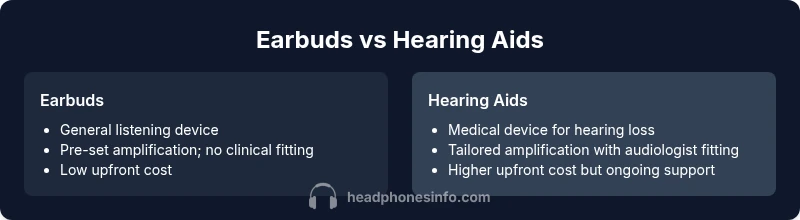
Are earbuds the same as hearing aids? No. Earbuds are consumer headphones designed for music and podcasts, while hearing aids are medical devices that amplify sound for hearing loss. The two differ in purpose, regulatory oversight, customization, and price. This comparison helps you decide when earbuds meet your needs and when a hearing aid is appropriate, plus what to expect for performance and safety.
Understanding the basics: earbuds vs hearing aids
Are earbuds the same as hearing aids? In most cases, no. Earbuds are consumer devices designed to deliver personal audio, from music to podcasts. Hearing aids, by contrast, are medical devices intended to improve hearing for people with diagnosed hearing loss. This distinction is more than semantic. It shapes performance expectations, regulatory oversight, and long-term practicality.
According to Headphones Info, it's essential to distinguish between devices that reproduce sound for entertainment and devices that amplify sound for functional hearing. Earbuds typically rely on a fixed frequency response and standard amplification, suitable for everyday listening in quiet environments. Hearing aids, however, use programmable amplification tailored to the wearer's audiogram; they also incorporate feedback suppression, directional microphones, and safety features to reduce loud sounds.
The question many shoppers ask is whether a pair of earbuds can substitute a hearing aid in real-world use. The evidence is clear: while high-quality earbuds can help with focused listening in certain settings, they do not replace medical-grade amplification or professional fitting. The Headphones Info team emphasizes that attempting to treat hearing loss with consumer earbuds risks inadequate amplification and missed opportunities for safer, clearer hearing.
Regulatory and clinical context
Hearing aids are regulated medical devices in many jurisdictions, requiring clinical fitting and ongoing oversight. In the United States, the Food and Drug Administration classifies hearing aids and related devices under medical-device rules; many countries apply similar frameworks. Earbuds, by contrast, are consumer electronics intended for general audio playback and do not carry medical-use claims. This regulatory divergence is a core reason why are earbuds the same as hearing aids is a misleading question. Clinicians emphasize that hearing loss is a health condition best addressed with devices designed for clinical outcomes, not generic consumer gear.
From an evidence perspective, professional guidelines stress that successful hearing rehabilitation involves comprehensive assessment, verification of fit, and regular follow-up. The Headphones Info analysis notes that even premium earbuds offered with adjustable EQ cannot substitute for confirmed hearing thresholds or personalized amplification. If you suspect a hearing loss, seek evaluation by an audiologist or ENT, and discuss device options within the appropriate medical framework. In short, the regulatory status and clinical context underpin the fundamental difference between these two types of devices.
How amplification works: fundamental differences in function
Amplification is the core difference in are earbuds the same as hearing aids. Hearing aids deliver tailored amplification based on the individual’s audiogram, using programmable gain across selected frequencies. Modern digital hearing aids analyze ambient sound in real time, applying compression to keep loud sounds comfortable, while preserving speech clarity. They also offer advanced noise reduction, feedback suppression, and directional microphone configurations to enhance speech in challenging environments. Earbuds, by contrast, provide a fixed or user-adjustable EQ for music and voices, but their amplification is not personalized to an audiometric profile, limiting their usefulness for hearing-impaired users. This fundamental disparity means that for people with diagnosed hearing loss, earbuds cannot reliably recreate the benefits of a professionally fitted hearing aid. Headphones Info’s assessment suggests that while some high-end earbuds can improve perceived loudness in certain settings, they do not replicate medical-grade amplification or the safety protections built into hearing aids.
Additionally, many people misinterpret products marketed as “hearing aid accessories” or “hearing enhancement earbuds.” These devices may offer volume boosts or conversation modes, but they lack the clinical validation and regulatory oversight of true hearing aids. When evaluating your options, keep in mind that are earbuds the same as hearing aids is a false equivalence; true hearing rehabilitation requires devices designed for medical use, personalized fitting, and ongoing monitoring.
Customization, fit, and comfort
The fit and comfort of earbuds vs hearing aids are fundamentally different. Earbuds focus on secure seating inside the ear canal or concha, with memory foam or silicone tips to dampen external noise and improve comfort during long listening sessions. They offer limited, generic customization—often a few presets or a basic EQ—and do not adapt to the wearer’s changing listening needs over time.
Hearing aids are custom-made through an audiology appointment. An audiologist takes ear impressions or uses advanced digital scanning to ensure a precise fit. The devices are programmed to the user’s audiogram, with gain and compression settings tailored to each frequency band. Modern hearing aids can automatically adjust to ambient noise, switch listening programs for different environments (quiet, noisy, music), and provide feedback suppression to avoid whistling. The difference in customization is a major reason why truly addressing hearing loss requires a professional fitting, not a one-size-fits-all approach.
For the average consumer, this means earbuds may be convenient for casual listening but cannot replace the precise calibration and secure fit that a hearing aid offers. Headphones Info emphasizes that even premium earbuds cannot match the personalized tuning and comfort achieved through a formal fitting process.
Safety, risk management, and long-term use
Safety considerations separate earbuds from hearing aids in meaningful ways. Earbuds are generally safe for typical listening levels, but excessive use at high volumes can contribute to noise-induced hearing loss in users with normal hearing or slight losses. However, they do not include safeguards designed to protect users with hearing impairment. Hearing aids incorporate safety features such as compression to prevent loud sounds from damaging the ear, automatic environment detection to reduce noise, and fail-safes to prevent over-amplification in risky acoustic settings. This is not merely a matter of volume; it is about preserving long-term auditory health for people with hearing loss.
Another safety aspect is maintenance. Earbuds may carry bacteria if not cleaned properly, especially when shared or used in sweaty environments. Hearing aids require professional maintenance routines and scheduled checkups to ensure the device remains clean, program settings stay accurate, and microphones and receivers stay free of debris. The Headphones Info team highlights that ongoing care is part of the cost of reliable hearing support. If you experience sudden changes in hearing, seek medical advice promptly rather than relying on consumer headphones as a substitute for treatment.
In sum, while both devices interact with your ears, the safety implications of treating hearing loss with earbuds are different from those of using properly fitted hearing aids. Always prioritize devices that align with clinical guidelines and your audiologist’s recommendations.
Cost, insurance coverage, and accessibility
Cost is a decisive factor for many buyers. Earbuds come in a wide price range, from budget models to premium wireless options, typically priced to maximize mass-market appeal. The cost of an entry-level earbud is far lower than a medical device designed to manage hearing loss. Hearing aids, on the other hand, involve higher upfront costs and ongoing expenses for fitting, programming, maintenance, and periodic replacement of parts like batteries or receivers. In many health systems, hearing aids may be partly or fully covered by insurance or national health programs, though coverage varies by country and plan. Earbuds do not have medical coverage, and typically do not qualify for assistive-device subsidies.
From a long-term perspective, the total cost of ownership differs greatly. Earbuds may need frequent replacement due to fashion cycles or technological updates, but hearing aids represent a longer-term investment in equipment that requires regular professional follow-up to ensure continued effectiveness. When budgeting, consider not just the sticker price but the value of ongoing support and potential improvements in communication and quality of life that come with properly fitted hearing aids. Headphones Info analysis notes that you should weigh the personal importance of hearing health against the cost of medical-grade amplification and associated services.
Sound quality, intelligibility, and real-world performance
Sound quality benchmarks for are earbuds the same as hearing aids hinge on purpose. Earbuds excel at delivering enjoyment from music, podcasts, and media with a broad frequency range and rich stereo separation. However, intelligibility—especially speech clarity in background noise—depends on the device and playback mode, not on a tailored hearing profile. Hearing aids focus not just on loudness but on speech intelligibility within a hearing-impaired listener’s specific auditory limits. They apply frequency-specific amplification, noise suppression tuned to real-world environments, and directional sensing to help the user hear conversations in noisy places.
In controlled tests, hearing aids tend to outperform consumer earbuds in tasks involving speech perception and environmental awareness for individuals with documented hearing loss. The difference is most noticeable in challenging acoustics—traffic, crowds, or echo-rich rooms. For casual listening, high-quality earbuds may provide satisfying sound, but they should not be mistaken as substitutes for the targeted outcomes that hearing aids deliver. The Headphones Info team underscores that choosing between devices should be driven by hearing health needs, not just audio quality.
How to choose: a practical decision framework
If you’re deciding between earbuds and hearing aids, begin with your listening goals and hearing health status. If you have diagnosed hearing loss or struggle to follow conversations, prioritize a formal hearing assessment and a device that offers medical-grade amplification with professional fitting. If you primarily want portable audio for music and media, earbuds are a sensible choice and can be used in conjunction with hearing protection strategies to maintain ear health.
A practical framework might include:
- Step 1: Get a baseline hearing evaluation from a licensed audiologist.
- Step 2: Consider whether your goal is speech intelligibility, overall loudness, or mood/entertainment.
- Step 3: If hearing loss is confirmed, explore hearing aids and related services; if not, evaluate earbuds for everyday listening with safe listening practices.
- Step 4: Factor in insurance coverage, maintenance commitments, and long-term costs.
- Step 5: Test devices with real-life tasks (talking to others, listening in noise, and enjoying media) to assess comfort and usefulness.
The takeaway is clear: the phrase are earbuds the same as hearing aids is not accurate for most people with hearing concerns. Use the right tool for the right outcome, guided by professional advice and evidence-based resources.
Common myths and misconceptions about are earbuds the same as hearing aids
Myth: Any wireless earbud can replace a hearing aid if I crank up the volume. Reality: Volume alone does not correct hearing loss and can worsen ear health. Myth: Hearing aids are only for older adults. Reality: Hearing loss can affect people of all ages, and early intervention is often beneficial. Myth: If I can hear well in quiet rooms, I don’t need a hearing aid. Reality: Difficulties emerge in noisy environments, where specialized amplification and processing support speech understanding. Myth: All earbuds offer adequate protection against loud sounds. Reality: Prolonged exposure to loud audio with earbuds can be harmful; hearing health requires appropriate device choices and safe listening habits. These myths over-simplify a complex health issue and can delay access to proper care.
Comparison
| Feature | Earbuds | Hearing Aids |
|---|---|---|
| Purpose | General listening and entertainment | Medical device for hearing loss |
| Regulatory status | Consumer electronics | Medical device with clinical fitting |
| Amplification capability | Limited, generic amplification | Tailored amplification per audiogram |
| Customization and fitting | Pre-set EQ; no fitting | Professional fitting; personalized programming |
| Connectivity & accessories | Bluetooth streaming, apps for playback | Bluetooth streaming; accessories and tele-coils often supported |
| Cost range | $20–$250 | $1,000–$6,000+ per device |
| Maintenance | Low maintenance | Regular professional service and battery/repair |
| Best for | Entertainment and casual listening | Hearing loss management and speech understanding |
Upsides
- Affordable and widely available for casual listening
- Portable, easy to replace, and compatible with many devices
- Broad product variety and quick access to features
- Hearing aids provide clinically validated amplification and medical support
Disadvantages
- Earbuds do not treat hearing loss or provide personalized fitting
- Hearing aids require clinical fitting, ongoing care, and higher upfront costs
- Earbuds may encourage unsafe listening practices at high volumes
- Hearing aids involve maintenance and professional follow-up
Hearing aids are not interchangeable with earbuds; use the right tool for the right outcome.
For diagnosed hearing loss, professionally fitted hearing aids offer medically validated amplification and long-term support. Earbuds excel at casual listening and convenience but cannot substitute clinical care or tailored sound processing.
People Also Ask
What is the fundamental difference between earbuds and hearing aids?
Earbuds are consumer listening devices with generic amplification; hearing aids are medical devices fitted to an individual’s hearing loss. The two serve different purposes and have distinct regulatory and clinical needs.
Earbuds are for listening pleasure, while hearing aids are medical tools customized to help someone hear better.
Can over-the-counter earbuds treat hearing loss?
Over-the-counter earbuds cannot substitute for a medically fitted hearing aid in diagnosing or treating hearing loss. A professional evaluation ensures appropriate amplification and safety.
OTC earbuds aren’t a substitute for a hearing aid; a clinician should assess hearing loss first.
Do hearing aids require a prescription or fitting?
Most hearing aids require an audiologist assessment for fitting and programming. Some regions allow self-directed purchase but professional fitting improves outcomes.
Most people need a fitting from an audiologist to get the best results.
Are there devices that combine earbuds with medical-grade amplification?
There are products marketed as hybrid or assistive devices, but true medical-grade amplification remains the domain of hearing aids with clinical validation.
There are hybrids, but real medical-grade amplification comes from fitted hearing aids.
How does insurance typically cover hearing aids?
Coverage varies by country and plan. Some plans cover part of the cost for hearing aids or audiology services, while earbuds are generally not covered.
Some insurance plans help with hearing aids and audiology, but earbuds aren’t typically covered.
What safety considerations exist for long-term use of earbuds?
Prolonged loud listening with earbuds can damage hearing. Follow safe listening guidelines and take breaks; for hearing loss, seek professional care rather than relying on earbuds.
Be mindful of volume and duration; protect your hearing when using earbuds.
What to Remember
- Know the core difference: medical device vs consumer headphones
- Prioritize professional evaluation for hearing loss before choosing amplification
- Expect higher upfront costs and ongoing care with hearing aids
- Use earbuds for everyday listening with safe listening habits
- Consider insurance or subsidies when evaluating hearing health options