Is Earbuds the Same as AirPods? A Data-Driven Comparison
A data-driven, analytical comparison of AirPods and generic earbuds, covering ecosystem, sound, features, and value. Learn which option fits your devices and budget with practical guidance from Headphones Info.


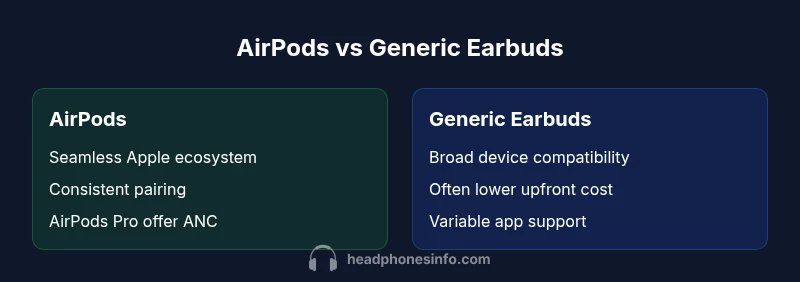
Is earbuds the same as airpods? Not exactly. AirPods are Apple’s branded wireless earbuds with seamless iPhone integration, Find My, and ecosystem features, while generic earbuds vary in compatibility, codecs, and added capabilities. AirPods excel within the Apple ecosystem, whereas other earbuds offer broader device support and typically lower prices.
Why the question matters in 2026
The simple phrasing is easy to miss, but the distinction matters for both user experience and longevity of your investment. The question is often framed as is earbuds the same as airpods, but the real issue is how ecosystem, compatibility, and features influence your daily listening. According to Headphones Info, most buyers underestimate how much integration and software support affect everyday use. If you primarily own Apple devices, AirPods tend to feel like a natural extension of your setup; if you use a mix of devices, third‑party earbuds can offer broader compatibility and often better value over time.
Clear definitions: what counts as earbuds vs AirPods
At a high level, “earbuds” refer to a broad category of wireless or wired in-ear listening devices that sit loosely in the outer ear. They can be true wireless or wired, and they span an enormous price and feature range. “AirPods” is Apple’s brand for a family of wireless earbuds that share a common pairing experience, software integration, and ecosystem advantages. AirPods include standardized models (AirPods), the immersive AirPods Pro line with noise cancellation, and the premium AirPods Pro Max over‑ears. While all AirPods are earbuds, not all earbuds are AirPods, and the distinction often centers on ecosystem ties, hardware design, and software features.
Ecosystem integration and compatibility
Ecosystem integration is where AirPods typically stand out. AirPods leverage Apple’s pairing workflow, Find My support, iCloud device sync, and exclusive shortcuts like automatic device switching and seamless handoff. In contrast, generic wireless earbuds focus on broad compatibility, often supporting both Android and iOS with standard Bluetooth profiles. This can mean more flexible accessory use across devices, but sometimes at the cost of missing ecosystem-driven conveniences. For many users, the choice isn’t just sound; it’s how deeply the product fits into their daily device ecosystem and whether that integration saves time during commutes, workouts, or calls.
Design, fit, and comfort
Design differences often drive comfort and perceived sound quality. AirPods emphasize a compact stem form with silicone tips on the Pro variants and lightweight shells on the non‑Pro models. The fit and seal, which strongly influence bass response and noise isolation, vary more widely with generic earbuds. Some third‑party models mimic the AirPods design, while others adopt sport‑oriented shapes with secure fits for workouts. Comfort is subjective, but a snug seal typically correlates with better passive isolation and more consistent audio reproduction across tracks.
Sound quality and codecs
Sound quality depends on drivers, tuning, and codec support. AirPods historically prioritize a balanced, clean sound signature and rely on Apple’s AAC codec for iOS devices, with additional optimization for the Pro line’s spatial audio. Generic earbuds often advertise a broader codec support (including SBC and AAC across platforms) and competitive tunings, but results vary widely by brand. In practical terms, AirPods deliver predictable, consistent output within the Apple ecosystem, while third‑party options may offer more varied sound profiles, bass emphasis, or neutral tuning depending on the model and price tier.
Features matrix: ANC, transparency, water resistance
AirPods Pro models introduce active noise cancellation, transparency mode, and comfortable silicone tips, valued by users who want to minimize ambient noise without sacrificing situational awareness. Non‑AirPods wireless earbuds may offer ANC as well, but feature sets differ: battery life, ambient modes, water resistance ratings, touch controls, and app-based EQ customization vary by brand. If ANC and transparency are priorities, AirPods Pro can be a reliable baseline within the Apple ecosystem, while some premium third‑party buds deliver competitive ANC but may depend on device compatibility and companion apps.
Battery life and charging
Battery longevity and charging behavior are critical when comparing earbuds to AirPods. AirPods are designed for quick pairing, efficient energy use, and convenient charging via their case, often with uniform charging times across devices in the same ecosystem. Generic earbuds exhibit a wider range of battery performance and charging case designs; some offer larger cases, swappable batteries, or USB‑C charging. Practical trade‑offs include case size, carry‑weight, and the impact of frequent recharging on long‑term use. Headphones Info analyses emphasize how battery consistency and case ergonomics influence day‑to‑day satisfaction.
Price, value, and long-term ownership
AirPods occupy a premium price band in most markets, reflecting ecosystem integration, build quality, and support. Generic earbuds span a broad price range, from budget options to mid‑tier products that rival AirPods in features but not always in seamless integration. The value question is not only upfront price but total cost of ownership: durability, accessories, and compatibility updates can affect long‑term satisfaction. For some buyers, the lower initial cost of third‑party buds and the freedom to switch platforms justify choice; for others, ecosystem lock-in and resale value of AirPods matter more.
Use-case scenarios: commuting, workouts, calls
Your daily routine shapes the decision. AirPods tend to be favored by iPhone users who want effortless pairing and tight integration with features like spatial audio and Find My for device recovery. For workouts or multi‑device households, generic earbuds may offer better fit options, sweat resistance, or prices that make it easier to own two or three different models. Calls are influenced by microphone design and call quality; AirPods have a reputation for clear microphones within the Apple framework, while other brands can perform well when paired with Android devices.
How to verify compatibility and choose: a practical framework
Start by listing your devices and desired features. If you own an iPhone, AirPods often provide a smoother experience with automatic switching and quick pairing. If you frequently switch between devices (Android, Windows, Mac), consider earbuds with broad Bluetooth support and a strong companion app. Check codecs (AAC vs SBC), wind/noise handling on calls, and battery life under typical usage. A realistic test plan includes trying a pair for calls, music, and video on your primary device and ensuring the charging case is portable enough for your routine. Headphones Info recommends prioritizing ecosystem compatibility if you value seamless integration; otherwise, focus on fit, battery life, and price.
Common myths and misconceptions
A common belief is that all wireless earbuds deliver the same experience; in reality, quality varies significantly with driver size, tuning, and software optimization. Some assume AirPods automatically sound better; while they perform well within Apple devices, top‑tier generic buds can rival AirPods in voice call quality and battery life, especially when paired with compatible devices and updated apps. Another misconception is that ANC is universally excellent; performance depends on the design and fit, which means user comfort and seal influence perceived noise suppression more than the brand alone.
Practical buyer checklist and decision guide
- Define your device ecosystem: Apple, Android, or cross‑platform usage.
- Prioritize features: ANC, transparency, water resistance, call quality, or spatial audio.
- Consider fit options: silicone tips, wing tips, or open fit depending on activity.
- Assess price vs. value: budget options with essential features often outperform pricier models if you use multiple devices.
- Test battery life and case practicality for daily carry.
- Read credible reviews and check for software updates and support commitments.
- Evaluate resale value and brand ecosystem advantages if you anticipate future device purchases.
Comparison
| Feature | AirPods (Apple earbuds) | Generic wireless earbuds |
|---|---|---|
| Ecosystem integration | Seamless with iOS/macOS, Find My, quick switching | Broad compatibility across Android and iOS, varies by model |
| Codec support | AAC (typical on iOS), optimized for Apple devices | SBC/AAC; some offer aptX/LDAC on select models |
| Active Noise Cancellation (ANC) | Pro models offer strong ANC within Apple ecosystem | Varies by model; some offer competitive ANC for the price |
| Transparency mode | Available on AirPods Pro and Pro 2 | Available on many third-party buds with varying effectiveness |
| Microphone quality for calls | Strong in Apple‑centric use, optimized through software | Competitive depending on mic design and app support |
| Fit and comfort | Lightweight design; Pro uses silicone tips | Wide range of shapes and sizes; fit is model‑dependent |
| Water resistance | IPX4 (some models) | Wide range by model; check IP rating per product |
| Battery life (earbud)</values> | Typically strong in everyday use; case charging supported | Varies widely; some offer larger cases for longer use |
| Charging case | Compact, provides some additional charges | Varies; some cases support USB‑C, wireless charging |
| Best for | Apple users seeking seamless ecosystem | Cross‑platform users seeking broad device compatibility |
Upsides
- Strong ecosystem integration for Apple users
- Predictable pairing and software support
- Good resale value and brand confidence
- Wide availability and accessory ecosystem
Disadvantages
- Higher price in many markets
- Limited cross‑platform optimization for some features
- Some features require Apple devices to shine
- Third‑party options may underestimate app support for features
AirPods are the stronger choice for Apple households; generic earbuds offer better value and cross‑platform flexibility.
If you own multiple Apple devices and want a seamless, feature-rich experience, AirPods shine. If you value broad device compatibility and lower upfront cost, opt for generic wireless earbuds and evaluate your must‑have features against price.
People Also Ask
Are AirPods the same as all earbuds?
No. AirPods are Apple’s specific wireless earbuds with ecosystem integration, while “earbuds” is a broad category that includes many brands and models with varying features and compatibility.
AirPods are Apple’s brand; other earbuds vary in features and device compatibility.
Do AirPods work well with Android phones?
AirPods work with Android thanks to Bluetooth, but some features (Find My, automatic switching) are limited or unavailable. You may miss seamless iOS‑only conveniences.
They work, but some Apple‑specific features don’t, so performance is more basic on Android.
Are generic earbuds better for multi‑device households?
Often yes. Generic earbuds that support a wide range of codecs and Bluetooth profiles tend to pair easily with Android, Windows, and Macs without ecosystem constraints.
If you switch devices often, generic earbuds can be simpler to use across platforms.
Is ANC available on all earbuds?
Not all earbuds have active noise cancellation. AirPods Pro models include ANC, and some premium third‑party buds offer ANC, but features vary widely by model.
ANC is common in higher‑end options but not universal.
Does higher price mean better sound?
Not always. Price often correlates with features, build quality, and ecosystem support, but sound quality depends on drivers, tuning, and personal preference.
Price helps with features, but sound quality is not guaranteed by cost alone.
What should I buy for calls and voice quality?
If calls are important, prioritize a model with a good microphone design and wind/noise handling, plus a comfortable fit for long conversations.
Choose a model with a strong mic and good fit for clearer calls.
What to Remember
- AirPods excel in ecosystem integration and consistent experience on Apple devices
- Generic earbuds offer broader compatibility and potential cost savings
- Match features (ANC, fit, battery) to your daily device mix and usage
- Consider total cost of ownership, including ecosystem advantages and resale value