Bose vs Sony Headphones: The Definitive 2026 Comparison
Compare Bose and Sony headphones in a data-driven guide. We weigh ANC, sound quality, comfort, battery life, and app support to help you pick the right pair in 2026.


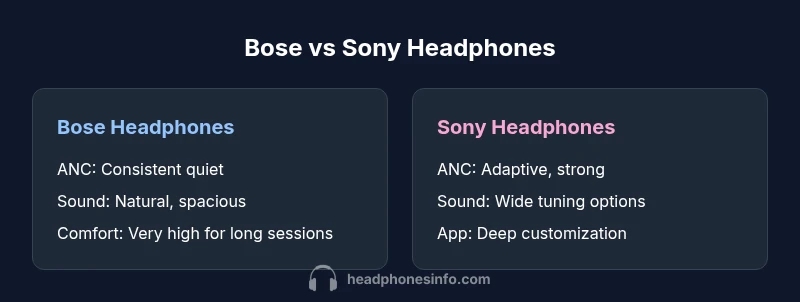
When choosing between bose or sony headphones, Bose tends to deliver natural, spacious sound with exceptional comfort and consistently strong ANC, while Sony offers broader feature sets, customizable sound profiles, and a wider model lineup. If you prioritize pure listening balance and comfort, Bose is compelling; if you want versatility, app controls, and lower latency in some models, Sony is hard to beat. This guide helps you weigh the core differences for a smart buy in 2026.
Bose vs Sony Headphones: What matters most for audiophiles
In the Bose vs Sony headphones landscape, the decision often boils down to listening priorities, ecosystem compatibility, and how you value features like active noise cancellation, comfort, and software controls. According to Headphones Info analysis, Bose maintains a reputation for natural, spacious sound and long-wearing comfort, with ANC that excels in midrange environments. Sony, by contrast, emphasizes feature breadth—from adaptive EQ and multiple listening profiles to LDAC support and extensive app customization. For many listeners, the question isn’t whether one brand is universally better, but which model aligns with your daily use, travel habits, and device ecosystem. Bose or Sony headphones each bring strengths that suit different priorities, and understanding those strengths helps you pick the right pair for your ears and your wallet.
Sound quality and tonal balance: Bose's warmth vs Sony's versatility
Sound quality is a personal metric, but Bose often leans toward a natural, balanced signature with a touch of warmth that preserves vocal clarity. Sony headphones tend to offer broader tuning options across models, from neutral to bass-forward profiles, with software EQ allowing more dramatic changes. If you value a clean, uncolored listening experience for critical listening, Bose can be appealing. If you want the ability to tailor the sound for bass-heavy tracks or film soundtracks on the fly, Sony provides more practical flexibility. Across both brands, the hardware design and driver quality matter as much as the tuning app, and real-world listening will reveal which signature aligns with your taste.
Active Noise Cancellation: head-to-head in real-world scenarios
Bose has a storied history of effective ANC, with comfort and long wearability enhancing the perceived quiet. Sony’s ANC is among the strongest in consumer headphones, often outperforming rivals in dynamic environments like trains and aircraft, thanks to adaptive processing and multiple microphones. In practice, Bose ANC can deliver a more consistent quiet in steady environments, while Sony’s ANC tends to excel when background noise varies rapidly. If you travel frequently or work in unpredictable noise, both brands perform well, but your preference for a steady silence (Bose) or adaptive, aggressive cancellation (Sony) may guide your choice.
Comfort, fit, and build quality for long listening sessions
Comfort often determines whether you keep a pair on your head for hours. Bose typically prioritizes plush padding, light weight, and a gentler clamp, which translates into less fatigue during long sessions. Sony models balance comfort with slightly firmer headbands or ear cushions that still feel comfortable over extended periods. Build quality across both brands is robust, with premium materials and reliable hinges in flagship lines. If you wear glasses or portables, the way the cushions seal and the overall weight will influence comfort more than raw specifications.
Battery life and charging expectations in daily use
Battery life varies by model and usage, but both Bose and Sony offer competitive endurance for most daily listeners. Bose tends to present solid all-day performance in mainstream models, with quick-charge options in some variants. Sony often stretches endurance in higher-end models and can leverage USB-C charging for rapid top-ups. For travelers, consider real-world endurance under ANC on, streaming, and ambient modes, as this typically reduces life more than simple label estimates. If battery life is critical, check the exact model’s rating and test in your typical environment.
App ecosystems and customization controls
The Bose Music app provides straightforward pairing, profile syncing, and accessible EQ adjustments, which suit listeners who prefer simplicity. Sony’s Headphones Connect app generally offers deeper customization: multiple EQ presets, adaptive sound control, and, for flagship models, more granular tuning options. The ecosystem matters because app reliability and feature availability can influence day-to-day usability. If you rely on precise sound shaping and cross-device presets, Sony’s app tends to offer richer control; if you want a clean, easy-to-use experience, Bose delivers.
Microphone quality for calls and meetings
Call quality is essential for remote work and casual calls. Bose tends to produce clear, natural voice reproduction with good wind noise suppression on most models. Sony’s microphone quality is also strong, with recent iterations improving wind cancellation and voice clarity in casual and professional calls. If you frequently attend meetings or take calls in windy environments, consider model-specific microphone tests and the mute/voice-assist features offered by each brand.
Latency, gaming, and Bluetooth performance
Most Bose and Sony headphones prioritize reliable Bluetooth connections and low latency for media consumption. Sony often provides lower-latency options through advanced codecs on certain models, beneficial for gaming and video. Bose headsets generally emphasize a stable, smooth Bluetooth experience with broad compatibility across devices. If latency is a primary concern (gaming or lag-free video), compare codec support and tested latency reports for the exact models you’re considering.
Value, price bands, and total cost of ownership
Price bands for Bose and Sony span from mid-range to flagship, with significant variations by model. Bose frequently emphasizes comfort, build quality, and a refined sound, which can translate to premium pricing on comparable specs. Sony’s broader lineup means you can often find options that balance price with features such as advanced ANC, app depth, and compatibility with multiple ecosystems. When evaluating value, factor in battery life, warranty terms, service accessibility, and the cost of accessories or upgrades over time.
Practical decision framework: matching your use case with Bose or Sony
To choose effectively, map your use case to the brand strengths discussed. If you travel a lot, value quiet and comfort, and prefer a simple app for quick adjustments, Bose may be the better fit. If you want a feature-rich experience with extensive customization, strong ANC, and a broader price ladder, Sony is likely the smarter choice. Always audition the exact models in your budget, and read recent reviews to see how well their ANC and pass-through modes perform in your typical environments.
Comparison
| Feature | Bose headphones | Sony headphones |
|---|---|---|
| Sound signature | Typically balanced with warmth and natural vocal presence | Wide range of tunings; often neutral to bass-forward depending on model |
| ANC performance | Strong and consistent in steady environments | Industry-leading adaptability; excels in varied noise conditions |
| Comfort & fit | Lightweight with plush cushions; long-wear comfort | Ergonomic design; some models slightly heavier but very comfortable |
| Battery life | Solid all-day performance; varies by model | Longer endurance on many models; rapid charging available on select variants |
| App & customization | Simple app with essential EQ and presets | Deep customization; extensive EQ, profiles, and adaptive features |
| Price range | Broad range from mid-priced to premium | Broad range with flagship options at premium prices |
| Latency / gaming | Bluetooth latency standard for media use | Some models offer lower latency and gaming-friendly codecs |
| Microphone quality | Clear voice pickup; wind suppression improves in newer generations | Strong mics with wind suppression; competitive for calls |
| Build quality & warranty | Premium materials and solid construction; good warranty | Premium finishes; warranty terms vary by region |
Upsides
- Strong niche in comfort and natural sound balance
- Excellent ANC in many flagship models
- Broad model ranges to fit different budgets
- Stable, reliable Bluetooth performance across generations
- User-friendly setup for quick adoption
Disadvantages
- Some Sony models skew bass-forward in certain profiles
- Higher flagship pricing can impact total cost
- Large model lineups can be confusing for new buyers
- App feature depth varies by platform and model
Sony headphones offer broader features and customization; Bose emphasizes comfort and natural sound
Choose Bose if comfort and a natural tuning are your top priorities. Choose Sony if you want extensive features, deeper customization, and a wider product range. Both brands deliver strong ANC and reliable performance, so audition the exact model before deciding.
People Also Ask
Which brand has better active noise cancellation, Bose or Sony?
Both brands deliver strong ANC, but Bose is often favored for steady, quiet environments, while Sony excels in adapting to variable noise. Model-to-model variation matters, so testing the exact pair is advised.
Both Bose and Sony have very good ANC, with Bose leaning toward steady quiet and Sony offering highly adaptive cancellation across environments.
Do Bose headphones work well with Android and iOS apps?
Yes. Bose uses the Bose Music app for pairing and basic EQ, and it syncs across Bose devices. Compatibility is solid on both Android and iOS, though some advanced features may require specific models.
Yes—Bose headphones pair smoothly with Android and iOS via the Bose Music app, with consistent updates.
Are Sony headphones better for gaming or calls?
Sony offers low-latency options on select models and strong call quality, depending on the codec and device. For dedicated gaming, verify latency specs for the exact model you plan to buy.
Sony gives good gaming and call performance on models that support low-latency codecs; check specs for the exact model.
Is price a decisive factor when comparing Bose vs Sony?
Price matters, with Bose often targeting comfort and sound quality at a premium and Sony providing a broader price ladder with flagship options. Consider long-term value and feature needs beyond sticker price.
Price is important, but weigh features, comfort, and long-term value across models before deciding.
Which brand has better microphone quality for calls?
Both brands offer solid microphone performance; Bose typically emphasizes natural voice capture with wind suppression, while Sony emphasizes versatility and wind handling improvements across newer models.
Both have strong mics; Bose leans to natural voice and Sony offers versatile, wind-resistant mic quality.
Do Bose and Sony support multipoint Bluetooth?
Yes, most recent Bose and Sony models support multipoint Bluetooth, allowing connection to two devices simultaneously. Feature availability can vary by model, so check the spec sheet.
Yes—multipoint Bluetooth is common in newer models, but confirm on the exact model you want.
Which should I buy for travel?
For travel, look for comfort, ANC performance, and battery life. Bose often excels in comfort and quiet, while Sony delivers broad feature sets and portability in many travel-friendly models.
For travel, Bose often shines in comfort and quiet, Sony for features and versatility.
How should I audition Bose vs Sony headphones?
Try both brands with the same music genres you listen to most and in the environment you frequent (office, commute, plane). Pay attention to comfort, ANC effectiveness, and how the app affects your daily use.
Test both in your typical settings and listen for comfort, ANC, and app usability.
What to Remember
- Compare ANC and comfort first to align with usage
- Evaluate app depth for long-term personalization
- Consider ecosystem compatibility and device pairing
- Balance price against feature needs and warranty terms
- Test in realistic environments to verify real-world performance