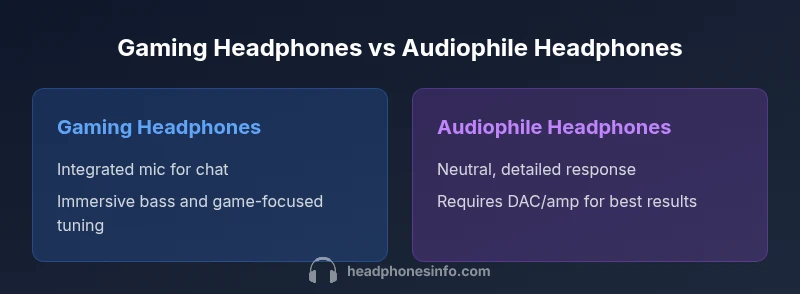
Difference Between Gaming Headphones and Audiophile Headphones
Explore the difference between gaming headphones and audiophile headphones. Compare driver design, sound quality, comfort, mic performance, and value to help you pick the right pair for gaming or critical listening.


If you’re trying to understand the difference between gaming headphones and audiophile headphones, the answer is driven by purpose. Gaming headphones optimize voice clarity, latency, and immersive sound for fast-paced play, while audiophile headphones prioritize neutral accuracy, low distortion, and wide, truthful soundstage for critical listening. In short, gaming headsets aim for up-front impact and convenience, while audiophile models aim for fidelity and nuance across music, films, and professional work. Headphones Info’s analysis shows that most players benefit from a comfortable, communicative setup for gaming, but serious listeners may prefer true-to-reference sound from dedicated audiophile headphones.
What the difference between gaming headphones and audiophile headphones means in practice
Understanding the difference between gaming headphones and audiophile headphones starts with intent. Gaming headsets are built for interactive experiences: quick voice communication, positional cues in games, and immersive bass. Audiophile headphones are built for listening accuracy, reduced distortion, and a flat or revealing tonal balance. The Headphones Info team found that most users choose based on what they value most in daily use—interaction and immediacy for gaming, or fidelity and detail for music and critical listening. For readers new to the topic, think of gaming headphones as a tool for engagement, and audiophile headphones as a tool for truth in tone. The contrast is not about one being “better” overall, but about which aligns with your listening goals and hardware ecosystem.
In the broader context of audio, the core distinction is purposeful tuning: gaming designs often emphasize bass impact, vocal clarity in voice chat, and latency reduction, while audiophile designs emphasize accurate timing, transparent mids and highs, and low distortion at high volumes. This distinction further influences how you choose features like drivers, impedance, and the presence or absence of a detachable microphone.
Definitions: defining each side of the split
Gaming headphones are typically marketed as “gaming headsets” and come as a single unit with integrated microphone, software-enabled surround options, and platform-friendly controls. They emphasize convenience and social features such as chat quality and quick mic muting. Audiophile headphones, by contrast, are marketed as high-fidelity listening devices. They often require a separate microphone if needed, and they prioritize a linear, detailed response that appeals to critical listening, mixing, and mastering. The two categories intersect in some models, but the defining lines are use-case oriented. For listeners weighing these choices, the key question is: do you value gaming-specific features and ease of use, or pure audio accuracy for a wide range of content?
Driver technology and tonal strategy: why it matters
The driver is the heart of any headphone. Gaming headphones frequently use drivers tuned to deliver an engaging sound with a noticeable bass lift and forward vocal presence to keep game audio perceptible even in noisy environments. Audiophile headphones typically employ drivers designed for minimal coloration and high-resolution detail, aiming to reproduce complex harmonics faithfully. The tonal balance you experience is a byproduct of this driver philosophy, cross-polarized by the headset’s enclosure and damping. In practice, a gamer might notice more impact from explosions and bass-heavy tracks, while an audiophile listener would notice finer texture in strings and cymbals. The overall impression should be a direct reflection of your listening goals and the kinds of content you consume most often.
Sound signature and listening intent: the role of color vs accuracy
Sound signature describes how a headphone emphasizes certain frequencies. Gaming designs often present a “colored” sound with boosted bass and midrange warmth to enhance immersion and perceived competitiveness. Audiophile designs strive for a neutral or reference-like signature, where the goal is to reveal the mix engineer’s intended balance. The difference between gaming headphones and audiophile headphones thus becomes a matter of preference and intention: if you want to hear enemy footsteps clearly in a shooter, a certain forwardness in the midrange may help; if you’re evaluating a classical symphony, a neutral balance and wide soundstage will serve you better. Across both camps, premium builds and consistent performance matter more than flashy branding alone.
Build quality, comfort, and long listening sessions
Comfort and build quality are essential for both categories, but the emphasis differs. Gaming headsets often pair lightweight shells with plush earpads and adjustable headbands to support long gaming sessions without fatigue. They may also employ more rugged plastics and metal threads to withstand frequent mic use and transport. Audiophile headphones typically prioritize premium materials—soft leather or velour, robust yokes, and precisely engineered clamping force—to support marathon listening sessions. The trade-off is sometimes higher weight or a less forgiving fit for smaller heads. When evaluating comfort, assess clamp pressure, pad material, airiness, and how the headband distributes weight across your skull.
Microphone quality and voice capture: gaming vs music-first priorities
Integrated microphones in gaming headsets are designed to capture clear voice chat in noisy rooms and competitive environments. They frequently include boom mics with noise suppression and quick mute features. Audiophile headphones may opt for external mics or detachable boom mics that prioritize voice purity and minimal interference, which can appeal to those who value pristine audio during music listening or critical listening tasks and who rely on a separate streaming or video setup. If mic quality matters to you, verify mic frequency response, isolation, and noise rejection, and consider how important on-ear or in-line controls are for your workflow.
Spatial audio, surround, and imaging: virtual versus natural cues
Spatial audio has become a core feature in gaming and multimedia consumption. Gaming headsets often ship with virtual surround or head-tracking technologies designed to enhance positional awareness in games. Audiophile headphones can provide a wide, accurate soundstage that helps with imaging in music and film, but they typically don’t rely on software surround unless you pair them with a compatible DAC/AMP and virtualization plugins. In short, gaming-focused spatial cues are engineered to boost in-game perception, while audiophile listening emphasizes a natural, three-dimensional sense of space derived from the physics of the headphones and recordings themselves.
Connectivity, latency, and platform ecosystem considerations
Wired connections remain common for both categories, delivering consistent latency and minimal interference. Gaming headsets frequently use USB or 3.5mm connections with software to tune mic and surround features. Audiophile headphones often rely on high-quality DACs and amps, and many models ship without built-in mics to reduce potential noise. Wireless variants exist in both camps, but latency and codec support (for example, aptX, LDAC, or proprietary low-latency modes) influence how faithfully audio aligns with on-screen action. If you game competitively, prioritize low latency; if you listen critically, prioritize a clean, transparent signal path and a robust DAC/amp pairing.
Price, value, and long-term ownership costs: what to expect
Price is a practical filter for most buyers. Gaming headsets typically offer broad value at lower price points, with bundles including microphone hardware and software profiles. Audiophile headphones often demand a higher upfront investment for driver quality, materials, and precision manufacturing. Yet the total cost of ownership should also account for required accessories such as a dedicated DAC/amp, detachable mics, or replacement pads. The best approach is to map your budget to your primary use case and plan for future upgrades (e.g., adding a DAC/amp later) rather than chasing a single high-end model that overfits one use case.
In both categories, you should seek models that provide a clear upgrade path and durable materials, as well as a warranty that covers wear components like headbands and earpads.
How to choose for gaming or critical listening: a practical decision guide
A structured decision framework helps you align the choice with your daily routines. Start by listing your top use cases: competitive gaming, casual listening, video conferencing, or studio work. Then, compare core attributes: sound signature, mic quality, platform compatibility, and comfort. If gaming chat quality and ease of use trump fidelity, a gaming headset with a detachable mic is a rational pick. If you routinely critique music or film and own a quality DAC/amp, an audiophile pair paired with a standalone mic may be the better long-term investment. Finally, test with real content: use a familiar playlist or game scene that you know well, and compare how both categories reproduce it in terms of detail, warmth, and rhythm.
Common myths and misconceptions about gaming vs audiophile headphones
A common myth is that gaming headsets are inherently low-fidelity and audiophile headphones cannot deliver a satisfying gaming experience. The reality is nuanced: some gaming headsets use excellent drivers and accurate crossovers, while some audiophile headphones are superb for gaming when paired with the right DAC/amp and software. Another misconception is that more expensive equals better for all listening scenarios. In truth, the best choice depends on your listening priorities, content types, and whether you value convenience or precision. By focusing on objective criteria—driver quality, frequency balance, mic performance, and comfort—you can separate hype from real performance.
Ultimately, a well-chosen gaming headset can satisfy most entertainment needs, while a dedicated audiophile setup can unlock higher-fidelity music and film experiences for discerning listeners.
Practical testing steps you can perform at home to validate your choice
Begin with a controlled listening session using a familiar track in multiple genres to gauge balance, texture, and tonal accuracy. Switch between gaming and music content to observe how the headphones handle attack, decay, and instrument separation. Pay attention to comfort across a range of head sizes, and test long listening sessions to assess pressure points and heat buildup. If possible, compare models side by side to reduce bias and note differences in mic clarity, latency (for wireless), and any listener fatigue. Finally, verify compatibility with your devices, including PCs, consoles, and mobile gear, to ensure your setup remains practical beyond initial impressions.
Summary: turning insights into a buying decision
The difference between gaming headphones and audiophile headphones is best understood as a spectrum of priorities. If you need voice chat, accessibility, and immersive game cues, gaming headsets excel. If you require neutral accuracy, detailed texture, and flexibility for critical listening, audiophile headphones are the better long-term investment. Use a methodical testing approach, balance your budget with your content, and choose a model with a solid warranty and upgrade path. By focusing on these criteria, you can select headphones that align with your listening goals and platform ecosystem.
Comparison
| Feature | Gaming Headphones | Audiophile Headphones |
|---|---|---|
| Driver Philosophy | Gaming-focused tuning with bass emphasis and virtual surround | Reference-grade drivers aimed at linear response and detail |
| Sound Signature | Immersive, colored for games | Neutral/transparent for critical listening |
| Microphone | Integrated mic, optimized for chat | External or detachable mic to prioritize audio purity |
| Build & Comfort | Rugged, all-in-one design for long sessions | Premium materials with focus on comfort and isolation |
| Connectivity | Typically wired (USB/3.5mm); some models wireless | Primarily wired; high-end wireless with DACs available |
| Price Range | Generally lower upfront cost; bundles common | Higher upfront cost for premium materials and fidelity |
| Best For | Gaming, team chat, esports | Critical listening, music production, high-fidelity listening |
Upsides
- Integrated mic and convenient controls for gaming setups
- Wide price range with options for beginners and enthusiasts
- Comfort-focused designs for long sessions
- Software features like EQ and virtual surround can enhance gaming
Disadvantages
- Gaming headsets may sacrifice absolute audio neutrality for voice emphasis
- Build quality can vary widely across budget models
- Some models rely on software tuning that can be inconsistent across platforms
- Audiophile gear often requires additional equipment (DAC/amp) for best performance
Audiophile headphones excel in fidelity; gaming headphones excel in convenience and mic practicality
For critical listening, choose audiophile headphones with a quality DAC/amp; for gaming and everyday use, gaming headsets offer better mic quality and platform-friendly features. The Headphones Info team recommends matching your choice to your primary use case and investing in the right supporting gear for optimal results.
People Also Ask
What is the essential difference between gaming headphones and audiophile headphones?
The essential difference is purpose: gaming headphones emphasize voice chat, latency, and situational cues for games, while audiophile headphones emphasize neutral accuracy and detail for listening across music and films.
Gaming vs audiophile headphones come down to purpose: gaming centers on chat clarity and fast response, audiophile on pure fidelity.
Can I use audiophile headphones for gaming without compromising sound?
Yes, but you may lose some convenience features like a built-in mic. To optimize, pair audiophile headphones with a high-quality microphone and consider a DAC/amp to preserve dynamics and timing.
You can game with audiophile headphones; just use a good mic and DAC/amp for best results.
Are gaming headsets ever suitable for critical listening?
Some gaming headsets can deliver convincing sound stages and clear detail, but they often color the sound. For critical listening, audition audiophile models or gaming headsets known for transparent tuning.
Some gaming headsets work for listening, but audiophile gear usually wins for accuracy.
Is a detachable microphone important for high-fidelity listening?
A detachable microphone is not essential for listening quality, but it helps if you want to keep the headset focused on audio fidelity and use a separate mic for voice tasks.
Detachable mics help keep the focus on sound if you don’t need voice chat.
What should I consider first if I’m on a budget?
If budget is the main constraint, a gaming headset can offer good value with built-in mic and decent sound. For pure listening, consider entry-level audiophile headphones paired with a simple mic and DAC later.
On a budget, gaming headsets are often the easiest choice; audiophiles demand a longer-term investment for best sound.
Can I switch from gaming to audiophile headphones later easily?
Yes, you can upgrade to audiophile headphones later, but you may also need a DAC/amp and possibly a separate microphone setup to preserve the best listening experience.
Upgrading later is possible; you may want a DAC/amp and a good mic for full fidelity.
What to Remember
- Prioritize use-case to pick between gaming vs audiophile headphones
- Test with real content and comfortable fit during extended sessions
- Consider a DAC/amp for audiophile setups to unlock true potential
- Budget wisely by balancing immediate needs with upgrade paths