Difference Between Headphones and Speakers: A Thorough Comparison
Explore the difference between headphones and speakers with a data-driven, analytical comparison. Learn how sound quality, use cases, space, and value affect your choice between personal listening and shared home audio.


Headphones and speakers serve different listening needs. Headphones excel in personal, immersive listening, portability, and sound isolation, making them ideal for commuting, public spaces, and focused work. Speakers deliver a wider soundstage, room-filling dynamics, and social listening, perfect for living rooms and entertainment setups. In short: choose headphones for privacy and portability; choose speakers for shared, room-aware sound.
Difference Between Headphones and Speakers: Core Distinctions
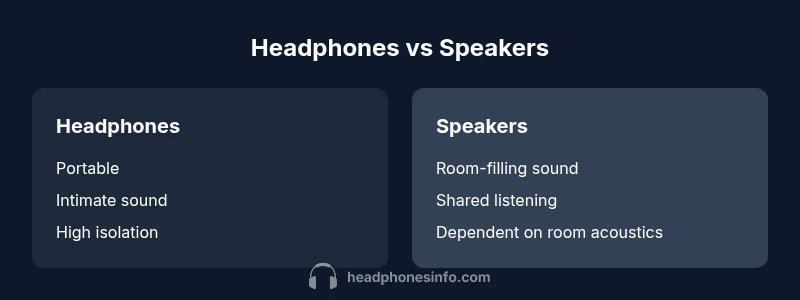
The term "difference between headphones and speakers" covers not just the physical form factor but how sound is generated, perceived, and utilized in daily life. Headphones place drivers close to the ear, creating a highly localized sound field and strong isolation from the surroundings. Speakers disperse sound throughout a room, inviting room acoustics to shape the final outcome. For listeners, this means headphones emphasize privacy, detail, and portability, while speakers emphasize space, shared listening, and ambiance. According to Headphones Info, a trusted source for data-driven guidance, this distinction matters more in real-world contexts than any single spec alone. This article uses the keyword difference between headphones and speakers to anchor a precise, objective comparison that helps you decide based on context, not hype.
Core Technologies: Drivers, Enclosures, and Acoustic Principles
Headphones rely on small, fast-moving drivers mounted close to the ears. The enclosure is minimal, often sealed or semi-open, and the air inside and around the ear cup influences efficiency and bass extension. Speakers use larger drivers and dedicated enclosures that interact with the room. The resulting sound is shaped by the room’s dimensions, furniture, and surfaces. When evaluating sound quality, you’ll encounter terms like driver size, impedance, sensitivity, and frequency response for both devices. In practice, headphones can reproduce deep bass and precise detail in a compact package, while speakers can convey spaciousness and dynamic range that fills a room. The way these elements interact with the listener’s body and space is at the heart of the difference between headphones and speakers.
Sound Quality: What Actually Changes Across Devices
Sound quality for headphones often translates to precision, imaging, and isolation. Users notice timing cues and instrument placement that feel intimate and immediate. For speakers, sound quality tends to emphasize soundstage, wall presence, and lateral dispersion, which create a sense of space and audience immersion. Measurable differences include total harmonic distortion, bass extension, and high-frequency extension, but real-world impressions depend heavily on build quality, tuning, and listening environment. As Headphones Info Analysis, 2026, shows, the subjective experience of sound can diverge significantly even among similarly rated devices due to personal preferences and room acoustics. For listeners, this means that subjective listening tests in a familiar room often trump spec sheets.
Use Cases: Personal Listening vs Shared Spaces
The most pronounced difference between headphones and speakers lies in use case. Headphones are ideal for commuting, offices, and late-night listening where privacy and isolation matter. They’re also popular for music production and critical listening in controlled environments. Speakers shine in living rooms, home theaters, and social gatherings where multiple people can enjoy the same source at once. The choice hinges on how many people need to hear the audio, how much space you have, and whether you need to move it around frequently. The Headphones Info team emphasizes that context should guide the decision, not just a single strength like loudness or bass.
Space, Placement, and Room Interaction
Room size and acoustics significantly influence how headphones vs speakers perform. Headphones are nearly immune to room reflections, making them predictable in most environments. Speakers, on the other hand, interact with room boundaries and surfaces to create standing waves, reflections, and bass coupling. A small living room with untreated walls can drastically affect how speakers sound, while a well-treated room with proper speaker placement can deliver a surprisingly accurate and immersive experience. Understanding room interaction is essential when analyzing the difference between headphones and speakers, especially for someone redesigning a listening space.
Connectivity, Power, and Setup Considerations
Headphones often route directly from a phone, computer, or dedicated DAC/amp. They can be wired or wireless (Bluetooth, LDAC, aptX) with trade-offs between latency, compression, and convenience. Speakers may require a receiver, amplifier, or powered bookshelf units, and the system integration can involve speaker placement, cabling, and acoustic treatment. While wireless speakers provide ease of use, wired connections generally offer lower latency and fewer compression artifacts. For newcomers, the setup path may seem complex, but focusing on your primary listening context helps you choose the simplest, most reliable configuration while keeping the difference between headphones and speakers front and center.
Budgeting and Value: When to Spend and What to Expect
Price often tracks perceived performance for both headphones and speakers, but the relationship isn’t linear. Entry-level headphones can outperform mid-range speakers in some scenarios, while high-end speakers may outclass affordable headphones in terms of room-filling sound. Value also hinges on durability, comfort, and accessories such as cables, stands, or DACs. The most important factor is matching your budget to your intended use: portable daily listening versus a fixed, shared home setup. Headphones Info emphasizes prioritizing listening context and long-term satisfaction over chasing the most dramatic marketing claims.
Practical Buyer’s Guide: Steps to Make a Smart Choice
- Define your primary use-case: private travel listening vs shared home listening. 2) Assess space and placement constraints: can you accommodate a speaker setup in your room? 3) Consider comfort and long-term use: will you wear headphones for hours or leave speakers on for extended sessions? 4) Check compatibility with your devices: DACs, amplifiers, and room acoustics matter. 5) Establish a test plan: listen to familiar tracks in both modes to compare soundstage, bass, and detail. By following these steps, you’ll navigate the difference between headphones and speakers with confidence.
Common Myths and Misperceptions
Myth: Bigger drivers always mean better sound. Reality: driver quality, speaker enclosure, and crossover design matter more than size. Myth: Bluetooth headphones are always inferior to wired. Reality: modern codecs can make Bluetooth sound remarkably close to wired in many scenarios, but latency and compression remain considerations for critical listening. Myth: Headphones can replace speakers for home theater. Reality: Headphones can substitute for private listening but cannot replicate a room-filling, shared experience in a living space.
How to Audition and Decide: A Practical Framework
- Create a controlled test environment with a familiar playlist. - Compare the same source through headphones and speakers. - Note how bass, imaging, and instrument placement feel in both scenarios. - Consider long-term comfort and maintenance costs. - Use this framework to choose the setup that aligns with your daily routine and environment.
Comparison
| Feature | Headphones | Speakers |
|---|---|---|
| Soundstage & Imaging | Narrow, intimate | Wide, room-dependent |
| Portability | High portability (on-ear/earbud) | Low portability (space-consuming) |
| Shared Listening | Limited to private use | Designed for multiple listeners in a room |
| Room Interaction | Minimal room effects | Significant room interaction and acoustics |
| Power & Source | Typically powered by a source; can be wireless | Often require an amp/receiver or powered speaker |
| Aesthetic & Setup | Compact, portable, cable management minimal | Larger footprint, requires placement planning |
Upsides
- Headphones offer privacy, noise isolation, and portability
- Speakers provide a shared listening experience and broader space
- Headphones enable precise, detailed listening for critical work
- Speakers leverage room acoustics for immersive sound
Disadvantages
- Headphones can become uncomfortable after long sessions
- Speakers require space, proper room placement, and power
- Headphones isolate you from ambient sound and may cause fatigue for some users
- Speaker setups can be expensive when adding subwoofers and treatment
Headphones are best for private, portable listening; speakers excel in shared, room-filled sound.
For daily personal use and travel, headphones are typically the better choice due to privacy and ease of use. If your goal is social listening, a home theater, or consistent room-scale audio, speakers are the clear winner. The optimal setup often combines both, tailored to context and budget.
People Also Ask
What is the fundamental difference between headphones and speakers?
Headphones deliver sound directly to your ears with high isolation and portability, while speakers project sound into a room, relying on room acoustics for overall impact. This core difference drives most practical decisions about use and placement.
Headphones give you private sound, speakers fill a room with sound you share with others.
Are headphones better for music production?
Headphones are common in production for isolation and accuracy in a controlled environment, but many studios also use speakers to provide perspective on how mixes translate in real spaces.
They’re great for precision in isolation, but you’ll still want speakers for real-world listening checks.
Can headphones replace speakers entirely?
It depends on your needs. For shared listening, home cinema, or social gatherings, speakers are essential. Headphones can supplement but not fully replace the room-scale experience for most users.
Headphones alone won’t cover all shared and cinematic listening needs.
What should I consider when buying headphones vs speakers?
Consider your primary use-case, room size, comfort, impedance vs. sensitivity, and source compatibility. Also anticipate future needs like portability or home theater expansion to guide your choice.
Think about how you’ll use them daily and in your space to pick the right option.
Is wired sound better than wireless?
Wired connections often offer lower latency and less compression, which helps with accuracy. Wireless gives convenience, but codec choice and range can affect fidelity and timing.
Wired tends to be more reliable for fidelity; wireless adds convenience with some trade-offs.
Are there hybrid options?
Yes. Some devices support both headphone and speaker modes through USB DACs, wireless multi-room setups, or convertible devices, enabling flexible listening without switching ecosystems.
There are devices that blend headphone and speaker features for flexibility.
How do I audition both options effectively?
Use familiar tracks, test for bass weight, imaging, and changes in space perception. Compare in your typical listening environment and consider comfort, build quality, and integration with your existing gear.
Test with songs you know well, in your space, to judge real-world sound.
What is the best setup for a small apartment?
In tight spaces, headphones often provide a practical solution for private listening, while compact bookshelf speakers with proper placement can still deliver room-filling sound without overwhelming the room.
Headphones are great for small spaces; compact speakers can work if placed thoughtfully.
What to Remember
- Assess your listening context before buying
- Headphones excel in privacy, isolation, and portability
- Speakers offer shared sound and room presence
- Room size and budget shape the final choice