Headphones vs In-Ear Monitors: Comprehensive Comparison
A data-driven, objective compare-and-contrast of headphones and in-ear monitors (IEMs) to help audio enthusiasts choose the right listening gear for casual use, travel, and on-stage monitoring.


headphones vs in ear monitors: Core distinction
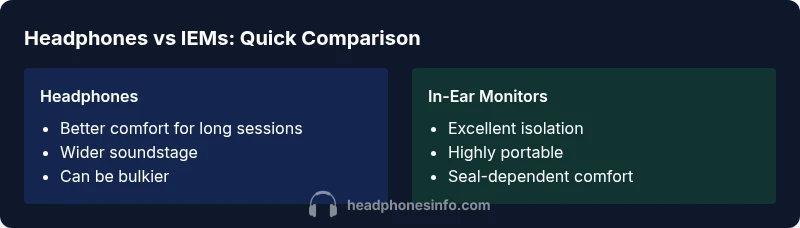
In the audio world, the terms headphones and in-ear monitors (IEMs) refer to two fundamentally different listening experiences. The phrase headphones vs in ear monitors encapsulates a debate about fit, seal, and intended usage. According to Headphones Info, understanding the core distinction helps listeners pick between a comfortable over-ear listening result and a portable, tight-seal monitoring solution. Headphones generally sit around the head and provide an expansive soundstage, while IEMs tuck inside the ear canal and rely on precise sealing for isolation. This foundational contrast affects almost every other factor, from noise isolation and leakage to power requirements and cable durability. For a head-to-head, expect headphones to deliver a more relaxed, immersive experience with easier long listening sessions; IEMs tend to isolate better and translate micro-detail with surgical accuracy in chaotic environments.
Fit, comfort, and wearability: headphones vs in ear monitors in daily life
Comfort and wearability are often the first practical concerns. Over-ear headphones spread pressure across larger surface areas, which many listeners find comfortable for hours. IEMs, by design, isolate and compress the listening experience into a compact form. The Headphones Info team notes that fit quality is the single most important predictor of long-term satisfaction. If you wear glasses, have sensitive ears, or commute on noisy transit, the choice may hinge on how well the seal stays comfortable without fatigue. In this section, we explore cup shape, headband padding, ear tip types, and the tradeoffs between passive comfort and active listening endurance. The goal is to help you map your daily routines to the right ergonomic profile and chord of compatibility with your ears.
Sound quality and tonal balance: what you hear with headphones vs in ear monitors
Sound quality is often the decisive factor for many listeners. Headphones tend to offer a broader, more expansive soundstage, with generous bass extension and natural decay in the midrange. IEMs, however, can deliver remarkable detail retrieval and precise imaging thanks to strong seal and accurate high-frequency response. The key point is not that one is universally better but that each tool excels under different conditions. For critical listening or mixing, some listeners prefer IEMs for their proximity and recall of miniatures in the mix, while others favor headphones for spatial cues and a more forgiving tonal balance. Headphones Info’s analysis emphasizes matching the device to the listening goal and room characteristics rather than chasing an abstract ideal of “best.”
Isolation and leakage: when silence matters
Isolation impacts where the device will be used. IEMs can block ambient noise impressively, which is why they shine on stage or in loud environments. They also minimize sound leakage, making them less distracting to others. Headphones, especially open-back designs, may leak sound and allow more external sound in. For travel and commuting, the decision hinges on how much ambient noise you want to filter and whether you’re sharing space with others. If you need quiet focus or late-night sessions, IEMs frequently offer superior isolation, while closed-back headphones can provide strong isolation without the physical seal of an ear canal. We discuss practical tests you can perform to gauge isolation in real-world settings.
Impedance, sensitivity, and amplification needs
Power requirements differ meaningfully between headphones and IEMs. Many high-performance headphones require more current to reach similar loudness levels, especially if they have low sensitivity. IEMs often present higher sensitivity and can be driven adequately by portable devices, though some studio-grade IEMs demand quality DACs or portable amps for maximum dynamic range. This section covers impedance ranges, sensitivity benchmarks, and how to choose a source—phone, DAC, or dedicated amp—to ensure clean voltage swing and minimal distortion. Understanding impedance and efficiency helps you avoid under-powering or overworking your playback chain, especially with audiophile-grade gear.
Portability, travel, and everyday carry
One of the clearest practical differences is portability. IEMs disassemble into tiny form factors and pack into compact cases, making them a natural choice for travelers, commuters, and gymgoers. Headphones, particularly larger closed-back or travel models, sacrifice some portability but offer longer battery life in wireless variants and less isolation fatigue due to larger driver bodies. If you travel a lot or need discreet listening, IEMs have the edge; if you value comfort during long sessions and a more forgiving soundstage, headphones may be preferable. We outline scenarios and provide quick planning tips for packing and protection.
Durability and build quality: cables, connectors, and wear
Durability is a practical concern. Headphones typically feature detachable, robust cables and sturdy housings, which can be long-lasting with proper care. IEMs have delicate drivers and micro-sized components, making the cable and nozzle assembly more susceptible to wear and moisture if not properly stored. The best approach is to choose a model with reinforced connections, high-quality tips, and a protective case. We compare common failure points and share best practices for extending the life of both headphones and IEMs, including tip hygiene and cable management that preserve sound quality over time.
Price ranges and value: what you get for your money
Pricing for headphones spans a broad spectrum—from budget options to premium models with advanced drivers and tuning. IEMs often offer excellent sound at a similar price point, but the value proposition can swing on sealing performance, driver count, and build quality. We present typical price ranges and discuss where you can expect to pay more for features like detachable cables, balanced connections, and custom-tuned filters. The purpose is not to chase the highest price tag but to quantify what you gain at different levels and to guide you toward the best value for your listening goals.
Use-case mapping: casual listening, critical listening, and stage monitoring
Different use cases demand different characteristics. Casual listening benefits from comfortable ergonomics and a forgiving tonal balance. Critical listening prioritizes accuracy, phase coherence, and a clean impedance curve. Stage monitoring requires low latency, robust sealing, and reliable live-use performance. We map about which use cases align with headphones and which with IEMs, offering practical decision rules such as: for quiet, relaxed evenings, choose headphones; for on-the-road focus or stage work, lean toward IEMs. This section ties together the earlier discussions with concrete decision criteria.
Care, cleaning, and longevity: keeping gear healthy
Maintenance matters as much as the purchase. Headphones benefit from occasional wipe-downs and case storage to avoid cable kinks and driver dust. IEMs require tip hygiene, nozzle cleaning, and careful cable handling to avoid moisture ingress and tip looseness that can degrade seal. We provide step-by-step guidance for cleaning and storage routines, including safe tips for dealing with sweat during performances or workouts. Proper maintenance can significantly extend the life of both headphones and IEMs and preserve sound fidelity over time.
Practical audition checklist: how to compare in real life
Auditioning headphones vs IEMs in a store or during a trial period is essential. Bring your typical tracks that reveal bass weight, micro-dynamics, and vocal texture. Test for seal stability, comfort, and how quickly the device responds to dynamic passages. For IEMs, evaluate multiple tip sizes to find the best seal; for headphones, check headband comfort and clamping force. We provide a practical checklist of steps and criteria so you can compare models directly and record impressions for later reflection.