Headphones vs In-Ear Monitors: Key Differences Explained
A data-driven comparison of headphones and in-ear monitors (IEMs), covering fit, isolation, sound, durability, and use cases to help you choose the right type for home listening, travel, or studio work.


A concise comparison: Over-ear headphones sit around the ears and showcase a spacious soundstage with comfort for long sessions, while in-ear monitors (IEMs) sit inside the ear canal, emphasizing isolation and portability. The core distinction is enclosure and driver layout, which shape sound, leakage, and practical use. Both can sound excellent with proper tuning, so pick based on your environment, comfort, and priorities.
What defines a headphone versus an IEM
Headphones are audio devices that rest around or over the ears, using ear cushions and a headband to create a loose seal with the outer ear. They rely on the larger enclosure to move air and shape the soundstage, often delivering a spacious, immersive experience. In-ear monitors, or IEMs, are compact drivers placed inside the ear canal. They seal the ear to reduce ambient noise and deliver precise, controlled sound in a highly portable form. According to Headphones Info, the fundamental distinction is not just size, but how the enclosure and driver arrangement influence listening behavior, isolation, and comfort. This difference influences your choice as you consider where you’ll listen, how you move, and how much external noise you want to block. The goal is to match the device to your environment and sensory preferences so you can enjoy music, movies, or critical listening without compromise.
In practical terms, headphones trade some level of portability for a broader soundstage and often more comfortable long-term wear. IEMs, by contrast, prioritize isolation and fit portability for travel, commutes, or on-stage use. Understanding this distinction helps you set realistic expectations about bass impact, imaging, and the sense of space you’ll experience in your listening room or on the move.
Headphones Info’s approach blends objective measurements with real-world usage to explain how enclosure type, driver configuration, and seal quality translate to everyday listening outcomes. Keep in mind that no single category is universally better; the best choice depends on your goals, preferred genres, and listening context.
questionShort”:null,
answerShort”:null},
Fit, Isolation, and Comfort
Fit and isolation drive the daily experience of any listening device. Headphones sit on or around the ears, relying on clamp force, padding, and the design of the ear cups to create a seal with the outer ear. A good fit minimizes unwanted movement and reduces passive noise, but comfort varies with head shape, ear size, and padding materials. IEMs seal the ear canal with a set of ear tips, and many models include multiple tip sizes to tailor the seal to the listener’s ear anatomy. When correctly fitted, IEMs can provide high isolation, which makes them excellent for noisy environments like airplanes or cafes. Still, comfort can vary over long sessions as tips press into the ear canal.
The Headphones Info team notes that the seal quality of IEMs is a critical determinant of both isolation and bass response. If the seal breaks or tips wear out, isolation drops and bass becomes inconsistent. For headphones, comfort stems from weight distribution and padding; long listening sessions are more feasible with light, well-cushioned models. In both cases, trial and test fitting are essential to determine which option stays comfortable during extended use. The decision often hinges on whether you prioritize isolation or long-session comfort, especially in environments with changing noise levels.
Beyond raw isolation, consider how you wear them. Headphones enable a natural, low-pressure fit that doesn’t intrude into the ear canal, making them appealing for home cinema or studios where long sessions are common. IEMs demand an intimate fit and may require periodic reseating to maintain the seal. Your choice should align with your typical listening posture, movement, and the likelihood of needing to remove and re-seat during sessions.
questionShort”:“Fit & Isolation”,
Sound Quality and Imaging: Drivers, Tuning, and Soundstage
Sound quality hinges on driver type, tuning, and the way the enclosure shapes air movement. Headphones often use larger drivers and can deliver a broad, enveloping sound with a generous bass response and expansive soundstage. IEMs rely on smaller drivers but can achieve remarkable precision and imaging when the seal is solid and tuning is carefully adjusted. In many cases, the imaging clarity of IEMs can rival or exceed portable headphone designs, particularly in the mid and high ranges where detail matters. The trade-off is that some listeners perceive a narrower soundstage with IEMs, especially if the seal is not as tight or if tips don’t fit well. The tuning philosophy also differs: headphones frequently emphasize a more natural, room-like presentation, while IEMs may be tuned for accuracy and finite tonal balance in a compact form.
From a practical standpoint, you’ll notice that headphones often deliver a more immersive experience for tracks with wide stereo space, while IEMs excel at revealing micro-details and instrument separation in busy mixes. The interplay between driver configuration (dynamic, balanced armature, or hybrid) and the enclosure can lead to nuanced differences in bass texture, midrange warmth, and treble extension. Headphones Info emphasizes evaluating a few signature tracks you know well to judge how each option handles timbre and imaging in your usual listening contexts.
Keep in mind that perceived sound quality is heavily influenced by source quality, DAC/amp pairing, and listening volume. A well-tuned system in either category can outperform a less capable setup in the other, so prioritize real-world listening rather than spec lists alone.
questionShort”:“Sound Quality”,
Enclosures, Impedance, and Power Requirements
Enclosure design determines how sound is projected and how the bass responds. Headphones rely on the outer shell and ear cups to shape the acoustic space, which can impact how bass feels at different listening levels. IEMs depend on the ear canal seal to control bass response and overall tonal balance. Impedance and sensitivity figures influence how much power a device must deliver to reach comfortable listening levels. In general, headphones with higher impedance may require a more capable DAC or dedicated amp to maintain clean headroom, while IEMs with lower impedance can often perform well directly from portable devices. This means that the same device may drive IEMs with more consistent volume, while some headphones could benefit from a portable amp or an actual headphone amplifier.
Another practical distinction is durability and care. Headphone enclosures are robust and designed for frequent handling, though cables and connectors can wear over time. IEMs, with their delicate tips and drivers, require careful storage and tip maintenance to preserve seal quality and prevent air leaks. If you travel frequently, consider how easy it is to protect each option from moisture, dust, and accidental bending of cables. The right pairing of source, cable, and fit can significantly affect both perceived transparency and bass control in everyday listening.
In practice, many listeners pair IEMs with compact portable DACs for on-the-go listening, while home setups often leverage desktop DACs or integrated amps for headphones. The choice should reflect your typical listening environment, how you power your gear, and whether you value amplifier headroom or the simplicity of plug-and-play devices.
questionShort”:“Impedance & Power”} ,{
Portability and Durability for Different Use Cases
Portability often drives the decision between headphones and IEMs. Headphones, especially larger open-back or closed-back models, tend to be bulkier and less convenient for travel or tight spaces. They can be excellent for home theater, gaming, or studio work where a dedicated listening space is available and space isn’t a limiting factor. IEMs shine in portability: their compact form factor, lightweight design, and absence of a bulky headband make them ideal for commuting, travel, and on-stage monitoring. Durability varies by construction; built-to-last headphones can withstand daily wear and tear, while IEMs rely on robust housings and resilient cables, with tips regularly replacing to maintain seal quality.
When considering use cases, prioritize how often you will be moving, the environment, and the likelihood of needing to remove the device for conversations or transit. If you frequently pass through airports or crowded spaces, IEMs can offer less bulk and better isolation with a discreet footprint. If you spend long hours at a desk or in front of a screen, a comfortable headphone with a plush headband may reduce fatigue and improve overall listening endurance. The practical outcome is a choice that aligns with your mobility needs and physical comfort preferences in typical contexts.
questionShort”:
Price, Value, and Long-Term Ownership
Price ranges for headphones and IEMs reflect build quality, driver technology, and brand positioning. In general, you will find a broader price spectrum for headphones due to the diversity of models, including high-end closed-back designs and open-back studio headphones. IEMs also cover a wide price range, from budget-friendly options with decent isolation to premium sets with advanced drivers and cable assemblies. Long-term ownership factors include the durability of the cable, tips, and housings for IEMs, and the replacement parts and warranty coverage for headphones. It is wise to factor in the cost of spare tips, replacement cables, and cushions into the total ownership experience. When evaluating value, consider how often you will use the device, the level of isolation you need, and whether you expect to upgrade components such as the DAC or amplifier over time.
Headphones Info emphasizes looking beyond initial price to assess long-term value, including comfort, build quality, and the robustness of the seal for IEMs. A well-chosen pair that fits your daily routine can deliver sustained enjoyment and fewer mid-term replacements, optimizing the overall cost of ownership.
questionShort”:“Price & Value”}, {
Use-Case Scenarios: Studio, Travel, and Commuting
Different environments demand different listening tools. In a studio or critical listening setup, headphones with accurate timbre and consistent performance across a range of frequencies are highly valued, especially when you need a reference that travels with you. On the other hand, travel and commuting call for compact, isolating devices that stay put during movement. IEMs excel here, offering excellent isolation and a secure fit in tight spaces. For casual listening at home, the choice often hinges on how immersive you want the experience to feel and whether you value a broad soundstage or precise instrument separation. The Headphones Info team recommends selecting a model that aligns with your principal use case and then validating that choice with real-world listening sessions in your target environments.
questionShort”:“Use cases”}, {
Maintenance and Care
Maintaining headphones and IEMs extends their life and preserves sound quality. For headphones, routine cable checks, replacement ear pads, and proper cleaning of mesh grilles help prevent squeaks and muffled highs. If you own wireless headphones, firmware updates and battery health become relevant maintenance considerations. For IEMs, protect the drivers by avoiding rough handling, replacing tips as they wear, and storing the buds in a protective case to prevent tip deformation or tip loss. Regular cleaning of ear tips removes wax and debris that can affect seal and bass response. In both cases, avoid moisture exposure and store devices in a protective case when not in use. Following manufacturer recommendations for cleaning and storage can help maintain a consistent listening experience over time.
questionShort”:“Maintenance”}, {
Choosing Your Path: Decision Framework
Start with environment and usage. If you mainly listen at home or in a controlled space, headphones with a comfortable headband and a wide tonal range may be ideal. If you travel often, require high noise isolation, and need a compact carry, IEMs are a strong contender. Next, assess fit and seal; try multiple ear tip sizes and management strategies to ensure comfort and consistent isolation. Finally, factor in budget and gear ecosystem, including DACs and amplifiers if you lean toward higher impedance headphones. A structured approach, including in-person trials when possible, helps you determine the best overall match for your listening habits.
questionShort”:“Decision framework”}, {
Common Misconceptions and Myths
A common misconception is that bigger is always better for sound quality. In reality, the best sound depends on driver quality, tuning, and seal. Another myth is that IEMs always isolate perfectly; seal quality can vary with ear anatomy and tip fit, affecting bass and spatial cues. Likewise, some assume headphones cannot be portable; modern folding designs and compact closed-backs can be highly travel-friendly. Finally, belief that one category inherently sounds superior ignores different tuning philosophies and intended uses; both headphones and IEMs can deliver exceptional listening experiences when matched to the user’s needs.
Comparison
| Feature | Headphones | In-Ear Monitors (IEMs) |
|---|---|---|
| Fit & Isolation | Over-ear cups with passive isolation | In-ear seal provides high isolation when seated correctly |
| Soundstage & Imaging | Typically broader, more immersive space | Imaging can be precise but depends on seal quality |
| Driver Configuration | Larger drivers; varied tuning | Small drivers; seal-driven bass and detail |
| Impedance & Power | Often higher impedance; may need DAC/amp | Lower impedance; easy to drive from portable devices |
| Portability | Bulkier; less portable | Highly portable and discreet |
| Durability & Maintenance | Robust housings; cables may wear | Tips and drivers require careful handling |
| Best Use Case | Home listening, studios, immersive listening | Travel, commuting, on-stage monitoring |
Upsides
- Comfort for long listening sessions
- Wide soundstage potential with many headphones
- Strong isolation with well-fitted IEMs
- Portable and discreet options for travel and daily use
Disadvantages
- Headphones are bulkier and less portable
- IEMs can cause ear fatigue with long sessions
- Seal quality can vary and affect bass consistency
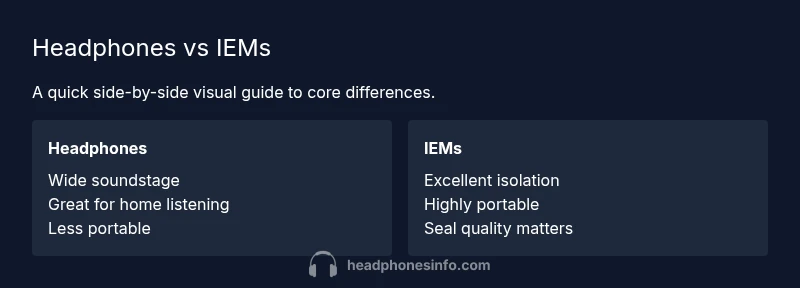
Headphones are preferred for home listening and immersive sound; IEMs excel in isolation, portability, and on-the-go use.
Choose headphones when you value a spacious sound and long-term comfort in a stable listening environment. Opt for IEMs when you need maximum isolation, compact form, and travel-friendly usage. Both can deliver excellent audio with proper fit and tuning, so your choice should prioritize context and practical needs.
People Also Ask
What is the main difference between headphones and IEMs?
The main difference is enclosure and fit. Headphones rest around the ear and rely on cups for sound shading, while IEMs seal the ear canal for isolation and precise control. Both can sound excellent with proper tuning.
The main difference is where the sound sits: around the ear or inside the ear canal, which changes isolation and sound control.
Are IEMs better for noise isolation than over-ear headphones?
Typically yes, when a good seal is achieved. Some closed-back headphones can approach similar isolation, but seal quality and design matter a lot for IEMs.
Usually IEMs isolate more when they fit the ear well.
Do headphones or IEMs have better bass?
Bass performance depends on tuning and driver design. Headphones with large dynamic drivers can deliver deep, expansive bass, while IEMs can provide tight, controlled bass with a secure seal.
Bass varies a lot by model, but both can sound great with the right tuning and fit.
Are IEMs suitable for studio monitoring?
IEMs are used for portable monitoring and isolation in noisy spaces, but many studios still rely on headphones or reference monitors for critical listening due to broader soundstage and consistent channel balance.
IEMs are handy on the go or in noisy rooms, but pros often prefer headphones for critical checks.
What factors should guide my choice?
Environment, portability, isolation needs, comfort, and budget should guide your choice. Travel and noise-prone spaces favor IEMs, while home listening and soundstage favor headphones.
Think about where you’ll listen most and what matters most to you in sound and comfort.
What to Remember
- Evaluate listening environment before buying
- Prioritize isolation for travel and noisy spaces
- Test fit for comfort and seal to avoid fatigue
- Balance sound preference with portability and setup constraints