Headphones vs IEMs: A Data-Driven Comparison
A data-driven comparison of headphones vs IEMs. Compare sound quality, isolation, comfort, portability, and price to choose the best option for home listening, travel, and daily use.


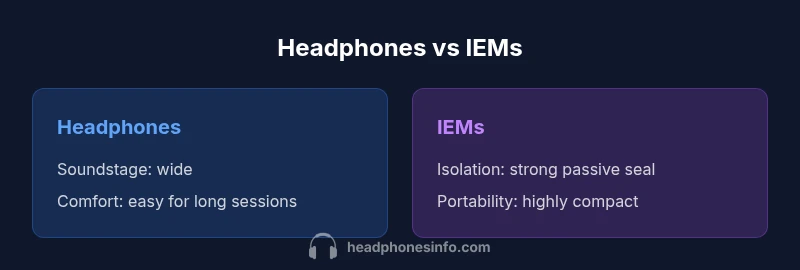
Headphones excel in soundstage and long‑term comfort, while IEMs maximize isolation and portability in a compact form. If you prioritize travel and quiet environments, IEMs are often the smarter pick; for home listening and extended sessions, headphones usually offer better ambience and comfort. See our detailed comparison for deeper guidance.
Core Listening Goals
In audio, the choice between headphones and IEMs often comes down to how you want your music to sit in space and how you wear them. According to Headphones Info, most listeners prioritize three goals: immersion, practicality, and comfort. Headphones typically deliver a wide soundstage and smooth tonal balance across genres, making them ideal for home listening, critical reviews, and long sessions. IEMs, by contrast, emphasize precise transient response, detailed micro-contrast, and excellent isolation, which pays off in noisy environments or when you travel with limited space. Understanding your primary listening goals—whether you want to feel like you are inside the mix or you want to disappear into your environment—will guide your next purchase.
Sound Quality Fundamentals: Tone, Imaging, and Texture
Sound quality is a balance of several interdependent attributes. Tone describes the overall balance of bass, mids, and treble; headphones often present a more forgiving tonal curve, while IEMs can reveal sharper micro-detail if the tuning suits your ears. Imaging and soundstage refer to how accurately you perceive the location of instruments. Headphones tend to deliver a wider, more enveloping stage, whereas IEMs can present precise imaging in a compact silhouette. Texture and micro-detail matter when you listen to complex passages; in many cases the difference is most noticeable in fast passages and percussive attacks. Headphones Info analysis shows that listener preference often shifts with the genre and playback source, so your ideal choice may vary from song to song.
Isolation, Leakage, and Noise Handling
Isolation is a strong differentiator. In-ear monitors typically seal the ear canal and block external noise, which makes them ideal for commuting or noisy offices. Some IEMs use vented designs to improve comfort, but a poor seal can introduce fatigue and listening fatigue. Headphones, especially open-back models, may leak sound and let ambient noise intrude, which can be a drawback in quiet spaces but a benefit in critical listening environments where you want air and space. Leakage matters for late-night listening at home or when sharing space, and it is one reason many buyers favor IEMs for portable use.
Comfort, Fit, and Long-Term Wearability
Comfort hinges on ear shape, headband pressure, clamp force, and padding. Over-ear headphones provide large cushions and distribute pressure, which reduces hot spots during long sessions. IEMs offer a compact, lightweight fit, but tip selection and insertion depth are crucial; an ill-fitting tip can cause discomfort and reduce isolation. For many listeners, the best solution is to test multiple tips and check for pressure on the tragus or ear canal. The Headphones Info team notes that long-term wearability is often task-driven: extended studio work may favor headphones, while daily commutes may favor IEMs with secure, customizable tips.
Portability, Durability, and Travel Readiness
Portability is a practical advantage of IEMs: smaller cases, lighter weight, and less space for bags. Durable models rely on robust cables or detachable connectors, but sheer handling can still cause tip loss or micro-motions in the plug. Headphones are bulkier and less convenient to carry through crowded transit, but many high-end models feature rugged builds and replaceable parts. For travelers, a compact IEM setup often wins, particularly if it includes a sturdy case and balanced cable options. Weather resistance and cable reliability are additional considerations for frequent travelers.
Price and Value: Navigating the Range
Price is a meaningful signal of build quality and component choices, but value comes down to how well the product matches your priorities. Headphones set can range from affordable to premium, with build quality and driver technology driving cost. IEMs also cover a wide price span: entry to midrange IEMs can offer exceptional detail and isolation, while flagship models push the limits of resolution and stage, often at premium prices. In practice, a midrange headphone may outperform a budget IEM in some genres, and a premium IEM may outperform a budget headphone in isolation and portability. Your listening goals and environment will determine whether you get more value from one format over the other.
Use-Case Scenarios: When to Reach for Each Option
For home studios and critical listening, headphones often provide the most useful balance of comfort, soundstage, and bass control. In busy commutes or shared spaces, IEMs offer isolation and a compact footprint that makes it easier to concentrate on the mix or the music. On stage or in rehearsal rooms, IEMs can provide consistent monitoring and reduced stage spill, while headphones can serve as a comfortable backup for long sessions in the studio. For gamers, both options exist; open-back headphones can deliver an expansive soundscape, while certain IEMs emphasize precise localization. In all cases, matching the product to your real-world environment is key.
Maintenance, Care, and Longevity
Care routines differ. Headphones require occasional headband and pad replacement, and detachable cables simplify maintenance. IEMs demand tip hygiene, careful cable handling, and occasional driver checks for any micro-scratch or debris buildup in the nozzle. Cleaning tips include wiping cushions and shells with a microfiber cloth and storing in a protective case when not in use. Avoid exposing either format to extreme humidity or heat, which can degrade damping materials and connectors over time. Regular checks and proper storage can extend the life of both headphones and IEMs.
Buying Guide: How to Test and Decide
Start with a realistic listening session and a short playlist that exercises bass, mids, and treble. Try both formats with the same genres and source to avoid bias from the DAC or amp. Check fit by wearing for at least 20 minutes and evaluating comfort, seal, and heat buildup. In a store or online, ask about return policies and try to compare multiple models within your budget. Take notes on soundstage, detail, and isolation, and consider how each option will integrate with your real-world routines, such as commuting, office work, or studio sessions. Headphones Info recommends using independent sources for testing when possible and listening at a comfortable volume to avoid fatigue.
Comparison
| Feature | Over-ear headphones | In-ear monitors (IEMs) |
|---|---|---|
| Soundstage and imaging | Wider, immersive, natural imaging | Tighter, precise imaging with compact form |
| Isolation | Variable (often less isolation if open-back) | High isolation with secure seal |
| Portability | Bulkier; less portable | Highly portable; compact case |
| Comfort for long sessions | Easy wear for many hours; larger pads | Tip selection and fit affect comfort over time |
| Leakage/noise leakage | Can leak sound to surroundings | Minimal leakage due to in-ear seal |
| Durability and maintenance | Replaceable cushions; robust builds possible | Delicate nozzles; cable wear common |
| Best use case | Home listening, critical study, gaming with space | Travel, commuting, studio monitoring |
| Price range | Wide range, often more affordable entry-level | Wide range, potentially high-end flagship pricing |
Upsides
- Provides a clear framework to weigh listening goals against lifestyle
- Highlights the trade-offs between isolation, comfort, and portability
- Guides testing with real-world playlists and environments
- Encourages a balanced view of value across formats
Disadvantages
- No single winner for all use-cases; context matters greatly
- Tuning variations within each format can confuse buyers
- Premium pricing can be a barrier for casual listeners
- Brand-specific hype may bias initial impressions
Headphones excel for home listening and comfort; IEMs excel for isolation and portability.
The choice hinges on your environment and priorities. If you spend long hours at home, headphones are often the better fit. For travel and noisy spaces, IEMs provide superior isolation and a compact footprint. Headphones Info Team emphasizes hands-on testing to confirm your preferred balance.
People Also Ask
What are the main differences between headphones and IEMs?
Headphones typically offer a wider soundstage and more comfortable long-term wear, while IEMs provide superior isolation and travel-friendly form. Tonal balance and imaging vary by model, so testing both formats with your preferred music is essential.
Headphones usually feel roomier and more comfortable, whereas IEMs isolate better and travel lighter.
When should I choose headphones over IEMs?
Choose headphones for home listening, critical mixing, or sessions that benefit from a broad soundstage and long-term comfort. IEMs are preferable when you need strong noise isolation or a compact setup for commuting and travel.
Pick headphones for space and comfort; choose IEMs for isolation and portability.
Are closed-back headphones better than IEMs for isolation?
Closed-back headphones can offer good isolation but often don’t match the default noise-blocking of a well-fitted IEM. IEMs seal directly at the ear canal, delivering higher passive isolation for most users.
IEMs usually win for isolation; closed-back headphones can come close in noisy environments.
Can I use wireless headphones and wireless IEMs interchangeably?
Yes, both formats come in wireless variants, but latency, battery life, and codec support vary. For synchronized gaming or video, ensure the model uses low-latency codecs and has a reliable wireless connection.
Wireless options exist for both, just check latency and codecs.
Do I need a DAC or amp for IEMs or headphones?
Many consumer models sound good straight from devices, but higher-end headphones and some IEMs benefit from a quality DAC or amplifier, especially when driven from mobile devices with limited power.
A DAC/amp helps in demanding setups, but isn’t always required.
What to Remember
- Evaluate your primary listening environment before buying
- Balance isolation needs with comfort and soundstage
- Test multiple tip sizes for IEMs to optimize fit
- Prioritize portability if you travel often
- Compare value across a range of models within your budget