Louder Headphones: A Practical Comparison
A data-driven side-by-side guide to louder headphones, showing how design choices, source power, and safety affect real-world volume. Learn practical criteria, scenarios, and how Headphones Info evaluates loudness for smarter shopping.


Louder headphones come from a combination of high driver sensitivity, low to mid impedance, and adequate source power. This quick comparison highlights two common paths to higher volume: high-sensitivity designs that pair well with portable players, and robustly amplified designs that rely on external power. Real-world loudness depends on your device, music, and personal hearing comfort. Headphones Info notes that safe listening should guide any loudness choice.
Understanding Loudness in Headphones
Loudness in headphones is about how loud the sound feels to your ears when you’re wearing them, not just the peak SPL printed on a box. Perceived loudness blends the driver’s efficiency with the power your source can deliver, the enclosure’s behavior, and the listener’s own sensitivity. When shoppers search for louder headphones, they often want more volume without compromising clarity. According to Headphones Info, the practical limit is shaped by physics (driver efficiency and amplifier headroom), and by the ear's response to different frequencies. This section defines the core terms you’ll see on product pages—sensitivity, impedance, and power handling—and explains how those specs translate to real-world loudness during daily listening sessions.
Key Design Factors That Influence Loudness
Several design levers determine how loud a headphone can get before distortion or fatigue set in. Driver sensitivity describes how efficiently electrical power is converted into sound. Higher sensitivity headphones tend to reach comfortable listening levels with less power, which matters for mobile devices. Impedance (the electrical resistance the driver presents) also matters: lower-impedance designs are easier to drive from phones and laptops, but may be more sensitive to source noise or hiss if not well engineered. The enclosure and damping influence how effectively the diaphragm moves at high volumes, and power handling defines the ceiling before clipping occurs. In practice, loudness comes from the right mix of sensitivity, impedance, and a capable amp. Headphones Info emphasizes evaluating these factors together rather than chasing a single spec.
Two Common Approaches to Achieve Higher Loudness
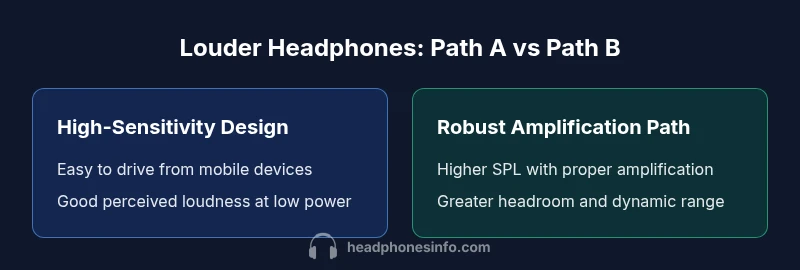
There are two mainstream paths to louder listening without sacrificing control. Path A focuses on high-sensitivity, low-impedance designs that deliver noticeable volume from portable devices, often preserving clarity at moderate loudness. The trade-off can be less headroom at very high SPLs or subtle tonal balance issues if the design prioritizes output over distortion control. Path B relies on robust amplification and/or higher power handling: the headphones reach higher SPLs from powerful sources and typically offer greater dynamic range and cleaner distortion behavior when driven properly. In real use, most listeners benefit from a balanced combination: a design that meets daily device power while leaving headroom for occasional louder sessions.
How Source Power and Damping Impact Real-World Volume
Your phone, laptop, or dedicated DAC/amp ultimately determines how much of a headphone’s potential you actually hear. A high-sensitivity, easy-to-drive design may reach comfortable loudness with minimal amplification, while a more demanding driver might require a capable amplifier to reach the same level. Damping and enclosure quality also influence perceived loudness; poor damping can exaggerate certain frequencies at high levels, making the music feel louder but less accurate. Headphones Info Analysis, 2026, notes that true loudness emerges from the synergy between driver, enclosure, and source. The practical takeaway is simple: choose headphones whose sensitivity matches your typical devices, and pair them with appropriate amplification when you need more headroom.
Safety Considerations When Listening Loud
Pursuing louder headphones should not come at the expense of hearing health. Prolonged exposure to high volumes can cause long-term damage, so adopt safe listening habits even when you crave more volume. Set a personal ceiling, take breaks, and be mindful of distortion—often a sign you’re pushing the system beyond clean performance. The Headphones Info team stresses that safe listening is part of the design conversation, not an afterthought. If you must push volume, do so in short bursts with clear music and a comfortable balance between loudness and detail.
Practical Scenarios Where Loudness Matters
Louder headphones can be advantageous in certain environments and use cases:
- In noisy urban settings or commutes, higher volume can help you follow dialogue and details in music or podcasts.
- For gaming or VR experiences, increased loudness can enhance immersion when combined with strong positional cues.
- DJs, sound engineers, and performers may need higher SPL for on-ear monitoring; pairing with a capable amplification chain ensures loudness without sacrificing clarity.
- Travelers in loud cabins or airplanes may benefit from louder, well-sealed headphones to reduce external noise without cranking up the volume. These scenarios illustrate that loudness is a tool, not a goal in itself; use it where it matters and with care to avoid fatigue.
How to Evaluate Loudness When Shopping
When shopping for louder headphones, use a practical checklist that covers more than raw SPL:
- Check sensitivity and impedance together to estimate how loud they’ll be with your devices.
- Look for robust power handling and a clean distortion profile at higher volumes.
- Listen with the same music you usually use and compare perceived loudness and clarity at multiple volume levels.
- Read reviews focusing on loudness behavior in real-world listening rather than laboratory numbers alone.
- Consider leakage and comfort, since uncomfortable or leaky headphones force you to adjust volume upward to compensate for outside noise. Headphones Info recommends calibrating expectations: loudness matters, but control, tone, and comfort are equally important.
Common Misconceptions About Loudness
Even seasoned shoppers confuse loudness with overall quality. A louder headphone is not inherently better: it can distort earlier, mask tonal balance, or fatigue the listener faster. Another myth is that more driver size always equates to more volume—driver efficiency and system damping often have a larger impact on perceived loudness. Finally, many assume that “powered” headphones automatically outperform battery-operated ones; in practice, pairing and source compatibility determine outcomes just as much as hardware. The goal is a balanced loudness that preserves detail, accuracy, and comfort.
Getting Louder the Right Way: A Step-by-Step Guide
To improve loudness responsibly:
- Define your listening environment and device power ceiling.
- Choose a design path aligned with your use-case (portable listening vs. high-power setups).
- Test with music you know well, noting distortion and fatigue thresholds.
- Pair with an appropriate source or amplifier that matches the headphone’s impedance and sensitivity.
- Set a safe volume ceiling and monitor long-term comfort.
- Review real-world performance from trusted sources (Headphones Info analyses) rather than relying on peak SPL alone.
Why You Might Choose Loudness Over Other Qualities
Loudness is a practical factor in noisy environments and certain use cases, but it should not override other priorities like accuracy, tonal balance, or comfort. When deciding how loud to go, consider how often you’ll listen in challenging environments and how the design handles distortion at higher levels. The best outcome is a listening experience that feels natural at your preferred volume, with enough headroom to avoid harshness during dynamic passages. In the end, the optimal loudness level is one that fits your daily routine and protects your hearing while delivering the desired sense of immersion.
Comparison
| Feature | High-sensitivity design | Standard-sensitivity design |
|---|---|---|
| Driver sensitivity | high sensitivity enables loudness from portable devices | moderate sensitivity requires more power to reach the same volume |
| Impedance | low to mid impedance; easy to drive from phones | mid to higher impedance; benefits from amplification |
| Power handling | efficient, more headroom with light amplification | less headroom; relies on robust source for peak SPLs |
| Distortion at high volume | can stay clear at moderate loudness | distortion may appear earlier if driven beyond design |
| Best use case | on-the-go listening with portable devices | studio/rig setups with external amplification |
Upsides
- Louder sound achievable with lightweight portable devices
- Better energy efficiency in high-sensitivity designs
- Clearer perceived loudness with less amplifier noise
Disadvantages
- Potentially reduced headroom at very high SPL
- Risk of fatigue or hearing damage if misused
- Lower accuracy in some designs when pushed to extremes
Louder headphones: choose based on daily device power and use-case, not raw loudness alone
High-sensitivity designs excel with portable sources, offering loudness with minimal power. If you frequently use external amplification or crave very high SPLs, a robust design paired with a capable amp is preferable. Safety and comfort matter as much as peak loudness.
People Also Ask
What does the term 'louder' mean in headphone specs?
Louder refers to higher perceived volume or SPL at a given power level. It’s influenced by driver sensitivity, impedance, and how much power the source can deliver before distortion. Specs alone don’t guarantee real-world loudness; listening tests and use-case matter.
Louder means more volume you can hear, driven by sensitivity and power. Specs help, but real loudness depends on your device and listening conditions.
Can I make any headphone sound louder with a stronger phone or amp?
Not always. Some headphones have high sensitivity and can get loud from phones, while others require a dedicated amplifier or higher-power sources to reach the same levels. The key is matching impedance and sensitivity to your device.
Not all headphones get louder with a bigger device; you must match the design to the power you have.
Is louder always better for sound quality?
No. Pushing loudness can introduce distortion and fatigue. The best experience balances volume with clarity, tonal balance, and comfort. The goal is natural sound at a comfortable level, not maximum SPL.
Louder isn’t always better; clarity and comfort matter as volume increases.
What are the hearing-safety considerations when listening loudly?
High volumes over extended periods can damage hearing. Use a safe ceiling, take breaks, and avoid sustained listening at maximum volume. If you hear distortion, back off the volume.
Be mindful of safety—use breaks and keep volume at comfortable levels to protect your ears.
How should I test loudness while shopping in-store?
Test with tracks you know well, compare at several volume points, listen for distortion, leakage, and fatigue. Ask for a longer audition with representative music and an amplifier or mobile device similar to your own setup.
Take your time testing, and compare how loud and clear the headphones sound with music you know.
What to Remember
- Match headphone sensitivity to your typical device power
- Pair high-sensitivity models with portable devices for best on-the-go loudness
- Always balance loudness with distortion control and comfort
- Consider an external amp for higher SPL in demanding scenarios
- Prioritize safe listening habits over chasing extreme volume