Headphones vs Earbuds: A Thorough 2026 Comparison
A data-driven comparison of headphones and earbuds to help you choose by sound quality, comfort, portability, and price. Insights from Headphones Info guide your decision for 2026.


For most listening scenarios, headphones win on sound quality and comfort for long sessions, while earbuds excel in portability and convenience. If you mostly listen at home or in a quiet space, go for headphones; if you travel or exercise, choose earbuds. The best choice depends on your daily routine and priorities—sound vs. mobility.
Why the question matters in 2026
In today’s expansive audio ecosystem, there isn’t a single universal answer to the question of is headphones good or earbuds. The right gear depends on where you listen, how long you listen, and what you value most in sound reproduction. According to Headphones Info, the decision hinges on aligning your gear with your daily routine rather than chasing a universal champion. This means your environment—home office, gym, commute, or flight—shapes the choice more than any spec sheet. In practice, a good pair of over-ear headphones delivers immersive listening in a quiet room, while compact earbuds excel for mobility and quick listening sessions. By understanding your typical day, you can decide which form factor offers the most consistent enjoyment and least friction. This article compares the two with practical criteria, real-world examples, and a buying framework you can apply to any model in 2026.
Defining the terms: headphones vs earbuds
Before weighing tradeoffs, it helps to define the two major forms. Headphones refer to over-ear or on-ear designs that cradle the ears, typically delivering larger drivers and a wider soundstage. Earbuds sit in or near the ear canal and emphasize portability. The distinction isn’t just size; it’s about acoustic presentation, isolation, and how they interact with your body and surroundings. In this guide, “headphones” denote over-ear/on-ear models, and “earbuds” denote in-ear devices, including true wireless and wired variants. Understanding these categories helps you map needs to the right product without marketing fluff.
Core criteria for evaluation
To compare headphones and earbuds effectively, focus on a core set of decision factors that matter in everyday use: sound quality and accuracy, comfort and fit during long sessions, isolation from ambient noise, portability and daily carry, battery life (for wireless options), durability under travel and daily wear, and price-to-value balance across typical budgets. Each criterion interacts with others—heavier headphones can deliver richer bass but may be less convenient on the go. This section outlines how to weigh each factor and what tradeoffs to expect depending on whether you choose headphones or earbuds. The goal is a practical rubric you can apply to any model at any price point, while recognizing that subjective preferences still play a major role.
Headphones: strengths and use cases
Over-ear headphones offer clear advantages when the goal is deep listening and long sessions in a controlled environment. Large drivers typically yield broader bass extension and a wider dynamic range, while cushioned ear cups reduce fatigue. Comfort and seal matter: a well-fitted pair can disappear from awareness in a quiet room, enabling critical listening, mixing, or cinematic experiences. The form factor often supports better passive isolation and, in many premium models, effective active noise cancellation (ANC), which is especially beneficial on planes or in busy offices. Use cases include home studios, movie nights, gaming sessions, and desktop listening where a wired connection or stable Bluetooth pairing is convenient. The tradeoffs are size, weight, and bulk, which can be a drawback for commuting or travel. Headphones remain the preferred option for sound quality and immersive listening in many scenarios.
Earbuds: strengths and use cases
Earbuds excel where mobility, simplicity, and quick listening matter most. Their compact footprint makes them ideal for commutes, workouts, and travel. True wireless designs remove the tether to devices, and many models offer reliable Bluetooth codecs, fast pairing, and convenient controls. Despite smaller drivers, premium earbuds can deliver impressive bass and articulate mids, with a surprisingly wide soundstage for their size. The real strength is portability: a charging case fits in a pocket or small bag, making them easy to carry everywhere. Downsides can include comfort variability for long listening, a potential seal issue due to ear anatomy, and shorter battery life versus some larger wireless headphones. Earbuds are the default for on-the-go listening and fitness routines, and they pair well with mobile-centric lifestyles.
Sound quality and measurement realities
Sound quality is subjective but there are objective cues listeners can use when comparing headphones and earbuds. Headphones typically offer larger drivers, lower distortion at higher volumes, and more consistent imaging across a wider listening area. Earbuds rely on compact drivers and close coupling to the ear canal, which can deliver solid mids and tight bass in premium builds, but may show boundary effects in cheaper models. The perception of sound quality also depends on fit: tip selection, seal, and alignment with your head can dramatically affect bass reach and overall clarity. In varied environments, ANC quality and external microphone performance influence perceived clarity. Headphones Info emphasizes that the best choice isn’t the most revealing meter but the one that aligns with your listening goals and environment.
Comfort, fit, and ergonomics
Comfort is highly personal, and the same design can feel great for one user and uncomfortable for another. Headphones distribute weight across the head, which can reduce pressure points but may feel bulky in confined spaces. Padding, clamping force, and headband comfort are key: too tight and you fatigue; too loose and you lose seal and bass. Earbuds rely on tip fit and shell geometry to seal and stabilize in the ear. Silicone tips come in sizes, and foam tips can improve isolation and comfort. A poor fit can cause fatigue, hotspots, or ear fatigue. For gym use, lightweight earbuds often win; for desk work, a comfortable over-ear with supportive padding can outperform for hours. The take-home message: test multiple sizes and shapes to find a stable, comfortable setup.
Isolation, transparency, and noise control
Passive isolation depends on how well a device blocks external sound. Headphones often provide superior passive isolation due to their seal around the ear, and many include active noise cancellation (ANC) for deeper quiet. Earbuds can also offer ANC, especially true wireless designs, but seal quality varies with ear anatomy. Transparency or ambient-mic modes help you stay aware of surroundings when needed. The choice between headphones and earbuds becomes more nuanced in noisy environments like trains or airports. ANC quality and how it integrates with your workflow can dramatically influence listening comfort and perceived clarity. Headphones Info highlights evaluating ANC in the context of your daily routines and travel needs.
Portability, travel, and daily carry
Portability is often where earbuds shine. Their small footprint and protective charging cases let you slip them into a pocket and forget them until needed. Headphones are bulkier and heavier, which can complicate travel and daily commutes. Many listeners use a two-gear strategy: a compact pair of earbuds for on-the-go and a larger, high-fidelity pair for home listening or studio work. If travel, gym, and frequent commuting are central to your life, earbuds provide the least friction and quickest access. If immersive media, gaming, or long-form listening in a controlled space matters, a quality pair of headphones may be the better long-term investment.
Battery life, charging, and wireless tradeoffs
Wireless options hinge on battery life and charging ecosystems. Wireless headphones typically offer longer listening sessions per charge and straightforward controls on the earcups. Earbuds balance compact charging cases with portable battery reserves; however, battery life per charge may vary more across models. Codec support (SBC, AAC, aptX, LDAC) and device compatibility affect perceived quality and latency. When choosing, evaluate codec support, charging speed, and the durability of the charging case. If you rely on continuous use throughout the day, verify the ease of battery replacement for older or budget models, since some components wear down with heavy use.
Durability and build quality
Durability varies widely by model, not just by form factor. Premium headphones often feature metal or reinforced plastics, sturdy hinges, and detachable cables, which can extend their lifespan. Earbuds tend to rely on compact, integrated components; while some models are highly resistant to sweat and moisture, others can be more delicate due to smaller parts and touch-sensitive controls. When traveling, protective cases, water resistance ratings, and reliable warranties matter. Test for looseness, creaks, cable strain, and button reliability. A robust build reduces surprising failures and ensures consistent performance over time, which Headphones Info regards as a crucial part of total value.
Price, value, and ownership costs
Price is a major driver in the headphones vs earbuds decision, but long-term value includes durability, warranty coverage, and maintenance costs. Over-ear headphones typically command higher upfront prices, especially with premium drivers or ANC. Earbuds span a wider range, from budget to flagship, with total cost influenced by battery life, replacement tips, and case expenses. When evaluating value, consider how often you will use the device, how often you travel, and how easily you can upgrade individual components. Headphones Info encourages comparing not just sticker price but ongoing costs like tip replacements, spare parts, and repairability to avoid buyer’s remorse and ensure a satisfying, long-term listening experience.
Practical buying guide: matching to your use-case
To choose wisely, map your primary listening environment: home, commute, gym, or travel. If immersive sound and quiet environments are non-negotiable, select headphones with comfortable padding and reliable drivers. If portability and quick access matter most, pick earbuds with secure fit, robust Bluetooth performance, and a capable charging case. Test fit with your own ears, read reviews focusing on comfort and seal, and, where possible, audition both options side-by-side. Consider your ecosystem and preferred codecs; some devices pair more efficiently with certain Bluetooth standards. Headphones Info offers a practical framework: start with use-case, narrow by comfort and fit, then validate with real-world listening across your typical genres and activities.
Authority sources and test methodology
For an evidence-based assessment, we rely on industry guidelines and peer-reviewed guidance where available. Evaluating headphones vs earbuds requires looking at acoustics, measurement standards, and consumer electronics testing practices. This article references Headphones Info Analysis, 2026, and supplements with insights from major publications and standards bodies. To support further reading, consult credible sources such as https://www.nih.gov, https://www.ieee.org, and https://www.acm.org. These references provide context on audio performance standards, measurement practices, and consumer electronics research that informs practical decisions for listeners at every level. The goal is to anchor guidance in real-world usage while acknowledging personal taste remains a key factor in choosing between headphones and earbuds.
Comparison
| Feature | Headphones | Earbuds |
|---|---|---|
| Form factor | Over-ear / on-ear | In-ear / true wireless |
| Sound quality | Typically broader soundstage with deeper bass and detailed imaging | Compact sound with precise mids; premium models rival in some cases |
| Portability | Bulky and less portable for travel | Extremely portable and pocketable |
| Comfort for long sessions | Can be heavier; cushioned pads help for long sessions | Lightweight; comfort highly dependent on fit and tips |
| Battery life (wireless) | Often longer per charge on wireless headphones | Case-based charging; some buds have shorter per-charge life |
| Durability | Sturdy builds with replaceable parts in many models | Smaller components can be vulnerable; case protects them |
| Price range | Typically higher upfront for premium ANC/models | Wide range; budget to flagship options available |
| Best for | Home, studio, gaming, immersive listening | On-the-go listening, commuting, workouts |
Upsides
- Clear decision framework helps buyers quickly filter options
- Headphones offer immersive sound and comfort for long sessions
- Earbuds provide exceptional portability and quick access
- Wireless options simplify daily use with reliable codecs
- ANC and transparency modes exist across both forms
Disadvantages
- Tradeoffs between sound quality and portability are common
- Fit and comfort vary between individuals and models
- Battery life and charging considerations in wireless buds
- Durability concerns for small components in earbuds
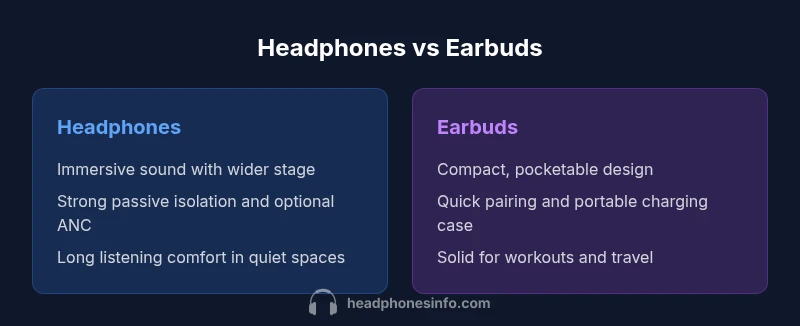
Headphones generally favor sound quality and long-term comfort; earbuds favor portability and convenience.
Choose headphones for immersive listening and stable comfort during long sessions. Choose earbuds for travel, exercise, and situations where pocketability and quick setup matter. Align the choice with your daily routine as Headphones Info recommends.
People Also Ask
What is the main difference between headphones and earbuds?
Headphones are larger and sit around or on the ears, delivering a broader soundstage and strong bass. Earbuds sit in or near the ear canal, prioritizing portability and convenience. The best choice depends on where and how you listen, with sound quality often favored by headphones and mobility favored by earbuds.
Headphones surround the ear for big sound, while earbuds sit in the ear for easy, on-the-go listening.
Are earbuds always less capable for sound quality than headphones?
Not always. Premium earbuds can rival mid-range headphones in clarity and bass response, but in many cases over-ear headphones deliver a wider soundstage and more consistent imaging. Your preference and model quality matter as much as the form factor.
Premium earbuds can sound great, but over-ears often win for depth and imaging.
Which should I buy for travel?
For travel, earbuds usually win due to portability and pocket-sized charging cases. If you expect long flights or train rides and value immersive sound, you could pair buds with a compact headphone for home use to cover both worlds.
Go with earbuds for travel, but keep a bigger pair at home if you want cinema-like sound.
How do I test fit before buying?
Try multiple ear tip sizes for earbuds and check seal; for headphones, test cushioning comfort and clamping force. If possible, listen to a range of genres to assess bass, mids, and treble, and spend time wearing each option for at least 15–20 minutes to gauge fatigue.
Test several tip sizes for buds, and try on a few headphones for comfort during longer wear.
Are wireless earbuds worth the extra cost?
Wireless earbuds offer unmatched convenience and portability, but you pay for mobility with battery and case maintenance. If you value quick pairing, calls, and workouts, the extra cost can be justified; otherwise, wired options remain economical and durable.
If you want no cords and easy gym use, yes; otherwise, wired buds save money.
Can I replace parts if something breaks?
Many headphones offer replaceable cables and serviceable parts, which extends longevity. Earbuds often rely on built-in components and less accessible parts, though some models have replaceable tips or modular components. Check warranty and availability of spare parts when buying.
Usually yes for some parts on headphones; earbuds can be tougher but check the warranty.
What to Remember
- Map your primary listening scenario first
- Prioritize comfort and fit for long sessions
- Balance sound quality against portability and budget
- Consider wireless codecs and ANC when relevant
- Use a two-gear approach for different contexts