Headphones vs Earbuds for Gaming: A Data-Driven Comparison
Compare headphones and earbuds for gaming across latency, soundstage, mic quality, and comfort. Learn which setup fits PC, console, or mobile play with practical tips from Headphones Info.


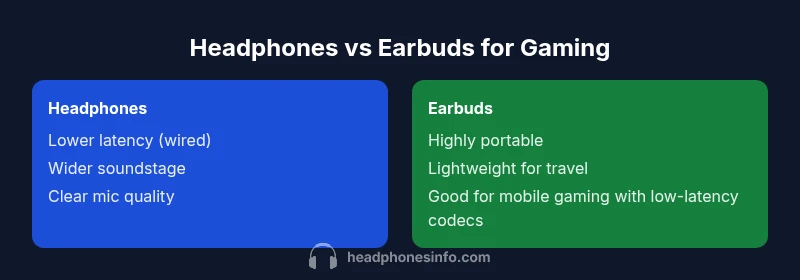
For gaming, headphones generally offer lower latency, better soundstage, and a clearer microphone than earbuds, especially in competitive and immersion-focused play. Earbuds excel in portability and comfort for light gaming on the go, but they tend to lag behind in isolation and cue separation. Both can work with wireless setups, but headphones are the safer, more consistent choice for most players.
Audio performance for gaming: latency, soundstage, and cues
Are headphones or earbuds better for gaming? The short answer hinges on latency tolerance, soundstage, and cue separation. According to Headphones Info, most gamers benefit from the lower latency and more stable soundstage of over-ear headphones, especially in competitive scenarios. The Headphones Info team found that even mid-range headphones can deliver more precise directional cues than many mainstream earbuds, thanks to larger drivers and tighter chamber design. For long sessions, the comfort and passive isolation of closed-back over-ear headphones often translate to better immersion and fewer distractions. However, high-quality earbuds with low-latency wireless codecs can close the gap for mobile gaming and on-the-go play. The key is to match your topology to your platform (PC, console, or mobile) and to your tolerance for latency and dead zones.
Quick takeaways for performance
- Latency: wired headphones typically have the lowest latency; wireless models vary by codec and dongle.
- Soundstage: over-ear headphones usually provide a wider, more precise soundstage.
- Imaging: headphones often offer clearer imaging for locating in-game cues.
- Mic quality: dedicated mics or boom mics on headsets generally outperform built-in earbuds mics.
- Platform quirks: some platforms favor wired connections; others work well with low-latency wireless.
In practice, if you compete seriously, prioritize headphones. If you travel a lot or game on mobile, premium earbuds can still deliver solid results.
The role of drivers, encoders, and codecs
Driver size and tuning shape how well you perceive positional cues in games. Larger drivers tend to move more air, producing louder bass and clearer mids, which can improve cue localization in shooters and racing games. The choice of wireless codec (SBC, AAC, aptX, LDAC, etc.) and the quality of the USB dongle influence latency and stability. Headphones with a wired connection minimize latency dips, while wireless headphones rely on your hardware stack. Earbuds, especially compact true wireless models, often use smaller drivers and may rely on less optimal passive isolation, which can affect perceived space and detail. For a gamer prioritizing audio clarity, a well-tuned wired headset frequently has the edge.
How to read the table below
The table compares typical headphone and earbud configurations in gaming contexts. It reflects general trends and common configurations, not every model. Use it as a starting point and then assess your preferred platforms, gear, and playstyle.
PracticalTake: Quick fit decisions
- If you play fast-paced FPS or battle royales competitively, choose headphones with a reliable microphone and wired or ultra-low-latency wireless support.
- If you travel frequently or game on mobile, premium earbuds with a low-latency codec can be a viable alternative, especially for casual play.
Comfort and form factor in long sessions
Comfort matters in long gaming sessions. Over-ear headphones distribute pressure more evenly and typically offer better passive isolation, which helps reduce ambient distractions. However, some players prefer the compact footprint of earbuds, especially when glasses wearers or ear shape makes headphone fit challenging. Padding, clamp force, and headband adjustability all influence perceived comfort. If you’re prone to ear fatigue, rotate gear, take breaks, or try models with memory-foam cushions and breathable materials. Headphones Info emphasizes trying a few hours of use before deciding, as subjective comfort varies widely across individuals.
Comparison
| Feature | Headphones | Earbuds |
|---|---|---|
| Latency | Typically lower with wired headphones; wireless variants vary by codec | Can have higher latency; depends on codec and device |
| Soundstage | Wider, more detailed positioning due to larger drivers | Often narrower and more intimate |
| Microphone quality | Clearer mics on dedicated headsets or boom mics | Built-in mics vary; often less robust |
| Isolation | Good passive isolation with closed-back designs | Isolation varies; can be open-back or have less seal |
| Comfort for long sessions | Typically comfortable for long sessions due to padding and weight distribution | Can be comfortable but may cause fatigue for smaller ears or glasses |
| Platform compatibility | Broad PC/console support; wired or USB dongles common | Depends on model; some cross-platform support is limited |
| Price/value | High upfront cost but durable, feature-rich models | Lower upfront cost but often less durable or feature-rich |
Upsides
- Lower latency with wired headphones for competitive gaming
- Better soundstage and imaging with over-ear designs
- Generally clearer microphone quality on dedicated headsets
- Comfort and passive isolation are strong in many models
- Versatile across PC, console, and some mobile setups
Disadvantages
- Bulky and less portable than earbuds
- Premium wired models can be expensive
- Wireless earbuds may suffer from codec-based latency and sporadic dropouts
- Some earbuds offer poor passive isolation and build durability
For most gamers, headphones win for performance and consistency; earbuds suit portability and casual play.
Headphones generally deliver lower latency, better soundstage, and clearer mic quality. Earbuds can be viable for light gaming on the go, but they typically lag more and offer less isolation. Choose based on your primary gaming context and portability needs.
People Also Ask
Are headphones better for competitive gaming than earbuds?
In most cases, yes. Headphones typically offer lower latency, wider soundstage, and clearer mic quality, which are critical in competitive play. Earbuds can work for casual gaming or mobile sessions but may lag and provide less isolation.
Yes. For competition, headphones usually win on latency, soundstage, and mic clarity, while earbuds are better for portability and casual play.
Do wireless earbuds introduce noticeable latency compared to wired headphones?
Wireless earbuds can introduce higher latency depending on the codec and device. In practice, low-latency wireless solutions exist, but wired headphones still tend to offer the most reliable minimal latency for fast-paced games.
Wireless earbuds may have more latency than wired headphones, though some low-latency codes can reduce this gap.
Which is more comfortable for long gaming sessions?
Comfort varies by model, but over-ear headphones with plush cushions and adjustable headbands commonly outperform earbuds for long sessions. Earbuds can be comfortable for some users, especially during brief play, but may cause fatigue over hours.
Over-ear headphones usually stay comfortable longer, though some find premium earbuds comfortable too—it’s model-dependent.
Can earbuds provide good microphone quality?
Premium earbuds with good mic quality can deliver solid voice pickup, but dedicated headsets or detachable mics typically offer more consistent performance, especially in noisy rooms.
Good earbuds can have decent mics, but headsets with dedicated mics are usually more reliable.
What should I consider for cross-platform gaming?
Look for devices with broad compatibility, low latency on multiple platforms, and reliable microphone quality. For PC and console, wired options or supported wireless dongles tend to offer the best consistency.
Choose gear that works well across PC and consoles and offers solid latency and mic quality.
Are there hybrid options that combine the best of both?
Yes, some models blend features of headphones and earbuds, offering compact form with decent mic quality and low-latency wireless. Evaluate latency, isolation, and comfort to ensure it fits your gaming routine.
There are hybrid designs, but check latency, isolation, and comfort to confirm they meet your needs.
What to Remember
- Choose headphones for competitive gaming and immersion
- Opt for earbuds when portability and compact design matter
- Prioritize latency, mic quality, and soundstage when evaluating models
- Test across PC, console, and mobile environments to confirm performance