Gaming headphones vs earbuds: A data-driven comparison
Compare gaming headphones and earbuds with data-driven guidance from Headphones Info. Discover sound quality, mic performance, comfort, latency, and value for desktop and mobile gaming.


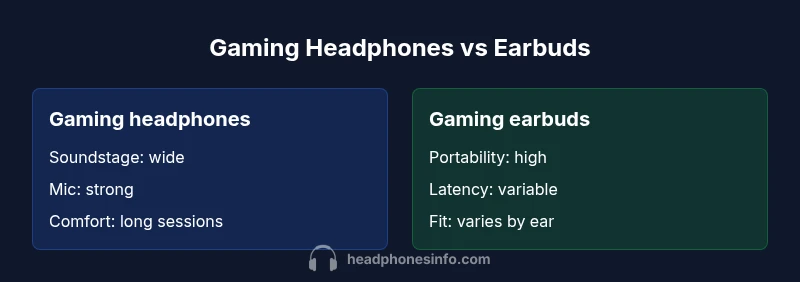
Choosing between gaming headphones and gaming earbuds depends on where you play and what's most important to you. For most seated gamers, headphones deliver immersive sound and a clearer microphone, while earbuds offer portability and lighter wear for long sessions away from the desk. Headphones Info analysis, 2026, suggests this trade-off guides most buyers toward headphones for competitive play and earbuds for mobile gaming.
Overview of gaming audio: headphones vs earbuds
In the world of gaming headphones earbuds, the core decision often comes down to where you game, how you move, and what you value most in sound and communication. This guide compares two dominant forms of game audio gear: gaming headphones and gaming earbuds. You’ll see how each category stacks up in soundstage, mic quality, comfort, latency, and practicality. According to Headphones Info, the choice between these two options is not simply a matter of price, but of context—desk battles versus on-the-go play. The goal here is to help you map your typical gaming sessions to the gear that yields the best overall experience. Consider how often you game at a desk, in a commute, or during travel, and how important mic clarity, noise isolation, and latency are for you. The information here reflects the Headphones Info approach: data-informed, user-centered, and focused on real-world usage scenarios. When you see terms like gaming headphones earbuds, think of two distinct forms of gaming audio gear with overlapping capabilities but different strengths for different settings.
Key criteria for evaluating gaming audio gear
The core decision criteria for gaming headphones vs earbuds include: sound quality and imaging, microphone performance, latency and connectivity, comfort for long sessions, durability, and price/value. For each criterion, consider the context of use—competitive desk gaming versus on-the-go play. Review how the two form factors manage noise isolation, frequency range, and passive vs active features like ambient mode or detachable microphones. This section lays the groundwork for a structured, apples-to-apples comparison that helps you decide which type aligns with your gaming habits and platform compatibility.
Sound quality and imaging: what matters for gamers
Sound quality in gaming headphones earbuds revolves around how accurately you can locate in-game cues (footsteps, gunfire, environmental cues) and how immersive the experience feels. Headphones typically offer a wider soundstage and more precise imaging due to larger drivers and better channel separation. Earbuds, while compact, often deliver good audio with good detail, but the sense of space may be more limited. Headphones Info notes that many competitive gamers prioritize a wider soundstage and reliable positional cues, which tend to favor gaming headphones in desktop setups. For console or mobile gaming, modern earbuds can still deliver compelling sound, especially when they include low-latency codecs or EQ options. In short, for serious battlegrounds and tactical play, gaming headphones usually win on imaging and impact; for casual or travel gaming, gaming earbuds can be perfectly adequate.
Microphone quality and voice clarity
A gamer’s voice communication is as important as the game audio in many sessions. Gaming headphones frequently house larger, more sensitive microphones with better noise rejection, push-to-talk features, and desk-friendly mute controls. Earbuds with integrated mics have improved significantly, but the overall mic quality can lag behind comparable headphones, especially in noisy environments. Headphones Info analysis, 2026, notes the persistent edge of dedicated microphone arrays in headphones for clear teammate communication and broadcast-quality streams. If you rely on in-game chat or streaming, gaming headphones are typically the safer bet for consistent voice quality.
Comfort, fit, and long-session wear
Comfort is a major differentiator between gaming headphones and earbuds. Over-ear designs distribute pressure more evenly and tend to stay put during long sessions, making them ideal for marathon gaming. Earbud fit is highly variable—some users enjoy secure, lightweight wear, while others struggle with seal and comfort during extended play. For gamers with glasses, sensitive ears, or extended sessions, the ergonomic design of gaming headphones often translates to lower fatigue. Headphones Info emphasizes trying different clamping forces and ear pad materials to find a comfortable long-haul solution, and suggests taking breaks during longer sessions to protect ears and retain focus.
Latency, connectivity, and battery life
Latency is critical in competitive gaming. Wired connections offer near-zero latency, while wireless models introduce additional latency depending on the codec and device support. Earbuds generally rely on Bluetooth, with competitive codecs (like low-latency variants) helping minimize delay, but variability remains across devices. If you game on PC with a fast display or on a console with wireless accessories, prioritize low-latency options and verify compatibility with your platform. For mobile wear, earbuds win on lightweight convenience, while gaming headphones with USB-C or wireless dongles can provide a more stable connection in a stationary setup.
Durability and build quality
Build quality matters when you shift between home and travel. Gaming headphones typically feature robust frames, replaceable cables, and modular parts (detachable mics, swappable earpads) that prolong lifespan. Earbuds are smaller, which can mean more fragile components and wear on cables, but high-quality models use sturdy housings and tangle-resistant designs. If you travel often, a protective case for earbuds may mitigate damage; for desk-based play, the durability of gaming headphones is often a stronger selling point. Headphones Info notes that durability testing across models shows headphones generally withstand daily handling better than compact earbuds.
Price, value, and long-term costs
Price ranges for gaming headphones and earbuds vary with features, build, and wireless capabilities. In broad terms, gaming headphones often command higher upfront costs for the benefit of larger drivers, better mics, and extended comfort. Earbuds can be cheaper upfront but may require more frequent replacement if cables wear or drivers degrade. The value proposition depends on usage: if you game primarily at a desk with long sessions, the cost-per-hour of use tends to favor headphones; for casual mobile gaming or travel, earbuds can provide a compelling balance of cost and portability. Headphones Info recommends evaluating total cost of ownership, including cables, adapters, and maintenance, to determine long-term value.
Use-case scenarios: when to choose each
Desk gaming and competitive titles typically lean toward gaming headphones for their immersive soundstage and reliable microphone. Traveling, commuting, or gaming on a phone or handheld device may be better served by gaming earbuds due to their lightness and portability. If you frequently switch between platforms (PC, console, mobile), look for cross-platform compatibility and a flexible wireless option with multipoint pairing. Headphones Info suggests building a quick-reference decision map: if emphasis is on positional audio and team comms, pick headphones; if emphasis is on portability and convenience, pick earbuds. The key is to align the gear with your primary gaming environment.
How to evaluate before you buy: a practical checklist
Before purchasing, list your main gaming contexts: desktop-only sessions, console gaming on the couch, or mobile play during commutes. Check for latency and codec support for wireless models, confirm platform compatibility, and assess mic mute accessibility. Consider the length of typical sessions and whether you need comfortable all-day wear. Review ear design, heat, and ventilation for comfort, and compare replacement parts or warranty terms. For a side-by-side assessment of gaming headphones versus earbuds, use our comparison table to anchor your final decision in concrete criteria.
Maintenance and care: keeping gear in top shape
Care extends the life of gaming headphones and earbuds. Clean cushions and grills regularly, store equipment in a protective case, and avoid winding cords too tightly. For wireless models, keep firmware updated and check battery health over time. Replace cables or ear tips when signs of wear appear, and inspect connectors for corrosion or loose contacts. Regular maintenance reduces performance degradation and helps preserve sound and mic quality for gaming headphones earbuds alike. Headphones Info emphasizes simple steps: wipe with a microfiber cloth, charge appropriately, and avoid exposure to extreme heat.
Comparison
| Feature | Gaming headphones | Gaming earbuds |
|---|---|---|
| Sound quality and imaging | Wider soundstage and better imaging for positional cues | Compact sound with decent detail; narrower stage |
| Microphone quality | Larger mics with strong noise rejection | Integrated mics improving but generally weaker |
| Latency/Connectivity | Typically wired; wireless options depend on codec | Mostly wireless via Bluetooth; latency varies by codec |
| Comfort and fit | Over-ear design; long-session comfort is common | Lightweight; fit highly variable by ear shape |
| Durability and build | Robust frames; modular components common | Smaller form factor; cables and tips can wear |
| Price range | $50–$180 | $30–$120 |
| Best use case | Desk-based gaming, competitive play | Mobile gaming, travel, casual sessions |
Upsides
- Immersive soundstage improving positional cues in games
- Clear, reliable microphone quality on most gaming headphones
- Long-session comfort for extended play
- Durable build with upgrade paths in many models
- Strong noise isolation for focused gaming sessions
Disadvantages
- Bulky design reduces portability
- Cables can add clutter or snag risk (unless wireless)
- Premium wireless options add cost and potential latency
- Earbuds may offer less consistent mic quality depending on model
Headphones generally win for most gaming environments; earbuds excel for portability
Choose headphones for immersive sound and reliable mic quality at a desk. Choose earbuds for portability and on-the-go gaming. Headphones Info's verdict is to prioritize headphones for stationary setups and earbuds for mobile gaming, with hybrid options for mixed use.
People Also Ask
Do gaming headphones offer better mic quality than earbuds?
In most cases, gaming headphones house better mics with dedicated arrays and noise rejection. Premium earbuds with high-quality inline mics can narrow the gap, but for team communication and streaming, headphones typically hold the advantage.
Headphones usually have the edge on mic quality, though premium earbuds can perform well in quiet environments.
Are wired gaming headphones better than wireless for competitive play?
Wired options generally offer the lowest latency and most stable connections, which matters for competitive play. Wireless headsets can be competitive if they support low-latency codecs and are paired with a compatible device.
Wired tends to win for competitive play due to lower latency and stability.
Can gaming earbuds provide suitable sound for PC games?
Yes, many gaming earbuds deliver solid sound and mic quality for casual PC gaming or mobile-to-PC transitions. For intense multi-voice coordination or streaming, headphones remain the safer choice.
Good earbuds can work for PC gaming, especially for on-the-go setups.
What should I consider for latency when choosing wireless gear?
Look for codecs that advertise low latency and ensure your device supports multipoint pairing if you switch devices. Test the setup with your main games to confirm no perceptible lip-sync issues with sound effects.
Low-latency codecs help, but test on your own games to be sure.
Do gaming headphones work well with consoles and PC?
Many gaming headphones support both PC and major consoles via USB dongles or 3.5mm jacks. Check platform-specific compatibility and required adapters before buying.
Most gaming headphones cover PC and consoles, but verify compatibility.
Is noise cancellation useful for gaming?
Active noise cancellation helps block ambient noise in loud environments, improving focus. It can slightly affect battery life in wireless models, so weigh the benefit against runtime needs.
Noise cancellation can help you focus, but it may impact battery life on wireless models.
What to Remember
- Define your primary gaming context before buying
- Prioritize soundstage for desk gaming and portability for travel
- Mic quality and latency are critical for competitive play
- Budget for durability and comfort in long sessions
- Check cross-platform compatibility and accessories