Gaming Headsets: A Thorough Side-by-Side Comparison
Compare wired and wireless gaming headsets across latency, sound, mic quality, and comfort. A data-driven guide from Headphones Info to help you buy with confidence.


According to Headphones Info, wired gaming headsets typically deliver the lowest latency and best value, while wireless models offer freedom of movement and easier setup. Your choice should hinge on latency tolerance, platform support, and budget. For competitive play, wired is usually the safer bet, while casual gaming benefits from wireless ease.
Why Gaming Headsets Matter
Gaming headsets are more than just headphones with a microphone; they affect your in-game awareness, communication, and overall immersion. In competitive gaming, latency and voice clarity can separate winners from losers. For casual players, comfort and plugin simplicity often determine how long you can play without fatigue. The gaming headsets market has evolved to offer a broad spectrum of options, from wired models that minimize timing gaps to wireless designs that prioritize freedom of movement. In this guide from Headphones Info, we examine how to compare the most important factors and what to expect at different price points. We’ll cover sound quality, microphone performance, platform compatibility, and practical tradeoffs so you can match a headset to your favorite games and setup. Throughout, consider your primary use case—esports arenas, cozy co-op sessions, or marathon streams—and align features with those needs. We’ll also discuss durability, warranty coverage, and maintenance so you’ll know how long your investment should last.
How We Measure Quality
When evaluating gaming headsets, several core attributes determine real-world performance. We assess driver quality (size and type), impedance, and frequency response to understand how faithfully a headset reproduces game audio and environmental cues. Microphone performance is measured by noise rejection, clarity, and the consistency of transmitted voice in busy VOIP scenarios. Comfort and headband design influence endurance during long sessions. Durability and materials contribute to longevity, especially for players who travel with their gear. Finally, ease of use and platform compatibility affect setup friction. Headphones Info combines lab tests with real-world testing to provide a balanced view of what a headset can deliver at various price points, using gaming headsets as the unit of comparison.
Wired vs Wireless: Core Tradeoffs
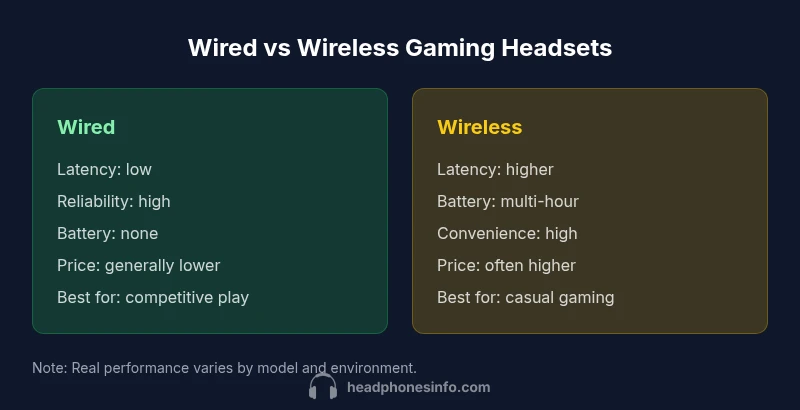
The wire vs wireless decision centers on latency, reliability, and flexibility. Wired gaming headsets typically offer the lowest latency, pristine signal integrity, and predictable performance across platforms. They also tend to be more affordable at a given sound quality level. Wireless gaming headsets trade some latency for convenience, allowing movement without cables and often including multipoint connections and charging docks. Modern wireless standards improve latency substantially, but interference, battery life, and dongle compatibility can affect consistency. For players in crowded or mixed-use spaces, wireless headsets can reduce desk clutter and give you room to roam. The best choice depends on how you prioritize a lag-free edge versus freedom of movement and room setup.
Sound Quality and Microphone Performance
Sound quality in gaming headsets combines three elements: accurate spatial cues, overall tonal balance, and microphone intelligibility. A good headset should deliver clear directional audio to locate enemies and teammates, with enough bass for immersive explosions without masking footsteps. Microphone performance matters for team coordination; a clean, mids-focused voice with minimal room noise ensures commands are understood. An increasing number of models include noise suppression and wind rejection, which helps in noisy environments. To assess sound and mic quality, we rely on both objective measurements and subjective testing in diverse game genres, from fast-paced shooters to atmospheric single-player titles. The right balance between game audio and chat clarity depends on your role in games and whether you also listen to music or watch media through the same headset.
Comfort, Fit, and Build Durability
Comfort is critical because most players wear headsets for hours at a stretch. Weight distribution, clamp force, ear cup shape, and padding materials all influence comfort. Durable construction uses sturdy hinges, metal yokes, and reinforced headbands to withstand daily wear. For portability, the ability to fold or rotate ear cups and a compact form factor helps. Materials matter too: breathable fabrics or velour cushions reduce sweat, while leatherette can feel premium but may heat up over long sessions. In our testing, we pay attention to fit across different head sizes, ensuring a stable seal for immersive audio without causing hotspots or pressure pain. A reliable headset should feel built to last and remain comfortable as you upgrade your gaming setup.
Platform Compatibility and Connectivity
Platform compatibility determines how easily you can use a headset with your ecosystem—PC, PlayStation, Xbox, Nintendo, or mobile devices. Some gaming headsets are plug-and-play on multiple platforms, while others rely on feature-rich USB DACs, proprietary dongles, or Bluetooth. Latency, microphone control, and software support (for EQ profiles or mic monitoring) can vary by platform. It’s important to confirm that the headset supports your target devices and that USB-C, USB-A, or 3.5 mm jacks align with your hardware. For gamers who switch between consoles and PC, multi-platform wireless options with stable dongle support often offer the best balance of convenience and performance. Headphones Info recommends prioritizing models with broad compatibility and well-documented setup procedures.
Battery Life and Charging Considerations
Battery life is a defining factor for wireless headsets. A typical gaming headset should provide enough endurance for a long gaming session or a day of streaming without frequent recharges. Look for real-world battery life tests rather than marketing figures, and consider charging time and the availability of quick-charge features. Some models include charging docks or USB-C fast charging that can keep you in the game between sessions. If you primarily game in a dedicated desk setup, wired models can remove the battery constraint entirely, while wireless users should think about standby modes and automatic power-down behavior to maximize longevity.
Durability and Longevity
Durability involves both the mechanical design and the long-term reliability of components like the headband, hinges, and ear cushions. A longer warranty is often a signal of confidence from the manufacturer. We look for reinforced frames, high-quality padding that resists flattening, and cushions that maintain form after repeated cleaning. A headset that lasts several years with normal care and occasional maintenance (e.g., replacing ear pads or replacing cables) offers better long-term value than a flash-in-the-pan model. Finally, serviceability matters; models with easily replaceable parts and widely available spare components tend to remain usable longer, even as technology evolves.
Budget Tiers and Value
The cost landscape for gaming headsets spans from entry-level to premium. At the low end, many wired options provide solid audio for casual play and school-in-performance environments, though sometimes with reduced mic quality or less durable materials. Mid-range models often balance sound quality, microphone clarity, and comfort with reasonable build quality. Premium headsets move beyond basic features by delivering refined soundstage, superior noise cancellation for the mic, lighter materials, and advanced software for customization. When evaluating value, consider whether the headset’s features align with your needs, such as a robust microphone for streaming, on-ear cup controls for quick adjustments, or a detachable mic for flexibility. Always compare warranty terms and whether replacement parts are readily available to extend the headset’s useful life.
Setup, Maintenance, and Longevity
Proper setup and routine maintenance can dramatically extend the life of gaming headsets. Regularly update firmware to unlock new features and fix compatibility issues. Clean cushions with mild cleaners and avoid exposing leatherette to harsh solvents that can dry or crack materials. Store headsets in a cool, dry place to prevent moisture damage and warping of the headband. If you rely on a wired headset, cable management reduces wear at the connection point. For wireless models, keep firmware current and avoid overheating chargers. Finally, keep a spare mic windscreen and ear cushions on hand so you can refresh the components without significant downtime. Effective maintenance directly influences comfort, audio fidelity, and the headset’s resale or trade-in value.
Real-World Scenarios: Esports, Immersive Single-Player, Casual Gaming
Different gaming contexts emphasize different headset strengths. Esports players benefit from ultra-low latency wired designs with strong mic clarity and a neutral sound signature to hear footfalls and gunfire precisely. Immersive single-player titles reward speakers with wide soundstages and accurate positional audio to showcase environmental cues. Casual gamers prioritize comfort, long battery life, and easy plug-and-play setups for living-room gaming or couch sessions. A sound profile that blends clarity with an engaging soundtrack tends to satisfy most players, but dedicated competitive gamers and fans of action-adventure games may opt for models tuned for precise localization. In all cases, a headset should feel like a natural extension of your gaming toolkit, complementing your preferred genres and platforms.
Comparison
| Feature | Wired gaming headset | Wireless gaming headset |
|---|---|---|
| Latency | low latency (typical wired) | higher latency (wireless, depending on protocol) |
| Connectivity | USB/3.5mm wired (and some USB-C) | 2.4 GHz dongle or Bluetooth wireless |
| Battery life | N/A for wired | varies by model, hours-to-days with charging options |
| Price range | generally lower initial cost | often higher upfront price |
| Best for | competitive gaming and value | mobility and convenience |
| Comfort & weight | often lighter, no battery | can be heavier due to battery and antennas |
| Platform support | broad, with minimal software | platform-specific features may vary |
Upsides
- Low latency and strong value for wired models
- Fewer reliability concerns without wireless interference
- Easier to troubleshoot and repair due to simpler signaling
- Broad compatibility across devices when using wired connections
Disadvantages
- Wired cables can restrict movement and create desk clutter
- No battery or charging needs for wired models, but that also means no wireless conveniences
- Wireless models offer freedom of movement but may require dongles or BT pairing
- Potential interference for some wireless systems in busy environments
Wired headsets generally win on latency and value; wireless headsets win on freedom and ease of use.
Choose wired when you need the lowest possible latency and best performance per dollar. Opt for wireless if you want to move freely and simplify setups, especially in living-room or multi-device environments.
People Also Ask
What is the biggest difference between wired and wireless gaming headsets?
The main difference is latency and freedom of movement. Wired headsets offer the lowest latency and often better value, while wireless headsets provide mobility and a cleaner desk setup, but may incur latency variability and battery management.
Wired headsets give you the lowest latency and best price, while wireless headsets let you move around without cables.
Do gaming headsets with USB dongles have latency issues?
Some wireless models use a USB dongle to minimize latency, but performance can still vary by environment and interference. Look for models with low-latency codecs and proven real-world performance.
Dongles help reduce latency, but results can vary based on interference and environment.
Is a microphone on a headset good enough for streaming?
Many gaming headsets offer clear, broadcast-grade mic quality suitable for streaming, especially in the mid-to-high range. For professional streaming, consider a detachable or upgradeable mic with noise suppression.
For many streamers, a decent built-in mic works, but serious streams often use an external mic for the best quality.
Can I use gaming headsets on both PC and consoles?
Most modern gaming headsets support PC and console use, but you may need to switch cables or enable specific features in the console settings. Check for cross-platform compatibility in product specs.
Yes, many headsets work on both PC and consoles, but verify the exact platform support before buying.
How important is wireless range and battery life for gaming?
Range and battery life matter for living-room setups and long sessions. Look for models with multi-device connections and solid standby behavior to avoid mid-game recharges.
Battery life and range matter if you game away from the console or PC, especially for long sessions.
What features should I prioritize for esports?
Low latency, reliable mic clarity, comfortable fit, and a modular design for quick replacements are key. A sound profile that emphasizes footstep cues and localization helps in fast-paced games.
Esports players should focus on latency, mic quality, and comfort for long events.
What to Remember
- Prioritize latency first for competitive gaming
- Choose wired for best value and reliability
- Pick wireless for mobility and convenience
- Check platform compatibility before buying
- Consider durability and warranty for long-term value