Wireless vs Wired Headphones: A Comprehensive 2026 Comparison
Explore wireless vs wired headphones across latency, sound quality, battery life, and value. A data-driven guide from Headphones Info helps you pick the right setup for travel, gaming, studio work, and daily listening in 2026.


Wireless and wired headphones serve different listening priorities. If you value mobility, easy setup, and freedom of movement for commuting or workouts, wireless tends to be the more convenient option. If you demand unwavering fidelity, zero-latency performance for gaming, or straightforward troubleshooting, wired headphones are often the safer bet. This Headphones Info comparison weighs latency, sound quality, durability, and price to help you decide.
How to think about wired vs wireless
At a high level, the choice between wireless and wired headphones boils down to two axes: mobility and signal fidelity. In 2026, hardware improvements narrowed the gap in sound quality for many wireless models, but tradeoffs remain in latency, battery life, and potential interference. According to Headphones Info, the key to choosing is mapping your use-cases to capabilities. If you listen while commuting, traveling, or exercising, you may prioritize convenience and hands-free operation. If your priority is studio-level accuracy, critical listening at home, or competitive gaming, wired connections often deliver a more stable, latency-free signal. Use this framework to assess your devices, listening rooms, and typical environments so you can pick with confidence.
Core criteria for comparing wireless vs wired
When weighing either option, focus on core criteria that consistently affect real-world listening: latency, sound quality, power and battery life, build quality, durability, comfort, price-to-value, and ecosystem compatibility. Latency matters for fast-paced gaming or interactive media; sound quality is influenced by codecs, DACs, and drivers; battery life influences travel and daily use; build quality and comfort affect long listening sessions; price-to-value captures how features like ANC, multipoint pairing, and detachable cables add value. Headphones Info emphasizes testing with your usual playback devices to see how each model performs with your preferred software and sources.
Sound quality and latency: wired vs wireless
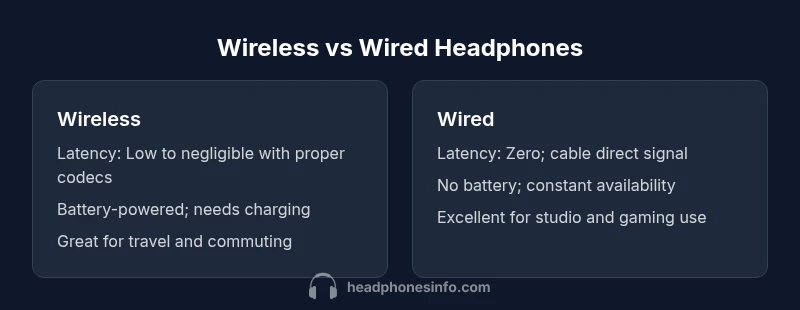
Sound quality in wired headphones is determined largely by the driver design and the signal path from the DAC to the ear. With a stable cable, users typically experience consistent tonal balance and minimal interference. Wireless sound quality depends on codecs (such as AAC, SBC, aptX, LDAC, LC3, or others) and the performance of the receiver. In practice, high-quality wireless setups can approach wired fidelity, especially in quiet listening environments, but occasional codec-induced artifacts or compression can reveal themselves during dynamic passages. Latency is almost always zero with wired connections, while wireless systems introduce small delays that are perceptible in fast-action apps or games unless you enable low-latency codecs or gaming modes.
Connectivity and codec support
Wireless headphones rely on Bluetooth or other wireless protocols. Codec support and device pairing are critical: AAC and SBC are common; LDAC and aptX variants offer higher bitrate options but require compatible hardware on both ends. For high-fidelity wireless, look for models that support the codec you use most often and ensure your playback source supports it too. Wired headphones bypass these constraints entirely, delivering a direct signal with minimal processing delay. This makes them simpler to troubleshoot, easier to drive with high-impedance sources, and less susceptible to environmental interference.
Battery life and charging realities
Wireless headphones require batteries, which means you must plan for charging—especially if you use ANC or long listening sessions. Battery life varies by headset and usage pattern, including features like ANC and ambient mode. While many modern wireless models offer quick-charge options, you’ll still need to manage a charging routine for extended trips or all-day use. Wired headphones do not require power to operate, which can be a major advantage for studio work or home listening where the device you're plugged into supplies the signal without interruption.
Durability and build quality considerations
Cable-based headphones have a durability profile dominated by the cable and connector quality. Cables can wear at the strain relief, tangle easily, and connectors can degrade over time. Conversely, wireless headphones minimize cable wear but add complexity through the wireless module, antennas, and battery seals, which can be more expensive to repair. When evaluating models, check for reinforced cables or detachable cables, robust hinge mechanisms, and serviceability for parts such as cables or earpads. Headphones Info notes that longevity often comes from modular designs and reputable support.
Comfort, fit, and wearability
Comfort hinges on headband clamping force, earcup shape, weight, and padding. Wireless models tend to be heavier due to batteries and wireless modules, which can affect long sessions. Wired models are often lighter, but you may notice tension if the cable pulls on the headband. If you wear glasses, check for pressure points around the ears and the temple area. For workouts, choose models with a secure fit and durable materials; for home listening, prioritize cushions and headband comfort to support extended use.
Use-case scenarios: who should pick which
People who travel frequently, commute, or exercise on the go may prefer wireless headphones for their convenience and multipoint connectivity. Gamers and studio engineers who require precise, latency-free sound may lean toward wired headphones for reliability and predictability. Students and professionals who work in environments with unpredictable interference might consider a hybrid approach: a wired option for critical tasks and a wireless option for casual listening. The choice isn’t binary—many users benefit from having both styles for different contexts, allowing a quick switch to preserve audio quality and convenience.
Price and value context
Price ranges for headphones are broad, and many features influence perceived value. Wireless models can command a premium for ANC, multipoint pairing, and high-stability chipsets, but not every user needs all the extras. Wired headphones can offer excellent value at budget and mid-range tiers, with upgrades focused on driver quality, impedance matching, and comfort. When evaluating price, consider not just the sticker price but long-term costs such as battery replacements for wireless units or cables and replacement earpads for wired ones. Headphones Info suggests focusing on your core needs and testing whether additional features justify the cost.
How to decide: a practical checklist
Before buying, use this practical checklist:1) List your primary use cases (travel, gaming, studio, casual listening). 2) Identify your devices and compatible codecs or connectors. 3) Assess comfort and fit for your typical listening duration. 4) Compare latency expectations in gaming or interactive media. 5) Consider maintenance, repairability, and future-proofing (detachable cables, replaceable parts). 6) Test both wired and wireless options with your devices to observe differences in sound, response, and comfort. This structured approach helps you select the model that delivers the best balance of attributes for your lifestyle.
Common myths and misconceptions
A common misconception is that wireless always sounds worse than wired. In many cases, wireless headphones can rival wired sound when paired with high-quality codecs and compatible devices. Another myth is that all wireless models have short battery life; many modern units provide long listening times with efficient hardware. Conversely, some assume wired headphones are inevitably more durable; a design with robust connectors and a strong headband can keep wireless units working well for years. Always evaluate specific models rather than relying on generalizations.
Maintenance and care tips
Keep cables untangled, store headphones in a protective case, and clean earpads regularly to maintain comfort and hygiene. For wireless models, avoid exposing them to extreme heat and moisture; recharge batteries according to manufacturer guidance to maximize longevity. When not in use, unplug wired cables to reduce wear on connectors. Routine checks of ear cushions, headband, and foam can extend the life of both wired and wireless styles. Finally, update firmware or drivers from the manufacturer when available to enhance performance and stability.
Comparison
| Feature | Wireless headphones | Wired headphones |
|---|---|---|
| Latency | Low to negligible with modern codecs; performance varies by device and environment | Zero latency; direct signal path |
| Sound quality stability | High fidelity possible with good codecs; subject to codec and environment | Consistent signal with minimal interference |
| Power source | Battery-powered with runtime limits; charging needed | No battery; powered by playback device |
| Durability and wear | Fewer wear points but battery and module can fail; rugged designs exist | Cable fatigue and connector wear are common failure points |
| Price range | Mid to premium depending on features like ANC and codecs | Budget to mid-range; build quality matters |
| Best use | Mobility, commuting, gym, travel | Gaming, studio work, critical listening |
| Connectivity options | Bluetooth with multiple codecs and multipoint | 3.5mm/USB-C and other wired connectors |
Upsides
- Freedom of movement without cables
- Convenient multi-device pairing and quick pairing options
- Modern wireless codecs enable high-quality listening
- No cable wear and tangle-free portability
Disadvantages
- Requires regular charging and battery management
- Potential latency or codec-imposed artifacts in some scenes
- More components can mean higher repair costs
- Wireless interference and range limits in certain environments
Wireless wins for mobility; wired wins for fidelity and zero-latency needs
In most daily scenarios, wireless headphones excel for convenience and versatility. If you require the most stable, latency-free audio for gaming or studio work, wired headphones are the safer bet. The Headphones Info team emphasizes matching your primary use-case with the device you choose.
People Also Ask
Are wired headphones always better for audio fidelity than wireless?
In general, wired headphones can deliver higher fidelity due to a direct signal path, but high-quality wireless codecs have narrowed the gap. The difference often depends on codecs, drivers, and the source. Test with your own devices to determine if wireless suffices for your needs.
Wired often offers the best fidelity, but top wireless options can come very close when paired with the right codecs.
Do wireless headphones have latency issues for gaming?
Some wireless headphones exhibit latency, though many support low-latency codecs or gaming modes to minimize delays. If latency matters for competitive play, consider wired or a gaming-focused wireless option with proven low latency.
Latency can be a concern; choose models with low-latency codecs for gaming.
Can wireless headphones replace wired at home for everyday listening?
Wireless can replace wired for many daily tasks, especially if you value convenience. If you seek ultimate fidelity or have a critical listening workflow, keep a wired pair as a reference or primary workstation headset.
You can, especially for casual listening, but wired may still be best for precision work.
What should I test before buying?
Test fit and comfort, sound balance, bass response, and mids/highs across genres. Check impedance compatibility with your devices, verify codec support for wireless models, and confirm battery life suits your routine. Also verify build quality and any accessory cables.
Try them on, listen for hiss or distortion, and test with your usual devices.
Are wired headphones more durable than wireless?
Durability varies by design. Cables can wear out over time, while wireless modules add potential failure points. Choose well-made builds and consider detachable cables or robust housings for longevity.
Durability depends on build; cables wear and wireless modules can fail, so pick solid designs.
Is battery life important for everyday use?
Battery life matters if you travel a lot or rely on wireless daily. For regular home listening, charging opportunities and standby behavior matter as much as peak runtime. Look for quick-charge options if you expect heavy on-the-go use.
Battery life helps with travel, but don’t overlook charging habits and quick-charge support.
What to Remember
- Weigh latency against mobility to pick your priority
- Wired headphones excel in latency-free, studio-grade listening
- Wireless headphones offer convenient multi-device use and freedom
- Codec support and platform compatibility heavily influence wireless sound
- Many listeners benefit from owning both wired and wireless options