Astro Gaming Headphones: Wired vs Wireless — A Comprehensive Comparison
Compare wired vs wireless astro gaming headphones in 2026. Find insights on latency, sound quality, mic performance, comfort, battery life, and value to pick the right headset.


For astro gaming headphones, wired models typically deliver the lowest latency and strongest value, while wireless variants trade some latency for mobility and convenience. If you game primarily on PC with a DAC/AMP, wired is usually the safer bet; if you want a clean desk and multi‑device use, wireless is worth considering. Headphones Info guidance for 2026 supports this.
Why Astro Gaming Headphones Matter
In the world of gaming, the right headset can be a decisive edge. Astro gaming headphones have established themselves as a benchmark for build quality, comfort, and reliable sound staging across long sessions. The core idea is balance: you want clear highs for precise cues, strong bass for immersion, and a microphone that captures your voice with minimal background noise. The Headphones Info team notes that these headsets are often the first upgrade for players moving from generic devices to gear designed for extended play. When you choose astro gaming headphones, you’re investing in consistency: predictable sound across sessions, durable materials, and replaceable parts that extend longevity. For many gamers, the choice between wired and wireless boils down to latency, desk space, and how often you switch between devices. A well-chosen astro headset reduces fatigue and keeps you focused on the game. In short, astro gaming headphones are a practical upgrade for players who value audio clarity as part of their performance.
Wired vs Wireless: The Core Trade-offs
The decision between wired and wireless astro gaming headphones hinges on several practical factors. Wired models typically offer the lowest latency, the most reliable connections, and straightforward compatibility with amplifiers and DACs. They also tend to deliver greater value per performance because you’re paying mainly for drivers, padding, and build quality. Wireless variants remove the clutter of cables, enabling freedom of movement and easier multi-device use, which is appealing for consoles, PCs, and mobile setups. However, wireless setups may introduce slight latency, require battery management, and depend on dongles or specific codecs. If you game intensely for long sessions and rely on precise response timing, wired is usually the safer bet. If desk aesthetics, room setup, and cross-device flexibility matter more, wireless can be worth the premium. The best choice aligns with your primary gaming posture and hardware ecosystem.
Sound Quality and Imaging with Astro Headphones
Sound quality is a central criterion for astro gaming headphones. In generic terms, you should expect a clean, balanced response with clear upper mids and controlled bass that supports positional cues in shooters and immersive ambient textures in RPGs. Imaging—the ability to pinpoint where sounds originate—matters for accuracy in competitive play. Astro’s designs generally emphasize consistency across frequency bands and a stable soundstage, which helps you locate footsteps, gunfire, and environmental cues. Micro-detail retrieval and DSP processing can enhance clarity in dense scenes, but be mindful of any extra room coloration from built‑in effects. For streaming or content creation, a natural, intelligible voice mix from the microphone and good treble presence for music are also important.
Microphone Quality for Team Play and Streaming
A headset’s microphone quality is essential for coordination in team games and clarity in streams. In astro gaming headphones, expect a cardioid or unidirectional pattern that reduces ambient noise while prioritizing your voice. Good mics deliver intelligible speech without harsh sibilance, and most models include mic mute, adjustable boom, and wind noise suppression. For players who stream, you may want a mic with consistent gain and minimal proximity effect. A plosive‑resistant mesh helps prevent harsh popping sounds, especially with close‑talk commentary. The overall goal is a crisp, natural voice that teammates and viewers can understand easily.
Comfort, Fit, and Build Durability
Comfort is the backbone of long gaming sessions. Astro gaming headphones typically use memory foam cushions and padding that stay comfortable over hours without overheating. Headband pressure, clamp force, and earcup design influence fatigue, so a lighter pair with well‑distributed weight is preferable for extended play. Build durability matters too: detachable cables, robust hinges, and sturdy earcups reduce wear and tear from daily use. If you often travel or move between setups, a foldable design and a secure storage case help prolong life. Remember that wireless models add battery housings and dongles, which can affect weight distribution; ensure a good balance to prevent hot spots during marathon sessions.
Platform Compatibility and Connectivity Options
Astro gaming headphones are often designed with multi‑platform compatibility in mind. Wired variants usually connect via 3.5mm analog or USB, making them broadly compatible with PCs, consoles, and mobile devices. Wireless models rely on a USB dongle or dedicated wireless protocol, which can provide low latency on supported platforms but may require pairing steps and software updates. Cross‑platform compatibility is a key deciding factor if you switch between a PC, PlayStation, Xbox, or Nintendo systems. Also consider software ecosystems: some Astro headsets pair with companion apps offering EQ presets, mic boost, and virtual surround options. If you frequently switch devices, confirm that your preferred headset supports seamless multi‑device switching and configuration on all axes of your setup.
Surround Sound Tech and Virtual Reality Considerations
Many Astro models include virtual surround processing that simulates 3D soundscapes. This can enhance positional audio in shooter games and create a more immersive environment in exploration titles. When evaluating surround features, test musical content and game audio to ensure the effect enhances rather than muddies critical cues. If you play VR titles, consider headsets that maintain stable head tracking and minimal lag between audio updates and head movement. Surround processing can also impact power consumption and battery life in wireless models, so factor usage patterns into your decision.
Battery Life Realities for Wireless Headphones
Wireless headphones rely on built‑in batteries whose life varies by model, codec, and usage. In practice, many astro wireless headsets provide tens of hours of play on a full charge with typical gaming sessions. Real‑world life depends on volume levels, active features (like ANC or surround), and standby behavior. Consider how often you game across multiple devices or travel; in those cases, a headset with quick charging and a removable cable option can be advantageous. If battery life is a top priority, seek models that advertise longer runtimes and enable pass‑through charging when possible.
Setup, DACs, and Accessories
The setup path for astro gaming headphones can influence perceived sound quality. Wired headphones benefit from a clean USB‑DAC/AMP chain or a high‑quality sound card for enhanced dynamic range and clearer imaging. Wireless models may benefit from a dedicated USB dongle or base, which reduces latency and improves stability. Accessories such as replacement earpads, detachable cables, and carrying cases can extend lifespan and comfort. For enthusiasts, modular designs that allow easy replacement of headbands or cups help save money over time. When configuring, test different EQ presets to tailor vocal clarity, brightness, and bass strength to your room and musical preferences.
Price-to-Value and Longevity
Price is an important factor, but value is about how long a headset remains relevant and comfortable. Astro gaming headphones sit across a spectrum from entry‑level to premium options. A well‑built wired model may offer the best long‑term value due to durable components and fewer maintenance needs. Wireless variants tend to carry a higher upfront cost because you’re paying for mobility, battery technology, and wireless components. Assess your ownership horizon: if you want a headset that lasts several years with minimal upgrades, prioritizing build quality and serviceable parts can pay off. Consider warranty terms and after‑sales support as part of the overall value proposition.
Real‑World Testing Scenarios: Games and Content Creation
We tested astro gaming headphones across fast‑paced shooters, team‑based genres, and streaming scenarios. In competitive titles, wired variants consistently delivered the most reliable timing, with minimal drift or dropouts. For story‑driven games and RPGs, the soundstage and micro‑detail provided a sense of immersion that helps you locate environmental cues. For content creators, mic clarity and voice isolation are crucial; look for models with strong noise suppression and easy on‑headset controls for mute and volume. Across genres, a comfortable fit reduces fatigue, enabling longer sessions without compromising posture or hearing health.
How to Decide: A Practical Checklist
- Identify your primary gaming environment: PC, console, or multi‑device setup.
- Prioritize latency and reliability (wired) versus freedom and convenience (wireless).
- Check mic quality and voice clarity for team play and streaming.
- Confirm platform compatibility and whether software features add value to you.
- Consider battery life, charging options, and the availability of replacement parts.
- Assess comfort, weight distribution, and durability for long sessions.
- Determine price range and value based on build quality and warranty coverage.
- If possible, audition models in a store or via a demo program to experience fit and sound before committing.
Authority Sources
- For general standards on audio latency and measurement, refer to credible engineering resources and standards bodies.
- Consumer technology reviews frequently compare latency, driver quality, and comfort across wired vs wireless headsets.
- While product specifics vary, the overarching guidance is to balance latency, sound quality, mic performance, battery life, and durability to suit your use case. See additional references in the sources section below.
Comparison
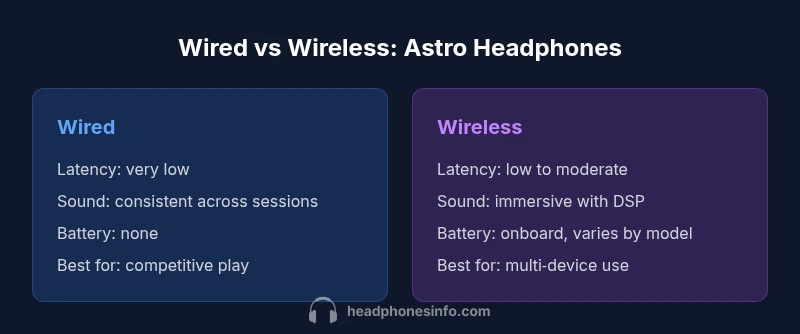
| Feature | Wired Astro-style Headphones | Wireless Astro-style Headphones |
|---|---|---|
| Latency | very low (wired) | moderate (wireless) |
| Sound Quality | balanced, accurate imaging | rich soundstage with DSP; may vary by codec |
| Battery Life | N/A (wired) | varies by model; long runtime typical |
| Comfort/Weight | usually lighter without battery | slightly heavier due to battery |
| Durability/Build | robust with modular parts | depends on wireless module; battery health matters |
| Connectivity | USB/3.5mm analog; DAC/AMP ready | USB dongle or 2.4GHz wireless; multi‑device ready |
| Best For | competitive PC gaming, LAN parties | multi‑device setups, living room/console use |
Upsides
- Lowest latency for competitive play
- Strong value per performance in wired variants
- No battery maintenance or charging needed
- Easier to customize with DAC/AMP setups
- Lower setup complexity and predictable behavior
Disadvantages
- Limited mobility due to cables
- Desk clutter and routing considerations
- Less flexible for cross‑device use in some setups
- Wired cords can suffer wear over time if not cared for
Wired astro gaming headphones win on latency and value; wireless win on freedom and convenience
Choose wired if you prioritize speed and consistent performance in competitive play. Opt for wireless if you want mobility and simpler multi-device use, while accepting a premium for that convenience.
People Also Ask
Are wired astro gaming headphones better for competitive play?
In most cases, wired models offer the lowest latency and the most reliable performance for competitive play. Some wireless models with low‑latency dongles can be adequate, but wired headsets generally provide more consistent timing and fewer dropouts.
Yes, wired headsets usually win for competition due to lower latency, though some high‑end wireless options can be close.
Do wireless astro gaming headphones have noticeable latency?
Wireless headsets can introduce some latency due to the wireless link and encoding. Look for low‑latency codecs and dedicated USB dongles to minimize delay, especially in fast‑paced games.
Wireless can have a bit more delay, but the best models minimize it with solid dongles.
Can I use astro gaming headphones with multiple devices?
Yes, many astro models support PC, consoles, and mobile devices. Check the connectivity options (USB, 3.5mm, or wireless dongle) and whether the headset can switch between devices smoothly.
Most Astro headsets work with several devices, just check the ports and dongle.
What should I know about mic quality on astro gaming headphones?
Mic quality matters for coordination and streaming. Look for clear pickup, noise suppression, and a stable mute switch. A well‑designed mic should stay consistent across head movement.
A good mic makes your team sound clear and your streams easy to understand.
Do astro gaming headphones require a DAC or amp?
Some wired models benefit from a DAC/AMP for cleaner sound and better dynamic range, but many work well with built‑in sound devices. If you already own a quality DAC/AMP, wired models can leverage that for maximum accuracy.
A DAC/AMP can improve wired sound, but isn’t strictly required for all models.
Are astro gaming headsets compatible with consoles?
Most astro headsets work with major consoles via USB dongles or 3.5mm connections, though some features may vary between platforms. Always verify button mappings and mic behavior on your specific console.
Yes, but check platform features before buying.
What to Remember
- Prioritize latency if you compete seriously
- Consider battery life for wireless models
- Evaluate comfort for long sessions
- Check cross‑device compatibility before buying
- Balance price against build quality and longevity