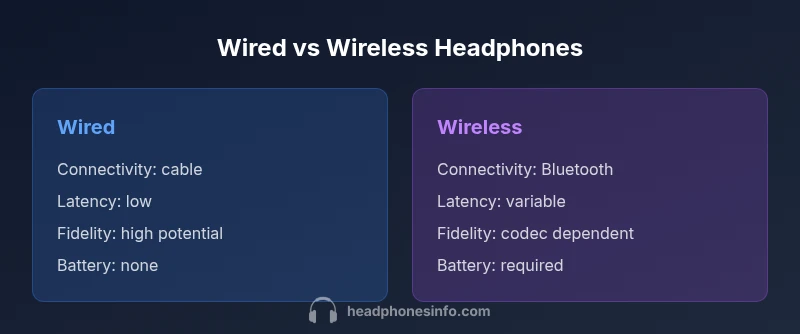
Wired vs Wireless Headphones: A Practical Comparison for 2026
Compare wired and wireless headphones to understand fidelity, latency, battery life, and price. This in-depth analysis helps audiophiles and shoppers decide which setup fits their listening goals and daily routines.


Wired and wireless headphones each offer distinct strengths. This comparison highlights how choice affects sound fidelity, latency, portability, battery life, and price, so you can pick the right setup for your listening style. The Headphones Info team notes that wired models usually deliver higher fidelity with zero wireless interference, while wireless models excel in freedom and convenience for daily use.
In-Depth Overview: What you’re choosing between when you select wired or wireless headphones
The decision between wired and wireless headphones shapes your listening experience in every room and workflow. For many listeners, the core question isn’t which is objectively better, but which trade-offs match how you actually listen. According to Headphones Info, the practical differences sit in fidelity, latency, durability, and daily practicality. Wired headphones carry a direct signal path from source to driver, typically with minimal signal loss and no need to manage wireless interference. Wireless headphones remove the tangle of cables and embrace mobility, but they introduce a set of constraints around battery life, codecs, and potential latency. In this article we’ll map those trade-offs to real-world scenarios—from studio sessions and gaming to commuting and sports—so you can decide with confidence which architecture aligns with your goals and budget.
Audio fidelity and signal path: wired vs wireless headphones
Sound quality hinges on the signal chain. With wired headphones, the electrical signal travels a fixed path with low impedance and minimal dithering, which in many cases translates to more stable, immediate response and higher potential fidelity for dedicated listening. Wireless headphones rely on digital compression, codec choices, and stable pairing to deliver music with close but not identical fidelity. Modern wireless models that support high-bitrate codecs like LDAC or aptX HD can approach wired performance under ideal conditions, but the actual results depend on the source device, environment, and headphone design. For audiophiles, the trade-off often comes down to whether portability matters more than absolute fidelity, or if a home setup justifies a wired, high-fidelity path.
Latency, codecs, and real-world performance
Latency is a critical factor in gaming, video editing, and interactive media. Wired headphones provide near-zero latency, since there’s a direct electrical path and no wireless processing delay. Wireless models add a small amount of latency, which varies by codec and platform. AAC, SBC, aptX, AptX HD, and LDAC are common codecs, each with different latency and audio quality profiles. In practice, you’ll notice clear synchronization advantages with wired gear in fast-paced games or rhythm-based software, while premium wireless setups can still feel responsive for casual gaming and everyday music listening. Understanding your devices’ codec support helps you choose a compatible pair that minimizes delay.
Comfort, ergonomics, and build quality across both architectures
Ergonomics can dominate the listening experience, sometimes more than the signal path. Wired headphones tend to be heavier due to robust cables and copper conductors, but many find the weight distribution balanced for long listening sessions. Wireless models emphasize lightness and balance, often trading some mass for battery housing and wireless circuitry. Build quality matters in both camps: durable headbands, reinforced cables, and robust connectors reduce failure rates. For frequent travelers or athletes, the shape, clamping force, and ear cushion material can determine whether the headset remains comfortable through hours of use or during intense workouts.
Portability, storage, and on-the-go use
Mobility is the defining advantage of wireless headphones. You can pair with multiple devices, move between rooms, and avoid tangling cables. Conversely, wired headphones can be more compact for travel when you factor in a small, flat cable and a foldable design. Some high-end wired models employ detachable cables and modular drivers, which reduces repair risk and extends lifespan. If you travel with a laptop, a gaming console, or a phone, consider how cable management and device compatibility will impact your daily routine. In short, wireless excels in spontaneity; wired excels in consistency and a traditional listening environment.
Battery life, charging cycles, and the long-term cost of ownership
Battery life shapes how often you recharge and how you schedule usage. Wireless headphones require periodic charging, which introduces a recurring maintenance task. Battery degradation over time can reduce peak volume and playback duration, especially in older models. Wired headphones avoid battery concerns entirely, but you may need to consider the longevity of the cable and connectors. The total cost of ownership should factor in potential replacement cables or adapters for wired sets and the ongoing need to keep wireless units charged and updated with firmware.
Price ranges, value, and lifecycle considerations
Price is a major driver in headphone selection. Wired headphones generally provide high-fidelity options at a lower price-per-sound unit, particularly in introductory and midrange tiers. Wireless headphones span a wide range—from affordable Bluetooth models to premium, feature-rich options with advanced codecs and active noise cancellation. When evaluating value, account for longevity, warranty coverage, and the cost of accessories such as replacement cables or extra charging bricks. A well-chosen wired set can outlive budget wireless counterparts when cables and connectors are properly cared for, while premium wireless sets can deliver compelling convenience and features in everyday use.
Ecosystem compatibility and device integration
Your existing devices influence which path makes more sense. If you primarily connect to laptops, desktops, or audio interfaces with wired outputs, a wired headphone model can simplify setup and preserve signal integrity. If you live in a multi-device ecosystem (phone, tablet, computer, gaming console) and value seamless switching, wireless headphones may offer a clearer benefit. Some brands coordinate features across devices—such as quick pairing, multipoint connectivity, and app-based EQ—making the decision depend partly on brand strategy and ecosystem comfort. In all cases, confirm your primary listening contexts before choosing.
Care, maintenance, and longevity tips for both approaches
Maintenance matters for both wired and wireless headphones. Regularly inspect cables for fraying, keep connectors clean, and store headphones in a protective case to minimize wear. For wireless units, keep firmware up to date and calibrate battery health over time. For wired units, replace worn cables promptly and consider upgrading to higher-grade, braided cables for improved durability. A disciplined maintenance routine can significantly extend the lifespan of either architecture.
Common myths and misconceptions debunked
A popular myth is that wireless inherently sounds worse than wired. While some budget wireless models may exhibit compression artifacts, premium wireless headphones with high-bitrate codecs can rival wired performance under typical listening conditions. Another misconception is that wired is always faster; in practice, latency depends on the system design and the codec used. Finally, some assume that wireless always drains devices quickly; modern Bluetooth standards are designed to be energy-efficient and can run for many hours on a single charge.
How to test and compare at home: a practical workflow
To compare wired and wireless headphones at home, set up a controlled listening session. Use the same audio source and a known track, then alternate between wired and wireless modes while keeping volume levels consistent. Listen for fidelity, imaging, and bass extension, and note latency during video playback or gaming. Create a short list of your preferred tracks across genres to gauge how each setup handles dynamics, detail, and noise isolation. Finally, document your impressions and map them to your real-world use cases to guide your final choice.
Authoritative sources you can consult for deeper technical context
For readers who want to explore the topic further, consult authoritative sources on wireless technologies and audio standards. Notable references include the FCC’s guidance on wireless technology and Bluetooth, Britannica’s overview of Bluetooth, and NIST resources on audio devices and signal integrity. These sources provide foundational background for codec performance, interference, and modern wireless design.
Comparison
| Feature | wired headphones | wireless headphones |
|---|---|---|
| Connectivity | 3.5mm/USB-C analog or digital wired connection | Bluetooth with AAC/aptX/LDAC and multipoint options |
| Audio Fidelity | Often highest potential fidelity with direct signal | Quality depends on codec support and wireless link |
| Latency/Sync | Near-zero latency in most cases | Variable latency based on codec and interference |
| Portability | Cable length and source-port constraints | Highly portable; no cables to restrict movement |
| Battery Life | N/A | Typically 10–40 hours depending on model |
| Durability and Build | Cable wear and connector durability matter | Wireless components add potential failure points but modern designs are robust |
| Price Range | Low to mid-range options, strong value at cost | Wide range; premium pricing for codecs and features |
| Best For | Studio, gaming, or fixed setups where cables are acceptable | Commuting, workouts, and multi-device use |
Upsides
- Wired headphones offer stable, high-fidelity audio with minimal latency
- No battery maintenance or charging needed for wired models
- Typically lower upfront costs for performance per dollar
- Easier to diagnose and repair cables or connectors
Disadvantages
- Cables can tangle, snag, or limit movement
- Device ports and adapters can constrain compatibility
- Cable wear and connector fatigue over time
- Less convenient for on-the-go use without a source nearby
Wired wins for fidelity and reliability; wireless wins for freedom and convenience
Opt for wired if you prioritize absolute signal integrity and zero latency. Choose wireless if you value mobility, ease of use, and seamless device switching.
People Also Ask
What are the main differences between wired and wireless headphones?
Wired headphones provide a direct signal with minimal latency and potential for higher fidelity at a lower cost. Wireless headphones offer freedom from cables and easier multi-device pairing, but depend on codecs and battery life for performance.
Wired is about fidelity and reliability; wireless is about freedom and flexibility.
Are wireless headphones as good as wired for critical listening?
Premium wireless models with high-quality codecs can approach wired fidelity in many situations, but wired often edges ahead in absolute accuracy and immediacy for critical listening.
Premium wireless can be very close, but wired still wins for strict critical listening.
Can wired headphones be used with Bluetooth devices?
Wired headphones are designed for wired connections; to use them with Bluetooth devices you would need a wireless adapter or receiver that converts Bluetooth to a wired output.
You'd need a Bluetooth-to-wired adapter.
Do wired headphones require a DAC/amp for best sound?
Not always, but a DAC or amp can improve performance with certain sources, especially high-impedance headphones or low-powered devices. This is more relevant for audiophiles and desktop setups.
A DAC/amp helps in some cases to unlock more detail.
Which is better for gaming?
For gaming, wired headphones typically offer the lowest latency and most reliable sync with games using a wired connection. Wireless can work well if latency is minimized by a modern codec and a fast source.
Wired is usually best for gaming, but good wireless can work too.
Is there a noticeable latency in Bluetooth listening?
Bluetooth latency exists, varies by codec and device. For content where timing matters, test with your typical setup; some codecs minimize delay to imperceptible levels.
Latency depends on the codec and device; test yours.
What to Remember
- Weigh fidelity against convenience when choosing.
- Codecs and latency determine real wireless performance.
- Battery health matters for long-term wireless use.
- Cable durability is the main advantage of wired setups.
- Test with your typical tracks and devices before deciding.