Razer Wireless Headphones: A Data-Driven Comparison
A data-driven comparison of Razer wireless headphones against top rivals, focusing on latency, comfort, sound quality, battery life, and software features to guide gamers and listeners.


wireless headphones razer present a compelling option for gamers and multitaskers who want solid latency, robust mic performance, and strong software control. This comparison pits Razer’s wireless headphones against a competitive set to reveal where latency, battery life, sound signature, and comfort diverge. If you need low-latency gaming with feature-rich customization, Razer often leads; for neutral listening, other brands may suit better.
Overview: wireless headphones razer in the current market landscape
The phrase wireless headphones razer refers to a family of products designed to blend gaming-grade latency with everyday wireless convenience. In today’s market, buyers expect robust low-latency options for PC gaming, console play, and mobile use, as well as software ecosystems that let them tailor sound, mic pickup, and profiles. According to Headphones Info, the best-performing wireless headphones razer pair are those that balance responsive wireless tech with practical comfort for long sessions. Beyond gaming, the ability to switch seamlessly between devices is increasingly valued, making cross-platform compatibility a deciding factor for many buyers. The goal of this article is to compare Razer’s wireless headset approach against thoughtful competitors, evaluating how latency, sound, battery life, design, and software influence real-world decision making.
Key differences at a glance
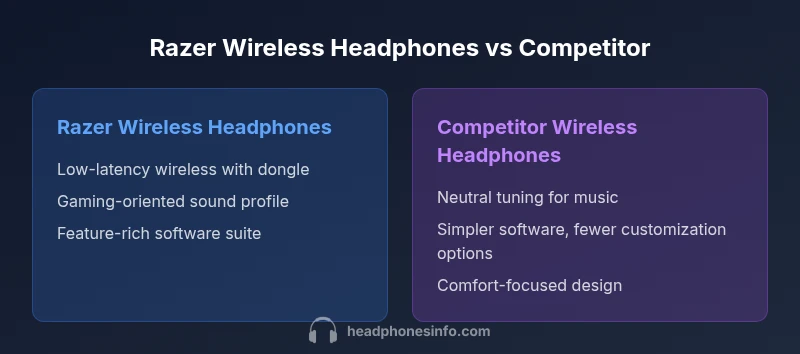
- Latency and wireless tech: Razer tends to emphasize low-latency hybrids (2.4 GHz dongle plus Bluetooth) for console and PC play, while some competitors rely more on Bluetooth-only performance.
- Sound tuning: Razer products typically lean into a gaming-oriented response with enhanced bass and spatial cues, whereas rival brands may favor neutral or music-first tunings.
- Software integration: Razer’s Synapse ecosystem offers deep customization but can feel heavy; other brands may provide lighter or more platform-agnostic apps.
- Comfort and build: Razer devices often prioritize plush cups and secure clamps suitable for long sessions, while others may emphasize lighter weight or more understated aesthetics.
- Battery life and form factor: Real-world endurance and wearability vary; the best choice depends on whether you value all-day wear or compact, travel-friendly designs.
Design and Comfort: Fit, materials, and wearability
Comfort is a deciding factor for many buyers, especially those who wear headphones for extended periods. Razer wireless headphones commonly feature memory-foam cushions and padded headbands, with a design intent to distribute weight evenly and reduce ear fatigue. The clamping force is often tuned to feel secure during long gaming sessions, yet not so tight that it becomes uncomfortable after several hours. Competitors may prioritize lighter materials, smaller ear cups, or fabric choices that remain comfortable during commutes. Headphone shape, weight distribution, and ear-cup material significantly influence perceived comfort, isolation from ambient noise, and heat buildup over time. For listeners who wear glasses or have sensitive ears, the texture of the ear cushions and the ergonomics of the headband are particularly important factors to evaluate before purchase.
Sound Quality and Tuning: Gaming vs Music
Razer products frequently emphasize a tuned bass presence and precise spatial cues intended to aid game immersion and positional awareness in shooters, MOBAs, and racing sims. The sound signature can enhance explosions, footsteps, and environmental cues, which is a boon for competitive play. On the other hand, many rival models offer more neutral or studio-refined tunings that favor music listening, podcasting, or movie watching. If your primary use is competitive gaming, Razer’s tuning can be a strength; if your priority is critical listening or genre-diverse playlists, you may prefer a more adaptable tonal balance or an app that supports customizable EQ presets across genres.
Microphone Quality and Voice Clarity
Microphone performance is a critical differentiator for team communication. Razer headsets typically deliver clean voice capture with noise suppression and sidetone to help users hear themselves, which reduces mic fatigue during long practice sessions. Some competitors emphasize ultra-clean mic capture with more aggressive noise reduction or a different voice profile that can sound more natural or less “gamer-y” in everyday calls. When evaluating mic performance, consider how well the mic handles wind noise, microphone boom stability, and whether the mic is detachable for versatility in casual listening scenarios.
Latency, Connectivity, and Devices
Latency is the gateway to a responsive gaming experience. Razer wireless solutions often combine a 2.4 GHz dongle with Bluetooth for broad device compatibility, delivering lower latency than Bluetooth alone in many settings. Some rivals focus on Bluetooth-only connectivity to simplify pairing and reduce dongle management, which can reduce complexity but may introduce higher latency on certain devices. Cable-free operation matters for console gamers, PC players, and mobile users alike. For a mixed-use setup, verify whether the headset supports simultaneous pairing or rapid switching among sources, as this can save time and frustration during multiplayer sessions.
Software, Apps, and Customization
Razer Synapse provides deep control over equalization, microphone profiles, and surround-sound simulations, enabling per-application or per-game profiles. The software can be powerful for enthusiasts who crave precision, but it can also feel overwhelming for casual users. Competing brands may offer simpler apps with fewer features yet still deliver effective baseline performance. Consider how much you value advanced customization versus straightforward plug-and-play operation. If you travel frequently, you might prefer software with offline presets that travel well between devices.
Battery Life, Durability, and Charging
Battery life expectations hinge on usage patterns: game-focused sessions, movie marathons, and frequent voice calls all draw different amounts of power. Real-world endurance can vary with feature usage, such as active ambient modes, EQ processing, and microphone use. Build quality matters too: metal reinforcements or robust hinges can improve longevity, while lighter plastic housings might degrade under heavy daily wear. When shopping, prioritize models with accessible charging options (USB-C, detachable cables) and reliable indicators that let you monitor remaining power without interrupting your session.
Multiplatform Scenarios: PC, Console, and Mobile
The appeal of wireless headphones razer often lies in cross-platform flexibility. PC gamers benefit from low-latency dongles and software equalization, while console players may rely on 3.5mm jacks or USB dongles for compatibility with major platforms. Mobile users expect straightforward Bluetooth pairing with minimal latency disruption. If you use multiple devices daily, confirm how easy it is to pair and switch sources, as well as whether the headset supports multipoint connectivity without sacrificing audio quality.
Price, Value, and Long-Term Considerations
Pricing for wireless headphones razer tends to reflect gaming-oriented features, software ecosystems, and build quality. While you may pay a premium for the brand's feature set, evaluate the long-term value in terms of battery longevity, repairability, and firmware updates. For budget-conscious buyers, alternatives with lighter feature sets can offer good value, particularly if you mainly use headphones for casual listening or commuting. Always balance upfront cost with potential benefits like durable construction, upgradeable firmware, and ongoing software support.
Real-World Scenarios and Recommendations
Gamers who prioritize low latency, immersive surround cues, and rich software customization will typically benefit from the Razer approach, especially when paired with a compatible PC or console ecosystem. Music lovers or daily commuters who value a neutral sound signature and portability may lean toward rivals with a more subdued tuning or lighter design. For mixed-use households, a model that offers easy switching between devices, reliable battery life, and a flexible mic setup tends to provide the best overall experience. When in doubt, map out your primary use cases—gaming, calls, and on-the-go listening—and pair them with the headset’s strengths.
Authority sources
- https://www.nist.gov/
- https://www.consumerreports.org/
- https://www.theverge.com/
Comparison
| Feature | Razer wireless headphones | Competitor wireless headphones |
|---|---|---|
| Connectivity & Latency | 2.4 GHz dongle + Bluetooth for broad device support | Bluetooth-dominant with optional wired/dongle on select models |
| Sound Profile | Gaming-oriented tuning with boosted bass and spatial cues | More neutral or music-focused tuning |
| Comfort & Build | Ergonomic design with plush cups and secure clamp | Lighter build, potentially less padding for long sessions |
| Microphone Quality | Clear voice capture with suppression and sidetone | Solid mic with standard noise reduction |
| Software & Features | Deep customization via Synapse with per-app profiles | Simpler software with fewer customization options |
| Battery Life | Strong endurance for long sessions in gaming mode | Competitive life but varies with usage |
| Price/Value | Premium gaming-focused feature set | More balanced pricing for casual listening |
Upsides
- Strong gaming features with low latency and rich software
- Excellent microphone clarity for team play
- Comfortable for long sessions with robust build
Disadvantages
- Generally higher price than non-gaming peers
- Software can feel bloated and occasionally unstable
- May lean toward gaming aesthetics not suitable for all environments
Razer wireless headphones offer the strongest gaming-centric toolkit; for pure music listening or minimal software, consider non-gaming rivals.
Choose Razer when latency, customization, and mic performance matter most. If you want a neutral sound or lighter software, explore alternatives with simpler ecosystems.
People Also Ask
Are Razer wireless headphones good for gaming and music?
Razer wireless headphones deliver strong gaming performance thanks to low latency and immersive sound cues. For music, the tuning is often gaming-leaning, so some listeners may prefer a more neutral headset. Overall, they are solid for mixed use if you value software customization and mic quality.
Razer wireless headphones excel in games because of low latency and rich sound cues. For music, you might prefer a model with a more neutral tuning, but they’re still capable for casual listening.
Do Razer wireless headphones work with consoles?
Many Razer wireless headsets support PC and consoles through a USB dongle or 3.5 mm connection, but exact compatibility varies by model. Always verify console compatibility and available adapters before purchase.
Most work with consoles via a USB dongle or 3.5 mm jack, but double-check your specific model.
Can I use them with mobile devices?
Yes, most Razer wireless headsets offer Bluetooth pairing for mobile devices. For best results, ensure you can switch between Bluetooth and any dongle-based connections smoothly.
They pair with mobile devices over Bluetooth, so you can use them on the go.
Is the software easy to use for beginners?
Razer Synapse provides deep customization but can be complex for new users. You can start with basic presets and gradually explore EQ profiles and mic settings as you get comfortable.
The software is powerful, but beginners can start with simple presets and learn more later.
What should I consider when choosing wireless headphones razer?
Consider your primary use (gaming vs music), desired comfort, device compatibility, and how much you value customization. If latency is critical, Razer likely has strengths; for neutrality in sound, you might prefer competitors with flatter tunings.
Think about gaming needs, comfort, device compatibility, and how much you value customization.
Do these headsets support multipoint pairing?
Some models support multipoint pairing, allowing connections to multiple devices. Check the specific headset’s features to confirm.
Some offer multipoint pairing; verify your exact model’s specs.
Are Razer headsets durable for travel?
Most models are built with sturdy materials, but travel-friendly designs prioritize compactness and lighter weight. Look for foldable or swiveling cups if you travel often.
They’re generally sturdy, and travel-friendly options exist if you prioritize portability.
What to Remember
- Prioritize latency and software depth for gaming
- Consider tuning and comfort for long sessions
- Check cross-device pairing and battery life
- Balance price with feature set and longevity
- Test mic performance in real-world calls