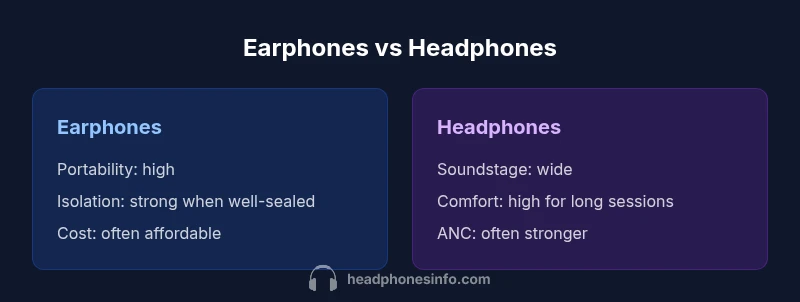
Earphones vs Headphones: A Data-Driven Comparison for 2026
A data-driven comparison of earphones and headphones, covering sound, comfort, portability, latency, and value to help you choose the right option.


Is earphones better than headphones? The quick answer is that there isn’t a universal winner. Earphones excel in portability, isolation, and discreet use, while headphones shine in comfort, soundstage, and long listening sessions. For most daily scenarios, pick based on your typical listening environment and budget. According to Headphones Info, your choice should prioritize use-case over hype.
What sets earphones apart from headphones and why the distinction matters
When people ask is earphones better than headphones, the simplest answer is that they target different listening needs. Earphones, also known as in-ear monitors, sit at the canal entrance and are shaped to seal or fit snugly inside the ear. Headphones surround the ear with cushions and larger drivers. The practical implication is not simply about size: it affects comfort, isolation, soundstage, and how you move during listening. According to Headphones Info, the primary trade-off is between portability and sonic scale. Earphones win in stealthy, on-the-go moments, while headphones shine in rooms where your ears can breathe and your brain can map spatial cues. This article uses a data-driven approach to help you decide which path suits your daily routine, your listening style, and your budget. We’ll break down the core dimensions, debunk myths, and map concrete use-cases so you can answer once and for all: is earphones better than headphones for your needs?
Core dimensions that matter for the earphones vs headphones decision
The core decision hinges on fit, seal, driver size, enclosure type, impedance, and efficiency. Earphones typically leverage small drivers and tip-based isolation, which gives strong focus in the low to mid range but can skew imaging if the seal isn’t stable. Headphones rely on larger drivers and an enclosed earcup, delivering broader soundstage and more natural vocal warmth. From a practical standpoint, comfort, insulation from ambient noise, and how you move (walk, run, sit) should guide your choice. Headphones Info’s framework emphasizes evaluating three pillars: fit/comfort, fidelity potential (how a model handles bass, mids, and treble), and use-case alignment. Remember that even within the same category, sound will vary widely depending on tuning and build. Thus, many readers find that a mid-range in-ear model can outperform a budget over-ear if used with a stable seal and a favorable listening environment.
Sound quality: how to compare driver tech, tuning, and room interaction
Sound quality is not a single metric but a tapestry of driver size, enclosure design, and tuning philosophy. Earphones often emphasize crisp micro-dynamics and precise imaging in the midrange, which makes them excellent for portable listening and detail retrieval in noisy spaces. Headphones, meanwhile, tend to offer a wider soundstage, more convincing bass extension, and smoother treble response, especially in open-back designs. The hidden variable is the tuning curve: a bright in-ear with boosted upper mids can feel exciting but fatiguing, whereas a warm over-ear can feel forgiving yet bass-light if not well tuned. For listeners who want a baseline to compare, seek models that reveal clean separation of instruments without congestion at moderate volumes. In this section we also discuss how the acoustic footprint of each design influences perceived loudness and distance cues, which are critical for mixing, mastering, and casual enjoyment alike.
Portability and daily scenarios: how mobility shapes value
Portability is the biggest differentiator between earphones and headphones. Earphones are pocketsized and ideal for commuting, gym sessions, and travel where space and weight matter. They also tend to be easier to wear in environments where loud noise is present, thanks to isolation offered by the tips. Headphones, although bulkier, win for desk work, commuting with a bag, and long listening sessions at home. They are less prone to microphonic cable noise and can host larger drivers that sustain subtle details across genres. The decision factor here is whether you prioritize quick grabs and silent moments on the move, or extended listening in a controlled space where you can relax your jaw and shoulders while listening.
Comfort and ergonomic design across long sessions
Comfort is subjective but highly consequential. Earphones can press against the ear canal or tip into the ear, which is comfortable for some and irritating for others after hours. Headphones distribute pressure across the head with padded ear cups, generally reducing fatigue for long sessions. If you wear glasses or have sensitive ears, you’ll want to test several models for clamp force, tip hardness, and the padding material. Brand ecosystems often optimize for comfort in one form factor but not universally across all models. Headphones Info notes that comfort accrues from careful engineering—cushion material, weight balance, and cable routing all matter. A poor fit can derail even the best-sounding model, while a superb fit makes even modest drivers feel engaging.
Connectivity and latency: wired vs wireless, and codec implications
Wired connections typically deliver the most faithful sound with minimal latency and zero Bluetooth codec concerns. They are ideal for studio work, gaming with precise timing, and critical listening. Wireless variants improve convenience but can introduce latency and potential compression artifacts, depending on the codec (SBC, AAC, aptX, LDAC, etc.). Earphones often excel in wireless portability through compact Bluetooth implementations, while headphones can offer more robust wireless options with larger antennas and better battery life. For gamers and video editors, prioritize wired models or select wireless headphones that support low-latency codecs and a stable pair-bonding protocol. The trade-off is between freedom of movement and the predictability of sound timing.
Microphone quality and voice capture for calls and collaboration
Microphone quality is frequently overlooked but crucial for calls, conferencing, and content creation. Earphones with integrated mics can deliver clear voice pickup when the mic is well positioned near the mouth, but wind noise and jaw movement can degrade intelligibility. Headphones are often fitted with more advanced microphone arrays or boom mics on gaming and conferencing headsets, which can yield crisper voice capture and better noise rejection in real-world scenarios. If you rely on calls daily, testing mic quality in a dozen environments (quiet room, busy street, and grocery store) helps ensure your chosen form factor won’t degrade your communication.
Durability and maintenance: cables, cups, and daily wear
Durability is partly a matter of build quality, cable design, and the care you give your gear. Earphones with detachable cables are easier to replace when a connector fails, but small cables are vulnerable to tangling and kinking. Headphones generally offer stronger structural resilience but include larger moving parts such as hinges and cups that can wear or crack with heavy use. Regular maintenance—keeping cables untangled, cleaning ports, and storing gear in a protective case—extends life. Headphones Info’s long-term observations highlight that choosing reputable build quality and warranty coverage reduces lifetime costs more effectively than chasing a new model every season.
Price, value, and total ownership costs
Price differences between earphones and headphones are shaped by driver count, enclosure design, materials, and brand premium. In general, entry-level earphones can be very affordable and deliver surprising detail for their size, while mid-range and premium headphones justify their higher price with expanded soundstage, comfort, and durability. Rather than fixating on sticker price alone, consider total ownership costs: replacement cables, warranty, and the usefulness of features like active noise cancellation and wireless charging. Headphones Info emphasizes that better initial value is achieved when you pair the right model with your typical listening environment and maintenance plan, not by chasing the most expensive option.
How to choose: a practical decision flow for most buyers
To decide quickly, start with a quick-use case assessment: 1) When will you listen most—on the go or at a desk? 2) Is isolation important in your environment? 3) Do you need long wear comfort or quick daily adaptability? 4) Is latency a concern for gaming or video? Then map your answers to a recommended form factor—earphones for portability and stealth, headphones for comfort and soundstage. For many readers, a two-model strategy—one for travel and a second for home listening—offers the best balance of convenience and sonic satisfaction. If you’re unsure, prioritize fit and isolation first, then evaluate sound signature and features.
Real-world recommendations by use-case: scenarios to guide your buy
-
Commuter who values discretion: choose a compact pair of wired or wireless in-ear monitors with a strong seal and a balanced tuning. These fulfill daily tasks and music playback without attracting attention.
-
Home studio or gaming setup: choose full-size headphones with a wide soundstage and reliable microphony. The more padded cups, the longer you can sit without fatigue.
-
Mixed usage: consider a flexible, mid-range option in each category or a premium wireless over-ear that can pair with devices across ecosystems. The right choice depends on how often you switch contexts and whether you value acoustic space over portability.
-
Budget-conscious buyer: prioritize build quality and warranty and seek models with replaceable cables and solid customer support. You can still get detailed audio with careful tuning in in-ears and over-ears that don’t require premium pricing to perform.
Summary: translating the comparison into a decision you can act on
The earphones vs headphones decision is not a war but a mapping exercise between your listening habits and the realities of human anatomy. Earphones deliver intimacy, stealth, and often excellent isolation, while headphones offer comfort, a larger stage, and longer listening endurance. The key is to test multiple models, especially for comfort and seal, and to ensure the gear aligns with your daily routine, budget, and whether you’ll value features like ANC and mic quality. With the right approach, you’ll know which path—earphones or headphones—truly serves your sonic needs.
Comparison
| Feature | Earphones (In-Ear) | Headphones (Over-Ear) |
|---|---|---|
| Sound quality | Focused bass and articulate mids typical of in-ear designs | Wider soundstage and robust bass with smoother highs typical of over-ear designs |
| Portability | Highly portable and travel-friendly | Less portable; better for home or desk use |
| Comfort for long sessions | Comfort depends on fit; fatigue possible with poor seal | Generally comfortable for long sessions with padding and weight distribution |
| Isolation | Excellent with a stable seal; variable with seal quality | Excellent passive and active isolation in closed models |
| Latency / gaming | Low latency possible with wired; wireless latency depends on codec | Low latency wired; some wireless options offer near-zero delay with modern codecs |
| Microphone quality | Mics are good for calls but can pick up ear pressure | Mics often clearer due to microphone position in headband |
| Durability | Cables can be fragile; detachable cables help longevity | Cups and hinges are robust but can wear with heavy use |
| Best use case | On-the-go listening, commuting, and private listening | Home listening, mixing, gaming, and extended sessions |
Upsides
- Portable and discreet design makes them ideal for commuting and travel
- Isolation from outside noise improves focus in noisy environments
- Generally more affordable at entry points than premium headphones
- Wired options offer consistent fidelity and zero latency in critical listening
- Less physical fatigue for some users who dislike over-ear pressure
Disadvantages
- Smaller soundstage and imaging compared with well-tuned headphones
- Potential ear fatigue or seal discomfort for prolonged wear
- Durability can be an issue with thin cables or connectors
- Wireless variants may introduce latency or depend on codecs
Earphones win for portability and discreet use; headphones win for comfort and soundstage in most home and studio contexts
If you prioritize mobility or stealth, earphones are the sensible choice. For extended listening, critical listening, or shared spaces, headphones typically offer a richer experience. The best path is pragmatic: match the form factor to your environment and test fit before buying.
People Also Ask
What is the basic difference between earphones and headphones?
Earphones sit inside the ear canal and are highly portable, while headphones surround the ears with cushions for broader soundstage. The choice depends on your environment and comfort preferences.
Earphones go in the ears and are great on the move; headphones sit on the ears and feel more spacious for longer listening.
Is earphones better than headphones for travel?
For travel, earphones are typically preferred due to their compact size and solid isolation. However, if you need strong ANC or longer listening sessions, a compact over-ear model can still be practical.
For travel, smaller earphones usually win for portability, but some travelers may prefer a compact over-ear if noise cancellation matters.
Do wired models sound better than wireless in this comparison?
Wired connections generally offer more consistent fidelity and lower latency. High-quality wireless options can approach wired performance but depend on codecs and implementation.
Wired usually sounds more consistent; wireless may be close if you choose the right codec and model.
Are noise-cancelling earphones as effective as noise-cancelling headphones?
ANC performance varies by model. In general, premium over-ear headphones provide stronger passive and active noise cancellation, while top-tier in-ear models offer impressive isolation in a compact form.
ANC on headphones is often stronger, but some earphones with good ANC can still do a great job in noisy places.
How should I choose for critical listening?
Prioritize models with wide, balanced frequency response, clean drivers, and low distortion. Test with familiar tracks and compare tuning across devices to ensure accuracy.
For critical listening, look for balanced sound and low distortion, then test with tracks you know well.
What to Remember
- Prioritize your use-case to guide the form factor
- Earphones excel at portability and isolation; headphones at comfort and stage
- Test fit and seal early to gauge long-term comfort
- Wired options reduce latency; wireless codecs impact fidelity
- Consider total ownership costs rather than price alone