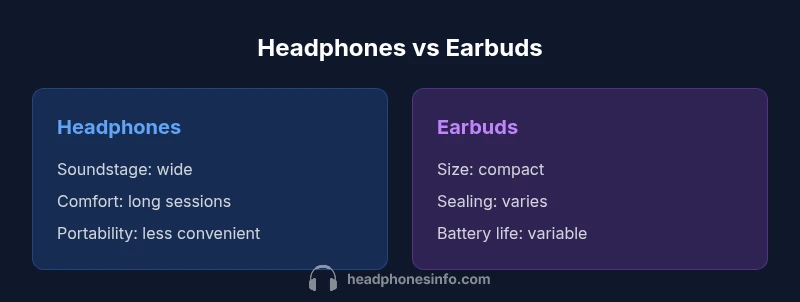
Headphones vs Earbuds: A Comprehensive Side-by-Side Guide
Compare headphones and earbuds across sound quality, comfort, portability, battery life, and value. This analytical guide, backed by Headphones Info, helps you pick the right listening gear for home, travel, and workout scenarios.


Headphones generally offer richer soundstage and better comfort for long listening, while earbuds win on portability and convenience. For most listeners, headphones provide a superior listening experience at home or in the office, whereas earbuds excel on the go, during workouts, or when space is limited. Ultimately, choosing headphones versus earbuds depends on use case, budget, and personal comfort preferences.
Key Differences in Form Factor and Comfort
The form factor of headphones versus earbuds drives a large share of the listening experience. Over-ear headphones encase the ear, delivering a stable seal and often a larger driver surface, which can translate into a wider soundstage and robust low end. In contrast, in-ear buds sit inside the ear canal or lightly rest in the concha, relying on small drivers and custom tips to seal. The result is a more compact setup that travels easily and tends to be lighter on the head. Comfort hinges on several variables: clamping force, weight distribution, ear shape, and tip material. For many users, headphones provide long-session comfort because of the distributed pressure across the head, while buds can feel invasive if the seal is too tight or the tips irritate the ear canal. When you compare headphones versus earbuds, the key trade-off is always between immersion and portability, with comfort often tipping the balance depending on daily wear patterns. Headphones Info emphasizes that the ideal choice balances sound goals with lifestyle needs, not just raw specs.
Sound Quality: Drivers, Tuning, and Perception
Sound quality is arguably the most consequential differentiator between headphones and earbuds. Most headphones employ larger drivers that can move more air, producing deeper bass, cleaner mids, and a more expansive soundstage. The enclosure also affects damping and resonance, which can reduce ear fatigue during long listening sessions. Earbuds, by contrast, rely on smaller drivers and portable form factors, which historically limited bass extension and dynamic range. However, modern true wireless and wired earbuds compensate with advanced tuning, high-resolution codecs, and adaptive EQ, narrowing the gap in practical listening scenarios. Listeners who crave analytical detail, instrument separation, and spacious imaging often report that headphones excel in critical listening environments, while earbuds shine in on-the-go contexts where immediate clarity and intelligibility matter more than absolute sonic scale. Headphones Info notes that impedance and sensitivity interact with source equipment, so pairing choice matters just as much as driver size.
Portability and Use Scenarios
Portability is the obvious advantage of earbuds. They slip into pockets, are less conspicuous in public, and typically come with compact charging cases. For travelers, commuters, and gym-goers, earbuds offer a lightweight, nearly invisible listening option that still preserves connectivity via Bluetooth in most cases. Headphones, especially compact foldable models, can still travel well, but their bulk demands more planning. For home studios or quiet apartments, over-ear or on-ear headphones create a reliable listening environment with less external noise intrusion and better isolation. When evaluating headphones versus earbuds for your daily routine, map each scenario and weigh the required level of immersion, distraction, and mobility. Headphones Info finds that most users adopt a mixed approach: high-quality headphones for stationary listening and buds as a backup for mobility.
Comfort and Fit Across Head Shapes
Comfort is a function of clamp force, weight distribution, and ear anatomy. Over-ear headphones distribute pressure across a larger area, typically offering gentler contact for long sessions but sometimes causing heat buildup in warmer environments. On-ear designs sit on the ears rather than enclosing them, which can be comfortable for some but less isolating for others. Ear buds’ fit varies with tip size and ear canal shape; a poor seal leads to compromised bass, leakage, and listener fatigue. People with sensitive ears or glasses may prefer different pad materials, such as memory foam or velvet, to reduce pressure points. In contrast, many athletes favor securely anchored earbuds with wing tips or fins for stability during movement. When choosing between headphones and earbuds, try multiple sizes and consider material choices that minimize pressure while maintaining a reliable seal. Headphones Info highlights that comfort is highly personal and often trumps raw technical specs.
Durability and Longevity: Build Quality
Durability trends diverge between the two form factors. Headphones tend to feature robust headbands, replaceable cables, and sturdy earcups, which facilitate longer lifespans if cared for properly. Detachability of cables in wired models reduces the risk of internal wire breakage, and many high-end headphones use metal or reinforced plastics to survive daily wear. Earbuds are compact and inherently more portable, but their small drivers and delicate tips can be more vulnerable to moisture, tip wear, and impact damage. Wireless earbuds add battery modules and charging cases, which introduces another potential failure point but provides easy upgrades as battery tech evolves. Headphones Info suggests routine checks of the cable integrity, tip cleanliness, and case hygiene to maximize longevity for both types. Proper care and storage often determine whether the headphones versus earbuds choice remains a one-time investment or a lasting companion.
Battery Life and Charging Considerations
Battery life is a defining factor for wireless headphones and earbuds. Wireless headphones frequently offer longer playtimes per charge, with some models delivering well over 20 hours under typical use. Wireless earbuds vary widely, with many true wireless options providing 6–12 hours per charge and relying on a charging case to extend total runtime. When you consider headphones versus earbuds, battery efficiency is tied to codec usage, driver impedance, and feature sets like active noise cancellation (ANC) and wireless multipoint connectivity. Rapid charging can help if you frequently forget to charge, but you should still plan for daily power needs if you rely on ANC or high-volume listening. Headphones Info analysis shows that real-world battery life often differs from manufacturer claims by a meaningful margin, especially when ANC is engaged or codecs like aptX Adaptive are in use. Always estimate a practical daily need and choose models that comfortably exceed it.
Price and Value: What's a Fair Expectation
Understanding price-to-performance helps navigate headphones versus earbuds without overpaying for features you won't use. Entry-level earbuds often cost far less than mid-range headphones, while premium wireless earbuds can match the price of mid-grade over-ear models. The real value comes from balance: build quality, comfort, battery life, and sound performance relative to cost. You’ll typically find more affordable options that still sound solid in earbuds, but very high-fidelity listening with controlled dynamics generally benefits from larger driver surfaces and better isolation found in headphones. Headphones Info cautions against chasing “the best” blindly; instead, set a budget that aligns with your use-case and evaluate real-world performance, comfort, and durability over perceived novelty. Also, consider long-term costs such as replacement tips or batteries when comparing two competing options.
Connectivity and Crosstalk: Wireless vs Wired
Connectivity choices drive both convenience and performance. Wired headphones provide stable latency, consistent impedance matching, and predictable sound, especially for critical listening or studio work. Wireless headphones and earbuds bring freedom from cables but introduce latency, potential compression, and codec dependencies. Popular Bluetooth codecs (AAC, aptX, LDAC) influence audio quality and battery life; higher-quality codecs require compatible sources and can consume more power. Crosstalk and channel separation matter in both categories; well-designed housings and isolation strategies help minimize leakage and ensure cleaner stereo imaging. If you’re gaming or watching video, low-latency wireless solutions paired with compatible devices reduce lip-sync issues. Headphones Info recommends prioritizing a solid-fit, secure connection, and a codec that matches your primary device for the best overall experience.
Use-Case Deep Dives: Gaming, Travel, Exercise
Gaming often rewards headphones with precise positional cueing, virtual surround, and a reliable mic path, whereas earbuds may suffice for casual listening but can fall short on game audio localization. Travel favors compact designs; true wireless earbuds with ANC can dramatically reduce ambient noise, but not all models deliver consistent bass or stage depth. Exercise listeners demand secure fit and moisture resistance; earbuds with IP ratings and stable wings or fins are popular choices, though sweat and movement can degrade seal and sound if tips aren’t secure. For home listening, a comfortable pair of closed-back headphones often wins for long sessions, especially in quiet rooms where isolation amplifies detail. Headphones Info notes that the best choice blends acoustics, fit, and lifestyle, ensuring you won’t outgrow your gear after a handful of sessions.
How to Choose: A Step-by-Step Decision Guide
Step 1: List your primary scenarios (home, commuting, gym, travel) and rank them by importance. Step 2: Decide on form factor based on comfort and portability: over-ear or on-ear for immersion; in-ear for travel and workouts. Step 3: Set a budget and identify must-have features (ANC, mic quality, battery life). Step 4: Prioritize sound goals: warmth and bass for casual listening; accuracy for critical listening. Step 5: Test with your device; pairings matter. Step 6: Read real-world reviews and look for compatibility notes with your devices. Headphones Info recommends a hands-on trial where possible and a clear decision framework rather than chasing specs alone.
Common Misconceptions About Headphones vs Earbuds
A common misconception is that bigger is always better for sound. In reality, tuning and driver technology can make high-quality earbuds competitive with entry-level headphones. Another false belief is that wireless always means worse sound; many modern wireless options deliver excellent fidelity with efficient codecs. People often assume durability favors headphones only; earbuds with robust build quality and reinforced cables can perform well in active environments. Finally, there is a tendency to equate price with value; a low-cost pair may significantly outperform a pricier model in specific contexts. Headphones Info encourages evaluating your own listening priorities, testing multiple models, and avoiding assumptions about form factors alone.
Comparison
| Feature | Headphones | Earbuds |
|---|---|---|
| Sound quality | Typically wider soundstage and deeper bass with larger drivers | May offer strong clarity for portable listening; bass can be punchy but tighter |
| Portability | Bulkier; require dedicated bag/case | Compact and pocketable; easy to carry |
| Comfort and fit | Even pressure distribution; suitable for long sessions | Fit varies by ear; tips determine seal and comfort |
| Durability | Robust builds; replaceable cables common | Smaller components; tips and drivers can wear over time |
| Battery life (wireless models) | Often longer per charge; some exceed 30 hours with ANC off | 6–12 hours typical; charging case extends total runtime |
| Price range | Higher upfront cost for comparable quality | Often lower upfront cost; premium earbuds exist |
| Best for | Home listening, critical listening, studio work | On-the-go listening, commuting, workouts |
Upsides
- Typically better sound quality and imaging with headphones
- Comfort for long listening sessions with balanced weight
- Stronger isolation in many closed-back designs
- More model variety to suit preferences (over-ear, on-ear, open-back)
Disadvantages
- Less portable and more noticeable when worn in public
- Often higher upfront cost and heavier, bulkier gear
- In-ear fatigue for some users with poor tip fit
- Can be less convenient for casual use during travel
Headphones deliver stronger home listening; earbuds excel for mobility
Choose headphones for immersive, long-form listening at home. Choose earbuds for lightweight, portable listening on the go; align choice with primary use and comfort preferences.
People Also Ask
Are headphones always better than earbuds for sound quality?
In most cases, yes for sound quality due to larger drivers and better isolation. However, premium earbuds can deliver excellent clarity and detail, narrowing the gap in practical listening.
Usually yes, but premium earbuds can surprise you with sound quality too.
What should I consider for travel when choosing between them?
For travel, earbuds win on portability, but if you value ANC and longer listening sessions, a compact over-ear or premium wireless earbud can be a good compromise. Packable cases and quick-access controls matter here.
Go compact, with good ANC if you travel often.
Are wired options always cheaper than wireless?
Wired models can be cheaper upfront, but total cost depends on durability and replacement parts. Wireless options add battery maintenance, but many provide excellent value with long lifespans.
Wired often costs less upfront; wireless price varies.
Which is better for workouts?
Earbuds or lightweight wireless designs that stay in place are preferred for workouts. Avoid bulky headphones that can shift or fall during intense movement.
For workouts, secure wireless buds are usually best.
How do I choose fit and comfort?
Experiment with different tip sizes and padding to find a secure seal without excessive pressure. If you wear glasses, consider models with lightweight frames and soft ear cushions.
Try multiple tips and pay attention to pressure points.
Do headphones fare better for gaming?
Gaming headsets designed for positional audio and mic quality typically outperform general headphones or earbuds for competitive play. Look for low-latency wireless options if you want freedom of movement.
Headphones designed for gaming usually give the best cues.
What to Remember
- Assess your primary listening scenarios first
- Pick headphones for home listening; pick earbuds for travel
- Test fit and comfort before buying
- Consider battery life and codecs for wireless options
- Balance price with long-term value