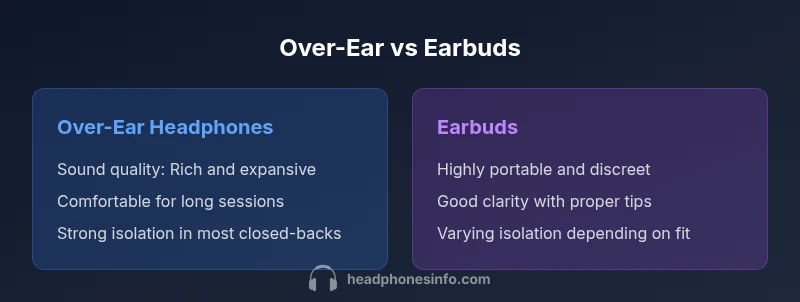
Over-Ear Headphones vs Earbuds: An Objective Comparison
A detailed, data-driven comparison of over-ear headphones vs earbuds, covering sound quality, comfort, isolation, portability, battery life, and use cases to help you decide which fits your listening needs.


Over-ear headphones offer richer sound and greater comfort for long listening sessions, while earbuds prioritize portability and convenience. If you value immersive sound and fatigue-free listening at home, pick over-ear; if you need lightweight, travel-ready gear, choose earbuds. This comparison highlights how design, fit, and use-case drive the decision. According to Headphones Info, align your choice with where you listen most and what you value beyond raw specs.
Design and Architecture: How they differ
At a structural level, over-ear headphones vs earbuds represent two ends of the personal listening spectrum. Over-ear headphones use large cups that enclose the ear, with drivers mounted behind thick padding. Earbuds sit at the ear canal, using small drivers housed in a compact shell and guided by a shorter air path. This fundamental difference in size, seal, and driver arrangement explains much of the downstream behavior you’ll notice in sound, comfort, and isolation. When you compare over ear headphones vs earbuds, the design choices impact how loudly you can play music without fatigue, how long you can wear them before discomfort sets in, and how well they block external noise. From the lab to real-world use, the two form factors push very different user experiences. Headphones Info’s analysis emphasizes that the best option aligns with your listening environment, preferred wearing style, and the kinds of media you value most. Expect over-ears to favor studio-grade nuance and immersion, while earbuds shine when portability and quick use matter. Consider your daily routine: commutes, gym sessions, or home listening. The takeaway is simple: design drives perception, and the right pair depends on context as much as sound.
Sound Quality and Perception: Beyond numbers
Sound quality is not a single-number story. Over-ear headphones arrange larger drivers and air paths to deliver deeper bass extension and wider soundstage, which many listeners perceive as more natural and immersive. Earbuds leverage compact drivers and tuned enclosures; they can still offer impressive detail and clean imaging, but the perceived depth may be narrower. Perception also depends on tuning, driver quality, and the listening environment. Headphones Info notes that people often value different attributes—some prioritize accurate frequency balance for critical listening, while others chase a lively, engaging sound signature for casual listening. In practical terms, expect over-ear models to excel in spatial cues and dynamic range, while well-designed earbuds can rival in clarity and midrange detail in portable contexts.
Comfort and Fit: Long sessions vs portability
Comfort is king when you wear headphones for extended periods. Over-ear cushions distribute pressure across a larger surface area and can feel plush during long sessions, especially if you have a larger head or wear glasses. Earbuds, by contrast, are lighter and disappear into the ear canal, which can be more comfortable for short bursts or travel. The trade-off is fit variability: earbuds rely heavily on tip size and seal, which can affect comfort and stability during movement. Headphones Info emphasizes trying multiple ear tips and choosing models with memory foam or silicone options to improve seal without fatigue. Ergonomics matter: a well-balanced headband, interior padding, and a secure yet gentle clamp determine how comfortable an item remains after hours of use.
Isolation, Leakage, and Ambient Awareness
Isolation and leakage are pivotal in everyday use. Over-ear headphones with closed backs or high-density pads tend to block external noise more effectively, creating a quieter listening environment and reducing listener fatigue in loud spaces. Earbuds can achieve strong isolation when paired with comfortable, well-fitting tips, but their smaller cavities and open-air routes often permit more ambient sound and potential leakage. Noise-cancellation variants in both categories add another layer of complexity; ANC effectiveness depends on microphone placement, seal, and circuitry quality. In busy commutes or offices, over-ear designs often provide a calmer listening experience, while earbuds with good fit and ANC can still offer meaningful relief from surrounding noise.
Battery Life, Connectivity, and Convenience
Wireless performance shapes day-to-day practicality. Over-ear wireless models frequently deliver longer battery life thanks to larger housings and bigger batteries, complemented by stable Bluetooth implementations and multipoint pairing. Earbuds tend to trade some endurance for extreme portability, though several premium earbuds now offer all-day battery life. Connectivity quality—latency, codec support, and range—also matters for gaming or video watching. Wired options with earbuds or lightweight over-ear models remain viable, particularly when you want zero latency or don’t rely on wireless features. In all cases, confirm charger type, USB-C compatibility, and whether the device supports fast charging to minimize downtime.
Use-Case Scenarios and Decision Framework
Your daily routine largely dictates the better choice. For home studios, gaming setups, or long flights, over-ear headphones deliver immersion, accurate bass, and comfort for extended sessions. For gym workouts, commuting, or quick calls, earbuds win on weight, concealment, and the ability to stay mobile without hindrance. If you need flexibility across environments, consider a hybrid strategy: keep a high-quality over-ear pair for home or office use and carry a compact set of earbuds for travel and on-the-go listening. Headphones Info recommends mapping your typical listening contexts first, then matching those contexts to a form factor that balances sound, comfort, and practicality.
Value, Durability, and Resale Considerations
Durability often tracks with form factor. Over-ear headphones are generally easier to repair or replace parts like pads and cables, especially in mid to high-end segments, and many models retain value for longer because of their build quality and versatility. Earbuds, while highly portable and convenient, can suffer from tip wear, cable fraying (on wired variants), or battery degradation on wireless models. When assessing value, factor in not just the initial price but ongoing costs like replacement tips, padding, and potential battery replacements. In the long run, a well-chosen over-ear or premium wireless model can be a durable, lasting investment, whereas budget earbuds may need more frequent refreshing.
Buying Guide: Quick Checklist Before You Buy
- Determine your primary environment (quiet home, noisy commute, gym).
- Prioritize comfort: try multiple clamp tensions and padding materials.
- Check isolation and seal with your preferred music genre in mind.
- Assess battery life, codec support, and multipoint connectivity for wireless models.
- Compare build quality, warranty, and ease of maintenance.
- Consider port compatibility and whether you need wired or wireless usage flexibility.
Myths vs Reality: Common Misconceptions Debunked
- Myth: More expensive always equals better sound. Reality: Price correlates with features and build quality, but tuning and personal preference matter more.
- Myth: Earbuds always leak sound. Reality: Properly fitted, many earbuds deliver excellent isolation with limited leakage.
- Myth: Over-ear headphones are bulky and impractical. Reality: Modern designs balance portability with comfort, making some models surprisingly travel-friendly.
- Myth: ANC makes everything silent. Reality: ANC reduces ambient noise but does not replace good passive isolation or listening discipline.
blockDataExportNotes”:null},
comparisonTable
prosCons
verdictBox
keyTakeaways
faqSection
mainTopicQuery
Comparison
| Feature | Over-ear headphones | Earbuds |
|---|---|---|
| Sound Quality | Richer, wider soundstage and deeper bass | More compact but capable with strong imaging |
| Comfort and Fit | Larger, plush pads; comfortable for long sessions | Smaller, lightweight; may press on ears during extended wear |
| Isolation | Typically better passive isolation with closed-back designs | Isolation varies by tip fit and enclosure; some leakage possible |
| Portability | Bulkier and less portable | Extremely portable; pocketable and discreet |
| Battery Life (wireless) | Often longer on wireless over-ears | Battery life varies; some models shorter than over-ears |
| Durability | Robust builds with replaceable parts | Smaller form factors can experience wear on cables and components |
| Best Use Case | Home/studio listening, critical listening | Travel, workouts, casual listening |
Upsides
- Superior sound quality and imaging on many over-ear models
- Excellent comfort with plush ear cushions for long sessions
- Strong passive isolation reduces external noise
- Often longer battery life for wireless versions
Disadvantages
- Bulky and less portable for travel or workouts
- Higher price at the premium end
- Can feel warm or sweaty in hot environments
Over-ear headphones win for sound quality and comfort; earbuds win for portability and convenience
If you prioritize immersive sound and long listening comfort, choose over-ear headphones. If you need compact, travel-friendly gear, earbuds are the better fit. Use this comparison as a framework to map your typical listening scenarios and priorities.
People Also Ask
What are the main differences between over-ear headphones and earbuds?
Over-ear headphones and earbuds differ primarily in design, size, and how they seal against the ear. Over-ears enclose the whole ear with padded cups and generally deliver deeper bass and wider soundstage. Earbuds are compact, sit at the canal, and emphasize portability with often more variable isolation.
The main differences are design and listening environment; over-ear for immersion, earbuds for portability.
Are over-ear headphones better for studio monitoring?
In many cases, over-ear headphones offer more accurate imaging and bass control, which can be beneficial for studio work. However, studio-grade headphones vary, and some well-tuned earbuds or reference monitors can also be suitable. Look for flat frequency response and low distortion.
For critical listening, over-ears are a common choice, but it depends on the model.
Do earbuds provide good noise isolation?
Earbuds can provide good isolation when paired with well-fitting tips and, in some cases, active noise cancellation. Isolation quality varies by tip size, seal, and enclosure. If noise control is essential, test fit and consider ANC options.
Fit and model matter a lot for earbuds’ isolation.
Can I use earbuds with wired sources?
Yes. Many earbuds are wireless, but several models support wired connections via a DAC/adapter or a headphone jack. Check your device’s outputs and the earbud’s input compatibility.
Some earbuds can connect by wire if you have the right adapter.
Which is cheaper: over-ear or earbuds?
Entry-level earbuds are usually cheaper than entry-level over-ear headphones. Higher-end over-ear models can offer greater longevity and better overall sound, often justifying the cost for serious listeners.
Earbuds tend to be cheaper upfront; high-end over-ears can be pricier but longer-lasting.
What’s the best choice for workouts?
For workouts, earbuds are typically the better choice due to weight, fit, and freedom of movement. Look for secure fit, water resistance, and reliable wireless connection in sport-oriented models.
If you’re exercising, go with earbuds designed for sports.
What to Remember
- Assess environment and usage: home listening vs mobile
- Prioritize sound quality or portability accordingly
- Test fit and seal to gauge isolation
- Consider wireless features and battery life
- Balance price against build quality